
Anti-PAK1 Polyclonal Antibody

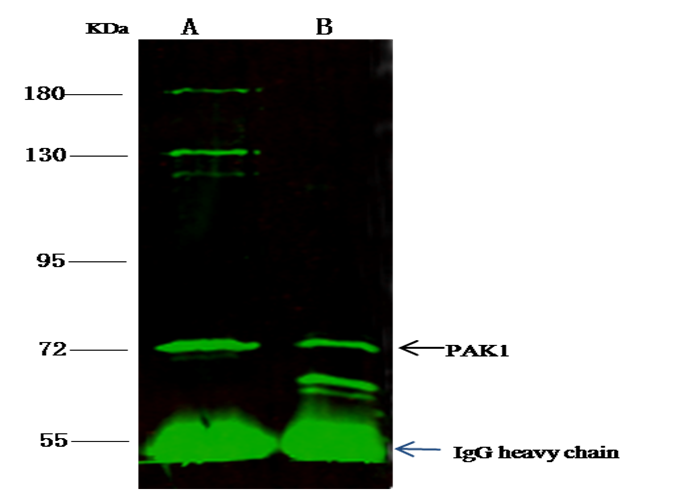
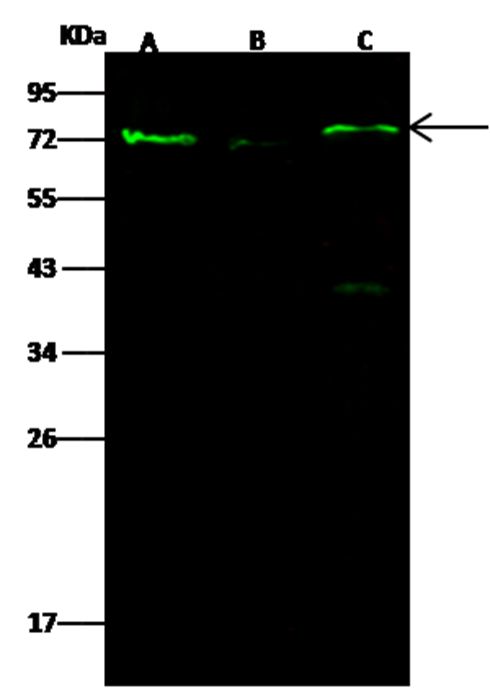
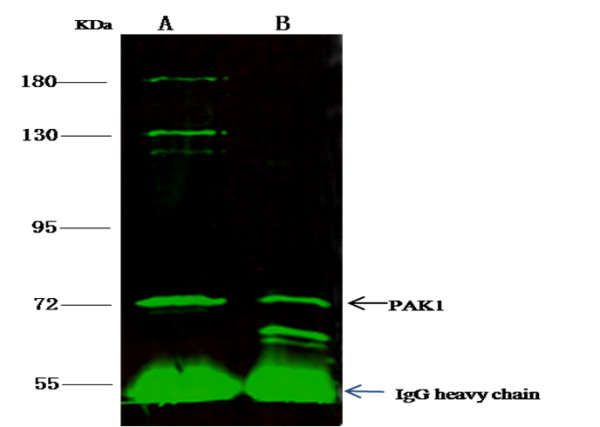

| Item number | Size | Datasheet | Manual | SDS | Delivery time | Quantity | Price |
|---|---|---|---|---|---|---|---|
| E-AN100004P.100 | 100 µl | - |
7 - 16 business days* |
389.00€
|
If you have any questions, please use our Contact Form.
You can also order by e-mail: info@biomol.com
Larger quantity required? Request bulk
You can also order by e-mail: info@biomol.com
Larger quantity required? Request bulk
P21-activated kinase-1 (PAK1) is an enzyme associated with multiple metabolic networks and... more
Product information "Anti-PAK1 Polyclonal Antibody"
P21-activated kinase-1 (PAK1) is an enzyme associated with multiple metabolic networks and different types of cancers.PAK1 (RAC/CDC42-activated kinase 1) is the major oncogenic/ageing kinase, and its dysfunction extends the healthy lifespan of C. elegans by activating HSP16 gene. The p21 protein (Cdc42/Rac)-activated kinase 1 (PAK1) expression appears to be predictive of prognosis in various solid tumors. PAK1 expression may be a predictive marker of overall survival and disease-specific survival in patients with solid tumors.p21-Activated kinase 1 (PAK1) has attracted much attention as a potential therapeutic target due to its central role in many oncogenic signaling pathways, its frequent dysregulation in cancers and neurological disorders, and its tractability as a target for small-molecule inhibition. Protein function: Protein kinase involved in intracellular signaling pathways downstream of integrins and receptor-type kinases that plays an important role in cytoskeleton dynamics, in cell adhesion, migration, proliferation, apoptosis, mitosis, and in vesicle-mediated transport processes (PubMed:12876277, PubMed:14707132, PubMed:19029984, PubMed:9032240, PubMed:9528787). Can directly phosphorylate BAD and protects cells against apoptosis. Activated by interaction with CDC42 and RAC1 (PubMed:9528787). Functions as a GTPase effector that links the Rho-related GTPases CDC42 and RAC1 to the JNK MAP kinase pathway (PubMed:9528787). Phosphorylates and activates MAP2K1, and thereby mediates activation of downstream MAP kinases (PubMed:12876277, PubMed:19029984, PubMed:9032240, PubMed:9528787). Involved in the reorganization of the actin cytoskeleton, actin stress fibers and of focal adhesion complexes (PubMed:9774440). Phosphorylates the tubulin chaperone TBCB and thereby plays a role in the regulation of microtubule biogenesis and organization of the tubulin cytoskeleton. Plays a role in the regulation of insulin secretion in response to elevated glucose levels. Part of a ternary complex that contains PAK1, DVL1 and MUSK that is important for MUSK- dependent regulation of AChR clustering during the formation of the neuromuscular junction (NMJ). Activity is inhibited in cells undergoing apoptosis, potentially due to binding of CDC2L1 and CDC2L2. Phosphorylates MYL9/MLC2. Phosphorylates RAF1 at 'Ser-338' and 'Ser-339' resulting in: activation of RAF1, stimulation of RAF1 translocation to mitochondria, phosphorylation of BAD by RAF1, and RAF1 binding to BCL2. Phosphorylates SNAI1 at 'Ser-246' promoting its transcriptional repressor activity by increasing its accumulation in the nucleus. In podocytes, promotes NR3C2 nuclear localization (PubMed:19029984). Required for atypical chemokine receptor ACKR2-induced phosphorylation of LIMK1 and cofilin (CFL1) and for the up-regulation of ACKR2 from endosomal compartment to cell membrane, increasing its efficiency in chemokine uptake and degradation. In synapses, seems to mediate the regulation of F- actin cluster formation performed by SHANK3, maybe through CFL1 phosphorylation and inactivation (PubMed:24089484). Plays a role in RUFY3-mediated facilitating gastric cancer cells migration and invasion. In response to DNA damage, phosphorylates MORC2 which activates its ATPase activity and facilitates chromatin remodeling. In neurons, plays a crucial role in regulating GABA(A) receptor synaptic stability and hence GABAergic inhibitory synaptic transmission through its role in F-actin stabilization (PubMed:25284783). In hippocampal neurons, necessary for the formation of dendritic spines and excitatory synapses, this function is dependent on kinase activity and may be exerted by the regulation of actomyosin contractility through the phosphorylation of myosin II regulatory light chain (MLC). Along with GIT1, positively regulates microtubule nucleation during interphase. Phosphorylates FXR1, promoting its localization to stress granules and activity. Phosphorylates ILK on 'Thr-173' and 'Ser- 246', promoting nuclear export of ILK. [The UniProt Consortium]
| Keywords: | PAK-1, p68-PAK, Alpha-PAK, Protein kinase MUK2, p21-activated kinase 1, Serine/threonine-protein kinase PAK 1, PAK1 Antibody Polyclonal Antibody |
| Supplier: | Elabscience |
| Supplier-Nr: | E-AN100004P |
Properties
| Application: | WB, ICC/IF, IP |
| Antibody Type: | Polyclonal |
| Conjugate: | No |
| Host: | Rabbit |
| Species reactivity: | rat |
| Immunogen: | A synthetic peptide corresponding to the C-terminus of the Rat PAK1 |
| Format: | Antigen Affinity Purified |
Database Information
| KEGG ID : | K04409 | Matching products |
| UniProt ID : | P35465 | Matching products |
| Gene ID : | GeneID 29431 | Matching products |
Handling & Safety
| Storage: | +4°C (avoid repeat freezing and thawing cycles) |
| Shipping: | +4°C (International: +4°C) |
| Signal Word: | Warning |
| GHS Hazard Pictograms: |

|
| H Phrases: | H317 |
| P Phrases: | P261, P272, P280, P302+352, P333+313 |
Caution
Our products are for laboratory research use only: Not for administration to humans!
Our products are for laboratory research use only: Not for administration to humans!
Information about the product reference will follow.
more
You will get a certificate here
Viewed