
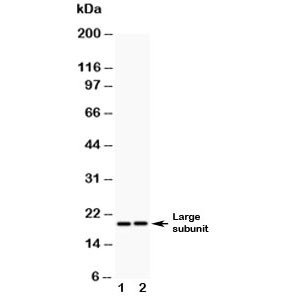
Anti-Caspase-8

Anti-Caspase-8
Item number Size Datasheet Manual SDS Delivery time Quantity Price
NSJ-R30825 100 µg - -

3 - 10 business days*

790.00€
 
0.5mg/ml if reconstituted with 0.2ml sterile DI water. The human CASP8 gene, whose product is... more
Product information "Anti-Caspase-8"
0.5mg/ml if reconstituted with 0.2ml sterile DI water. The human CASP8 gene, whose product is also known as Caspase-8 and FLICE, encodes an interleukin-1beta converting enzyme (ICE)-related cysteine protease that is activated by the engagement of several different death receptors. It is immediately recruited to the Fas receptor once it oligomerizes, and its protease activity is crucial for the apoptotic response generated by the resulting death-inducing signaling complex (DISC). This gene contains at least 11 exons spanning approximately 30kb on human chromosome band 2q33-34. This region of human chromosome 2 was previously reported as the location of the CASP10 gene, whose product is closely related to CASP8. Caspase-8 deficiency in humans is compatible with normal development and shows that the enzyme has a postnatal role in immune activation of naive lymphocytes. Protein function: Thiol protease that plays a key role in programmed cell death by acting as a molecular switch for apoptosis, necroptosis and pyroptosis, and is required to prevent tissue damage during embryonic development and adulthood. Initiator protease that induces extrinsic apoptosis by mediating cleavage and activation of effector caspases responsible for the TNFRSF6/FAS mediated and TNFRSF1A induced cell death (PubMed:23516580, PubMed:8681376, PubMed:8681377, PubMed:9006941, PubMed:9184224, PubMed:8962078). Cleaves and activates effector caspases CASP3, CASP4, CASP6, CASP7, CASP9 and CASP10 (PubMed:8962078, PubMed:9006941). Binding to the adapter molecule FADD recruits it to either receptor TNFRSF6/FAS mediated or TNFRSF1A (PubMed:8681376, PubMed:8681377). The resulting aggregate called death- inducing signaling complex (DISC) performs CASP8 proteolytic activation (PubMed:9184224). The active dimeric enzyme is then liberated from the DISC and free to activate downstream apoptotic proteases (PubMed:9184224). Proteolytic fragments of the N-terminal propeptide (termed CAP3, CAP5 and CAP6) are likely retained in the DISC (PubMed:9184224). In addition to extrinsic apoptosis, also acts as a negative regulator of necroptosis: acts by cleaving RIPK1 at 'Asp-324', which is crucial to inhibit RIPK1 kinase activity, limiting TNF-induced apoptosis, necroptosis and inflammatory response (PubMed:31827280, PubMed:31827281). Also able to initiate pyroptosis by mediating cleavage and activation of gasdermin-D (GSDMD): GSDMD cleavage promoting release of the N-terminal moiety (Gasdermin-D, N-terminal) that binds to membranes and forms pores, triggering pyroptosis. Initiates pyroptosis following inactivation of MAP3K7/TAK1. Also acts as a regulator of innate immunity by mediating cleavage and inactivation of N4BP1 downstream of TLR3 or TLR4, thereby promoting cytokine production. May participate in the Granzyme B (GZMB) cell death pathways (PubMed:8755496). Cleaves PARP1 (PubMed:8681376). [The UniProt Consortium]
Keywords: , Caspase-8 Antibody
Supplier: NSJ Bioreagents
Supplier-Nr: R30825

Properties

Application: WB, IHC (paraffin)
Antibody Type: Polyclonal
Conjugate: No
Host: Rabbit
Species reactivity: human
Immunogen: Amino acids 257-277 (NNHNFAKAREKVPKLHSIRDR-human)
Format: Purified

Handling & Safety

Storage: +4°C
Shipping: +4°C (International: +4°C)
Caution
Our products are for laboratory research use only: Not for administration to humans!
You will get a certificate here
or to request a certificate of analysis.
Read, write and discuss reviews... more
Customer review for "Anti-Caspase-8"
Write a review
or to review a product.
Viewed