
Cookie preferences
This website uses cookies, which are necessary for the technical operation of the website and are always set. Other cookies, which increase the comfort when using this website, are used for direct advertising or to facilitate interaction with other websites and social networks, are only set with your consent.
Configuration
Technically required
These cookies are necessary for the basic functions of the shop.
"Allow all cookies" cookie
"Decline all cookies" cookie
CSRF token
Cookie preferences
Currency change
Customer-specific caching
FACT-Finder tracking
Individual prices
Selected shop
Session
Comfort functions
These cookies are used to make the shopping experience even more appealing, for example for the recognition of the visitor.
Note
Show the facebook fanpage in the right blod sidebar
Statistics & Tracking
Affiliate program
Conversion and usertracking via Google Tag Manager
Track device being used


| Item number | Size | Datasheet | Manual | SDS | Delivery time | Quantity | Price |
|---|---|---|---|---|---|---|---|
| NSJ-FY13231 | 100 µl | - | - |
3 - 10 business days* |
790.00€
|
If you have any questions, please use our Contact Form.
You can also order by e-mail: info@biomol.com
Larger quantity required? Request bulk
You can also order by e-mail: info@biomol.com
Larger quantity required? Request bulk
Rabbit IgG in phosphate buffered saline, pH 7.4, 150mM NaCl, 0.02% sodium azide and 50% glycerol,... more
Product information "Anti-phospho-ULK1 (Ser556) / Unc-51 like autophagy activating kinase 1, clone 31U30"
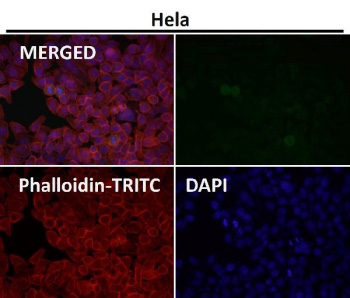
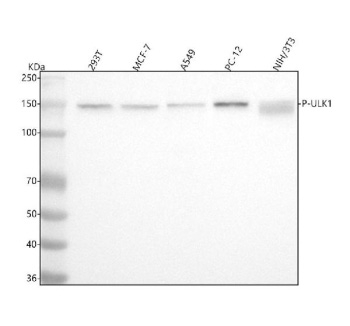
Rabbit IgG in phosphate buffered saline, pH 7.4, 150mM NaCl, 0.02% sodium azide and 50% glycerol, 0.4-0.5mg/ml BSA. Phospho-ULK1 (Ser556) antibody detects Unc-51 like autophagy activating kinase 1 phosphorylated at serine 556, encoded by the ULK1 gene. ULK1 is a serine/threonine kinase that initiates autophagy in response to nutrient status and energy stress. Phosphorylation at Ser556 is an important regulatory event that integrates upstream signaling pathways to control autophagosome formation. Phospho-ULK1 (Ser556) antibody provides researchers with a highly specific reagent to study the regulation of autophagy and its role in physiology and disease.ULK1 functions as the mammalian homolog of yeast Atg1, acting at the top of the autophagy hierarchy. Research using Phospho-ULK1 (Ser556) antibody has demonstrated that phosphorylation at serine 556 by AMP activated protein kinase promotes activation of ULK1 under conditions of energy depletion. This modification stimulates autophagy initiation by enabling the ULK1 complex to recruit downstream autophagy machinery. By contrast, mTORC1 signaling suppresses ULK1 through phosphorylation at other sites, highlighting the dynamic control of ULK1 activity by nutrient and energy signals.Phospho-ULK1 (Ser556) antibody has been used to show that phosphorylation at this site acts as a molecular switch for autophagy induction. In starvation or low energy states, phosphorylation at Ser556 ensures cells adapt by recycling cytoplasmic contents through lysosomal degradation. This process provides metabolic substrates for survival and maintains homeostasis. Inhibiting phosphorylation at Ser556 impairs autophagy, underscoring its essential role in this pathway.Dysregulation of ULK1 phosphorylation has been linked to human disease. Studies with Phospho-ULK1 (Ser556) antibody have revealed that impaired autophagy contributes to neurodegenerative diseases, metabolic disorders, and cancer. In cancer, altered ULK1 phosphorylation influences tumor cell survival under stress conditions, promoting growth in nutrient-poor environments. In neurodegeneration, reduced ULK1 activation leads to accumulation of toxic proteins. These findings emphasize the clinical importance of monitoring ULK1 phosphorylation states.Phospho-ULK1 (Ser556) antibody is widely used in western blotting, immunohistochemistry, and immunofluorescence. Western blotting reveals phosphorylation-dependent shifts in ULK1 activity, immunohistochemistry highlights tissue-specific patterns of autophagy activation, and immunofluorescence demonstrates dynamic localization of phosphorylated ULK1 at autophagosome initiation sites. These applications make Phospho-ULK1 (Ser556) antibody an indispensable reagent in autophagy research.By supplying validated Phospho-ULK1 (Ser556) antibody reagents, NSJ Bioreagents supports research into energy sensing, autophagy regulation, and disease mechanisms. Detection of phosphorylation at Ser556 provides a precise marker of ULK1 activation and autophagy initiation.
| Keywords: | Anti-phospho-ULK1, Anti-phospho-Unc-51-like kinase 1, Anti-phospho-Autophagy-related protein 1 homolog, Anti-phospho-Serine/threonine-protein kinase ULK1, Phospho-ULK1 (Ser556) Antibody / Unc-51 like autophagy activating kinase 1 |
| Supplier: | NSJ Bioreagents |
| Supplier-Nr: | FY13231 |
Properties
| Application: | IF, ICC, WB |
| Antibody Type: | Monoclonal |
| Clone: | 31U30 |
| Conjugate: | No |
| Host: | Rabbit |
| Species reactivity: | human, mouse |
| Immunogen: | A synthesized peptide derived from human Phospho-ULK1 (S556) |
| Format: | Affinity Purified |
Database Information
| KEGG ID : | K21357 | Matching products |
| UniProt ID : | O75385 | Matching products |
| Gene ID : | GeneID 8408 | Matching products |
Handling & Safety
| Storage: | -20°C |
| Shipping: | -20°C (International: -20°C) |
Caution
Our products are for laboratory research use only: Not for administration to humans!
Our products are for laboratory research use only: Not for administration to humans!
Information about the product reference will follow.
more
You will get a certificate here
Viewed