
Cookie preferences
This website uses cookies, which are necessary for the technical operation of the website and are always set. Other cookies, which increase the comfort when using this website, are used for direct advertising or to facilitate interaction with other websites and social networks, are only set with your consent.
Configuration
Technically required
These cookies are necessary for the basic functions of the shop.
"Allow all cookies" cookie
"Decline all cookies" cookie
CSRF token
Cookie preferences
Currency change
Customer-specific caching
FACT-Finder tracking
Individual prices
Selected shop
Session
Comfort functions
These cookies are used to make the shopping experience even more appealing, for example for the recognition of the visitor.
Note
Show the facebook fanpage in the right blod sidebar
Statistics & Tracking
Affiliate program
Conversion and usertracking via Google Tag Manager
Track device being used

| Item number | Size | Datasheet | Manual | SDS | Delivery time | Quantity | Price |
|---|---|---|---|---|---|---|---|
| NSJ-FY13051 | 100 µg | - | - |
3 - 10 business days* |
790.00€
|
If you have any questions, please use our Contact Form.
You can also order by e-mail: info@biomol.com
Larger quantity required? Request bulk
You can also order by e-mail: info@biomol.com
Larger quantity required? Request bulk
Adding 0.2 ml of distilled water will yield a concentration of 500 ug/ml. TXNRD1 antibody detects... more
Product information "Anti-TXNRD1 / Thioredoxin reductase 1"
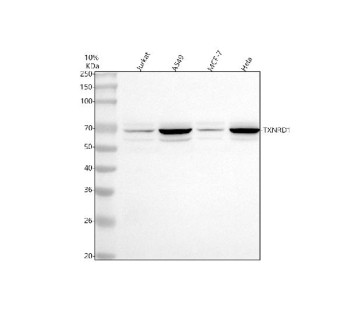
Adding 0.2 ml of distilled water will yield a concentration of 500 ug/ml. TXNRD1 antibody detects Thioredoxin reductase 1, a selenocysteine-containing enzyme that maintains cellular redox balance by catalyzing the NADPH-dependent reduction of thioredoxin. The UniProt recommended name is Thioredoxin reductase 1 (TXNRD1). This enzyme is a central component of the thioredoxin system, which regulates antioxidant defense, DNA synthesis, and redox signaling.Functionally, TXNRD1 antibody identifies a 654-amino-acid cytosolic enzyme composed of an FAD-binding domain, NADPH-binding domain, and a selenocysteine-containing active site motif (GCUG). TXNRD1 reduces oxidized thioredoxin, which in turn regenerates reduced cysteine residues in target proteins, maintaining redox homeostasis. It also directly reduces lipid hydroperoxides, hydrogen peroxide, and other disulfide-containing molecules, contributing to cellular antioxidant capacity.The TXNRD1 gene is located on chromosome 12q23.3 and encodes the cytosolic isoform of thioredoxin reductase. TXNRD1 expression is regulated by the transcription factor NRF2 through the antioxidant response element (ARE) under oxidative or electrophilic stress. Its activity is essential for maintaining a reducing intracellular environment, supporting cell survival, and modulating signaling pathways such as apoptosis and proliferation.In redox biology, TXNRD1 plays a dual role: it protects cells from oxidative stress yet also supports cancer cell survival under high metabolic demand. Elevated TXNRD1 expression is frequently observed in tumors, where it promotes resistance to chemotherapeutic agents and radiotherapy. Conversely, TXNRD1 inhibition induces oxidative stress, mitochondrial dysfunction, and apoptosis, making it a therapeutic target for cancer and inflammatory diseases.Beyond oncology, TXNRD1 contributes to immune function, lipid metabolism, and cardiovascular health. Its deficiency leads to increased susceptibility to oxidative damage, accelerated aging, and metabolic imbalance. In experimental models, altered TXNRD1 expression affects insulin sensitivity and lipid peroxidation levels, linking it to metabolic and neurodegenerative disorders.TXNRD1 antibody is widely used in redox biology, metabolism, and cancer research. It is suitable for western blotting, immunohistochemistry, and enzymatic assays to monitor TXNRD1 expression and activity. This antibody supports investigations into antioxidant defense, redox signaling, and selenoprotein regulation. In pharmacology, it helps evaluate TXNRD1 as a biomarker of oxidative stress and drug response.Structurally, TXNRD1 forms a homodimer with active sites on each subunit and utilizes FAD and NADPH cofactors for electron transfer. Its C-terminal selenocysteine residue is critical for catalytic turnover. NSJ Bioreagents provides TXNRD1 antibody reagents validated for use in redox homeostasis, antioxidant enzyme, and cancer metabolism research.
| Keywords: | Anti-TXNRD1, Anti-Peroxidase TXNRD1, Anti-Thioredoxin reductase TR1, Anti-Thioredoxin reductase 1, cytoplasmic, Anti-KM-102-derived reductase-like factor, Anti-Gene associated with retinoic and interferon-induced mortality 12 protein, TXNRD1 Antibody / Th |
| Supplier: | NSJ Bioreagents |
| Supplier-Nr: | FY13051 |
Properties
| Application: | WB, ELISA |
| Antibody Type: | Polyclonal |
| Conjugate: | No |
| Host: | Rabbit |
| Species reactivity: | human |
| Immunogen: | E.coli-derived human TXNRD1 recombinant protein (Position: Y93-Y326) |
| Format: | Purified |
Database Information
| KEGG ID : | K22182 | Matching products |
| UniProt ID : | Q16881 | Matching products |
| Gene ID : | GeneID 7296 | Matching products |
Handling & Safety
| Storage: | +4°C |
| Shipping: | +4°C (International: +4°C) |
Caution
Our products are for laboratory research use only: Not for administration to humans!
Our products are for laboratory research use only: Not for administration to humans!
Information about the product reference will follow.
more
You will get a certificate here
Viewed