
Cookie preferences
This website uses cookies, which are necessary for the technical operation of the website and are always set. Other cookies, which increase the comfort when using this website, are used for direct advertising or to facilitate interaction with other websites and social networks, are only set with your consent.
Configuration
Technically required
These cookies are necessary for the basic functions of the shop.
"Allow all cookies" cookie
"Decline all cookies" cookie
CSRF token
Cookie preferences
Currency change
Customer-specific caching
FACT-Finder tracking
Individual prices
Selected shop
Session
Comfort functions
These cookies are used to make the shopping experience even more appealing, for example for the recognition of the visitor.
Note
Show the facebook fanpage in the right blod sidebar
Statistics & Tracking
Affiliate program
Conversion and usertracking via Google Tag Manager
Track device being used

| Item number | Size | Datasheet | Manual | SDS | Delivery time | Quantity | Price |
|---|---|---|---|---|---|---|---|
| NSJ-FY12748 | 100 µg | - | - |
3 - 10 business days* |
790.00€
|
If you have any questions, please use our Contact Form.
You can also order by e-mail: info@biomol.com
Larger quantity required? Request bulk
You can also order by e-mail: info@biomol.com
Larger quantity required? Request bulk
Adding 0.2 ml of distilled water will yield a concentration of 500 ug/ml. TRPV4 antibody detects... more
Product information "Anti-TRPV4 / Transient receptor potential cation channel subfamily V member 4"
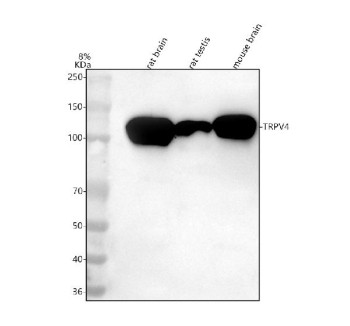
Adding 0.2 ml of distilled water will yield a concentration of 500 ug/ml. TRPV4 antibody detects Transient receptor potential cation channel subfamily V member 4, a calcium-permeable non-selective cation channel that responds to mechanical, osmotic, and thermal stimuli. Encoded by the TRPV4 gene on chromosome 12q24.11, this protein belongs to the vanilloid subfamily of transient receptor potential (TRP) channels and functions as a multimodal sensor integrating diverse physiological signals. TRPV4 channels are activated by moderate heat (27-35oC), hypotonic cell swelling, shear stress, and endogenous lipids such as epoxyeicosatrienoic acids. These channels play central roles in osmoregulation, mechanotransduction, nociception, and vascular physiology.TRPV4 forms tetrameric channel complexes at the plasma membrane, where calcium influx through the pore initiates downstream signaling cascades. It interacts with cytoskeletal and scaffolding proteins including PACSIN3, AKAP150, and actin-binding proteins to fine-tune mechanosensitivity. In epithelial tissues, TRPV4 regulates ciliary beating and barrier permeability. In sensory neurons, it mediates mechanical pain and contributes to thermal sensation. In vascular endothelial cells, TRPV4 activation triggers calcium-dependent vasodilation through nitric oxide release, influencing blood pressure regulation and flow adaptation.The TRPV4 antibody is widely used in physiology, neuroscience, and cardiovascular research to detect TRPV4 expression and localization. Western blot analysis typically identifies a 98 kilodalton band corresponding to TRPV4, while immunofluorescence reveals membrane and cytoplasmic localization in epithelial and neuronal cells. This antibody allows detailed investigation into TRPV4-mediated calcium signaling and mechanical responsiveness across tissues. Dysregulation of TRPV4 function is associated with diseases such as neuropathic pain, pulmonary edema, skeletal dysplasias, and Charcot-Marie-Tooth neuropathy type 2C.Mechanistically, TRPV4 operates as a polymodal integrator linking mechanical and chemical cues to calcium signaling and gene expression. Mutations that enhance or suppress TRPV4 channel activity disrupt normal ion homeostasis and cellular volume regulation. The TRPV4 antibody enables researchers to assess expression changes under osmotic, mechanical, or thermal stress, supporting mechanistic studies of signal transduction and cellular adaptation. NSJ Bioreagents provides this antibody validated for its applications, ensuring robust detection of TRPV4 in both native tissues and recombinant systems.
| Keywords: | Anti-TRPV4, Anti-Osm-9-like TRP channel 4, Anti-Vanilloid receptor-like protein 2, Anti-Vanilloid receptor-like channel 2, Anti-Transient receptor potential protein 12, Anti-Vanilloid receptor-related osmotically-activated channel, Anti-Transient receptor |
| Supplier: | NSJ Bioreagents |
| Supplier-Nr: | FY12748 |
Properties
| Application: | WB, ELISA |
| Antibody Type: | Polyclonal |
| Conjugate: | No |
| Host: | Rabbit |
| Species reactivity: | human, mouse, rat |
| Immunogen: | E.coli-derived human TRPV4 recombinant protein (Position: R64-D408) |
| Format: | Purified |
Database Information
| KEGG ID : | K04973 | Matching products |
| UniProt ID : | Q9HBA0 | Matching products |
| Gene ID : | GeneID 59341 | Matching products |
Handling & Safety
| Storage: | +4°C |
| Shipping: | +4°C (International: +4°C) |
Caution
Our products are for laboratory research use only: Not for administration to humans!
Our products are for laboratory research use only: Not for administration to humans!
Information about the product reference will follow.
more
You will get a certificate here
Viewed