
Cookie preferences
This website uses cookies, which are necessary for the technical operation of the website and are always set. Other cookies, which increase the comfort when using this website, are used for direct advertising or to facilitate interaction with other websites and social networks, are only set with your consent.
Configuration
Technically required
These cookies are necessary for the basic functions of the shop.
"Allow all cookies" cookie
"Decline all cookies" cookie
CSRF token
Cookie preferences
Currency change
Customer-specific caching
FACT-Finder tracking
Individual prices
Selected shop
Session
Comfort functions
These cookies are used to make the shopping experience even more appealing, for example for the recognition of the visitor.
Note
Show the facebook fanpage in the right blod sidebar
Statistics & Tracking
Affiliate program
Conversion and usertracking via Google Tag Manager
Track device being used


| Item number | Size | Datasheet | Manual | SDS | Delivery time | Quantity | Price |
|---|---|---|---|---|---|---|---|
| NSJ-V6086-20UG | 20 µg | - | - |
3 - 10 business days* |
684.00€
|
||
| NSJ-V6086-100UG | 100 µg | - | - |
3 - 10 business days* |
1,265.00€
|
If you have any questions, please use our Contact Form.
You can also order by e-mail: info@biomol.com
Larger quantity required? Request bulk
You can also order by e-mail: info@biomol.com
Larger quantity required? Request bulk
Antibody in 1X PBS with 0.05% BSA, 0.05% sodium azide. Stimulator of interferon genes protein... more
Product information "Anti-STING1 / Stimulator of interferon response cGAMP interactor 1, clone MSVA-515M"
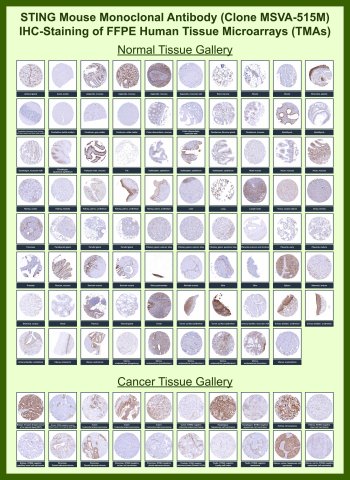
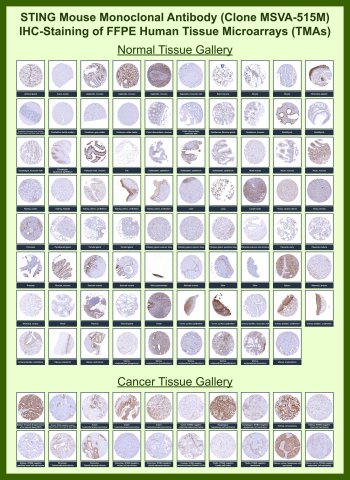
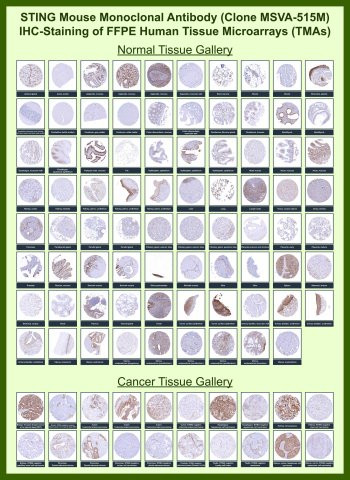
Antibody in 1X PBS with 0.05% BSA, 0.05% sodium azide. Stimulator of interferon genes protein (STING1), encoded by the STING1 gene and also known as TMEM173, is an endoplasmic reticulum-associated adaptor protein that functions as a central regulator of cytosolic DNA sensing and innate immune signaling. STING1 Antibody for IHC enables visualization of STING1 protein distribution within tissue sections by immunohistochemistry, supporting investigation of innate immune activation and inflammatory signaling within histologic specimens. STING1 operates as a key component of the cGAS-STING pathway, which detects cytosolic DNA originating from viral infection, bacterial pathogens, or damaged host cells. When cyclic GMP-AMP synthase (cGAS) recognizes cytoplasmic DNA, it generates the cyclic dinucleotide cGAMP, which binds to STING and induces conformational activation. Activated STING subsequently translocates from the endoplasmic reticulum to the Golgi apparatus, where it recruits signaling molecules such as TBK1 and IRF3 that drive transcription of type I interferons and other inflammatory mediators.In immunohistochemistry studies, STING1 expression can be visualized in immune cells and stromal cell populations participating in innate immune responses. Macrophages, dendritic cells, and other immune cell types involved in pathogen recognition may demonstrate cytoplasmic staining patterns corresponding to STING signaling complexes within intracellular membrane compartments. Immunohistochemical analysis therefore provides valuable insight into the spatial distribution of STING1-expressing cells within tissues and allows evaluation of innate immune signaling activity within inflammatory environments and tumor microenvironments.Beyond host defense against pathogens, STING signaling has been implicated in tumor immunity, autoinflammatory disorders, and responses to DNA damage. Activation of the STING pathway contributes to the production of interferons and inflammatory cytokines that influence immune surveillance and immune-mediated tumor responses. Consequently, antibodies targeting STING1 are widely used to investigate innate immune signaling pathways and immune cell activation within tissue samples.An antibody such as clone MSVA-515M supports immunohistochemical detection of STING1 expression in formalin-fixed, paraffin-embedded tissues. Visualization of STING1-positive cells can help identify immune cell populations involved in innate immune signaling and supports research examining inflammatory responses, immune activation, and host defense mechanisms within tissue environments.This antibody is also part of a broader collection of IHC antibodies validated by tissue microarray analysis, supporting consistent staining across normal and cancer tissues.
| Keywords: | Anti-STING1, Anti-Transmembrane protein 173, Anti-Mediator of IRF3 activation, Anti-Stimulator of interferon genes protein, Anti-Endoplasmic reticulum interferon stimulator, STING1 Antibody / Stimulator of interferon response cGAMP interactor 1 |
| Supplier: | NSJ Bioreagents |
| Supplier-Nr: | V6086 |
Properties
| Application: | IHC |
| Antibody Type: | Monoclonal |
| Clone: | MSVA-515M |
| Conjugate: | No |
| Host: | Mouse |
| Species reactivity: | human |
| Immunogen: | Recombinant fragment (around amino acids 190-290) of human TMEM173 protein (exact sequence is proprietary) |
| Format: | Purified |
Database Information
| KEGG ID : | K12654 | Matching products |
| UniProt ID : | Q86WV6 | Matching products |
| Gene ID : | GeneID 340061 | Matching products |
Handling & Safety
| Storage: | -20°C |
| Shipping: | -20°C (International: -20°C) |
Caution
Our products are for laboratory research use only: Not for administration to humans!
Our products are for laboratory research use only: Not for administration to humans!
Information about the product reference will follow.
more
You will get a certificate here
Viewed