
Cookie preferences
This website uses cookies, which are necessary for the technical operation of the website and are always set. Other cookies, which increase the comfort when using this website, are used for direct advertising or to facilitate interaction with other websites and social networks, are only set with your consent.
Configuration
Technically required
These cookies are necessary for the basic functions of the shop.
"Allow all cookies" cookie
"Decline all cookies" cookie
CSRF token
Cookie preferences
Currency change
Customer-specific caching
FACT-Finder tracking
Individual prices
Selected shop
Session
Comfort functions
These cookies are used to make the shopping experience even more appealing, for example for the recognition of the visitor.
Note
Show the facebook fanpage in the right blod sidebar
Statistics & Tracking
Affiliate program
Conversion and usertracking via Google Tag Manager
Track device being used



| Item number | Size | Datasheet | Manual | SDS | Delivery time | Quantity | Price |
|---|---|---|---|---|---|---|---|
| NSJ-FY13022 | 100 µg | - | - |
3 - 10 business days* |
790.00€
|
If you have any questions, please use our Contact Form.
You can also order by e-mail: info@biomol.com
Larger quantity required? Request bulk
You can also order by e-mail: info@biomol.com
Larger quantity required? Request bulk
Adding 0.2 ml of distilled water will yield a concentration of 500 ug/ml. STING1 antibody detects... more
Product information "Anti-STING1 / Stimulator of interferon genes / TMEM173"
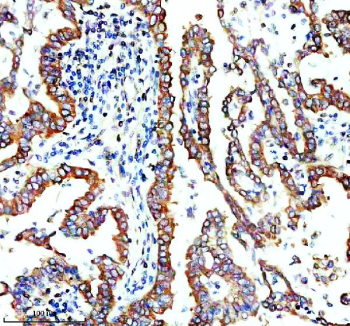
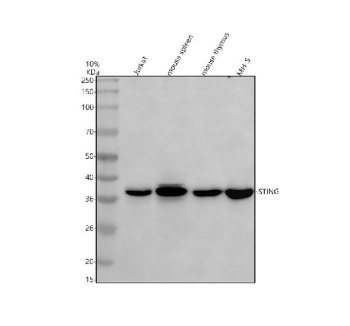
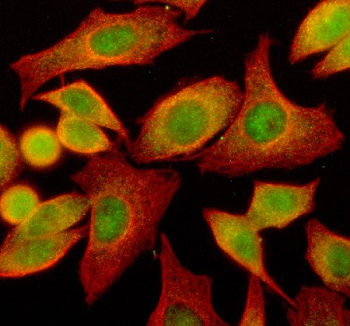
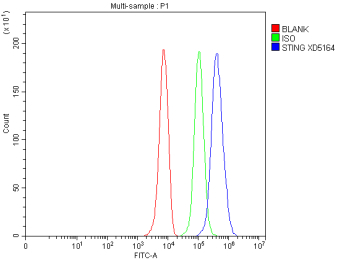
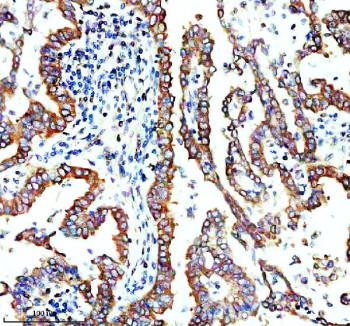
Adding 0.2 ml of distilled water will yield a concentration of 500 ug/ml. STING1 antibody detects Stimulator of interferon genes (TMEM173), a central adaptor protein in the cytosolic DNA-sensing pathway that activates type I interferon responses. The UniProt recommended name is Stimulator of interferon genes (TMEM173). This transmembrane signaling protein is critical for innate immunity, serving as a bridge between cytosolic DNA detection and antiviral gene transcription.Functionally, STING1 antibody identifies a 379-amino-acid endoplasmic reticulum (ER) adaptor protein that senses cyclic dinucleotides (CDNs) generated by the DNA sensor cGAS. Upon binding to cyclic GMP-AMP (cGAMP), STING undergoes conformational changes and translocates from the ER to the Golgi apparatus, where it recruits and activates the kinase TBK1. Activated TBK1 phosphorylates IRF3, triggering transcription of interferon-stimulated genes and cytokines such as IFN-beta, establishing an antiviral state.The TMEM173 gene is located on chromosome 5q31.2 and encodes a conserved multi-pass transmembrane protein expressed in immune, epithelial, and endothelial cells. STING signaling not only defends against viral infection but also detects self-DNA released during cellular stress, DNA damage, or mitochondrial leakage. While crucial for host defense, persistent STING activation can drive autoinflammation, tissue injury, and autoimmune disease.STING functions as a master regulator of cytosolic DNA responses, mediating immune recognition of viral, bacterial, and tumor DNA. Gain-of-function mutations in TMEM173 cause STING-associated vasculopathy with onset in infancy (SAVI), a severe autoinflammatory disorder characterized by excessive interferon signaling. Conversely, impaired STING activation increases susceptibility to infection and impedes tumor immune surveillance. In oncology, STING serves as a therapeutic target for cancer immunotherapy, where agonists are used to boost antitumor immunity through interferon induction and dendritic cell activation.STING antibody is widely used in immunology, oncology, and inflammation research. It is suitable for western blotting, immunofluorescence, and immunoprecipitation to detect endogenous STING protein and study its activation dynamics. This antibody supports investigations into innate immune signaling, interferon pathway regulation, and host-pathogen interactions. In cancer studies, STING detection helps evaluate immune activation following treatment with STING agonists or DNA-damaging agents.Structurally, STING forms a homodimer with a cytosolic ligand-binding domain that interacts with cGAMP and CDNs. The protein contains four transmembrane helices anchoring it to the ER membrane and a C-terminal tail essential for TBK1 and IRF3 recruitment. NSJ Bioreagents provides STING1 antibody reagents validated for use in innate immune signaling, inflammation, and antiviral response research.
| Keywords: | Anti-STING1, Anti-Transmembrane protein 173, Anti-Mediator of IRF3 activation, Anti-Stimulator of interferon genes protein, Anti-Endoplasmic reticulum interferon stimulator, STING1 Antibody / Stimulator of interferon genes / TMEM173 |
| Supplier: | NSJ Bioreagents |
| Supplier-Nr: | FY13022 |
Properties
| Application: | WB, IHC, ICC/IF, FC, ELISA |
| Antibody Type: | Polyclonal |
| Conjugate: | No |
| Host: | Rabbit |
| Species reactivity: | human, mouse, rat |
| Immunogen: | E.coli-derived human TMEM173/STING recombinant protein (Position: L66-K347) |
| Format: | Purified |
Database Information
| KEGG ID : | K12654 | Matching products |
| UniProt ID : | Q86WV6 | Matching products |
| Gene ID : | GeneID 340061 | Matching products |
Handling & Safety
| Storage: | +4°C |
| Shipping: | +4°C (International: +4°C) |
Caution
Our products are for laboratory research use only: Not for administration to humans!
Our products are for laboratory research use only: Not for administration to humans!
Information about the product reference will follow.
more
You will get a certificate here
Viewed