
Cookie preferences
This website uses cookies, which are necessary for the technical operation of the website and are always set. Other cookies, which increase the comfort when using this website, are used for direct advertising or to facilitate interaction with other websites and social networks, are only set with your consent.
Configuration
Technically required
These cookies are necessary for the basic functions of the shop.
"Allow all cookies" cookie
"Decline all cookies" cookie
CSRF token
Cookie preferences
Currency change
Customer-specific caching
FACT-Finder tracking
Individual prices
Selected shop
Session
Comfort functions
These cookies are used to make the shopping experience even more appealing, for example for the recognition of the visitor.
Note
Show the facebook fanpage in the right blod sidebar
Statistics & Tracking
Affiliate program
Conversion and usertracking via Google Tag Manager
Track device being used

| Item number | Size | Datasheet | Manual | SDS | Delivery time | Quantity | Price |
|---|---|---|---|---|---|---|---|
| NSJ-FY12329 | 100 µg | - | - |
3 - 10 business days* |
790.00€
|
If you have any questions, please use our Contact Form.
You can also order by e-mail: info@biomol.com
Larger quantity required? Request bulk
You can also order by e-mail: info@biomol.com
Larger quantity required? Request bulk
Adding 0.2 ml of distilled water will yield a concentration of 500 ug/ml. PIK3C2B antibody is... more
Product information "Anti-PIK3C2B / Phosphoinositide 3-kinase-C2-beta"
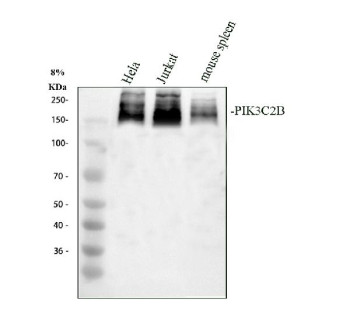
Adding 0.2 ml of distilled water will yield a concentration of 500 ug/ml. PIK3C2B antibody is used to study Phosphatidylinositol 4-phosphate 3-kinase C2 domain-containing subunit beta, a class II phosphoinositide 3-kinase that generates phosphatidylinositol 3-phosphate and phosphatidylinositol 3,4-bisphosphate to orchestrate membrane trafficking and growth signaling. As a lipid kinase enriched at endosomal and clathrin-coated structures, this enzyme influences receptor internalization, endocytic recycling, and cargo sorting, shaping the amplitude and duration of pathways such as AKT and MAPK. By coupling local phosphoinositide synthesis to vesicle dynamics, Phosphatidylinositol 4-phosphate 3-kinase C2 domain-containing subunit beta helps maintain compartment identity and directional transport across the endo-lysosomal system.Structurally, the protein contains an N-terminal C2 domain for membrane engagement, a catalytic PI3K core, and regulatory regions that tune localization and activity. Its lipid products act as docking cues for PX and FYVE domain proteins, recruiting effectors that drive membrane curvature, scission, and maturation. In epithelial models, altered activity perturbs clathrin-mediated endocytosis and primary cilium function, whereas in endothelial contexts it modulates barrier properties, trafficking of adhesion molecules, and response to shear stress. These functions collectively position Phosphatidylinositol 4-phosphate 3-kinase C2 domain-containing subunit beta as a coordinator of vesicle flux and signal timing.In disease research, shifts in expression or copy number of the PIK3C2B gene have been reported in several cancer types, motivating studies that examine how endocytic control intersects with proliferation and invasion. Because endosomal signaling platforms determine downstream transcriptional outcomes, profiling this kinase can clarify resistance mechanisms to receptor tyrosine kinase inhibitors and reveal vulnerabilities linked to trafficking bottlenecks. Neurobiology and metabolism studies also leverage the pathway, given the importance of phosphoinositides in synaptic vesicle cycles and insulin-responsive trafficking.Researchers use PIK3C2B antibody for western blotting to quantify endogenous protein across cell states, for immunofluorescence to map subcellular pools at clathrin lattices and early endosomes, and for immunoprecipitation to define complexes with adaptors and coat proteins. In fractionation workflows, the antibody helps relate lipid kinase distribution to functional readouts such as cargo recycling rates, phosphoinositide mass assays, and live-cell trafficking reporters. When combined with pharmacologic PI3K perturbation or CRISPR knockdown, PIK3C2B antibody supports cause-and-effect tests linking local lipid synthesis to receptor fate and signaling persistence.The PIK3C2B antibody from NSJ Bioreagents integrates cleanly into multi-modal pipelines that couple imaging, proteomics, and lipid analytics, giving teams a reliable anchor for studies of endocytosis, receptor resensitization, and compartmentalized PI signaling. With careful experimental design, investigators can trace how spatially resolved phosphoinositide production by this class II kinase controls membrane identity and information flow from the plasma membrane to the nucleus.
| Keywords: | Anti-PIK3C2B, Anti-C2-PI3K, Anti-Phosphoinositide 3-kinase-C2-beta, Anti-Phosphatidylinositol 4-phosphate 3-kinase C2 domain-containing subunit beta, PIK3C2B Antibody / Phosphoinositide 3-kinase-C2-beta |
| Supplier: | NSJ Bioreagents |
| Supplier-Nr: | FY12329 |
Properties
| Application: | WB, ELISA |
| Antibody Type: | Polyclonal |
| Conjugate: | No |
| Host: | Rabbit |
| Species reactivity: | human, mouse |
| Immunogen: | E.coli-derived human PIK3C2B recombinant protein (Position: R21-E1009) |
| Format: | Purified |
Database Information
| KEGG ID : | K00923 | Matching products |
| UniProt ID : | O00750 | Matching products |
| Gene ID : | GeneID 5287 | Matching products |
Handling & Safety
| Storage: | +4°C |
| Shipping: | +4°C (International: +4°C) |
Caution
Our products are for laboratory research use only: Not for administration to humans!
Our products are for laboratory research use only: Not for administration to humans!
Information about the product reference will follow.
more
You will get a certificate here
Viewed