
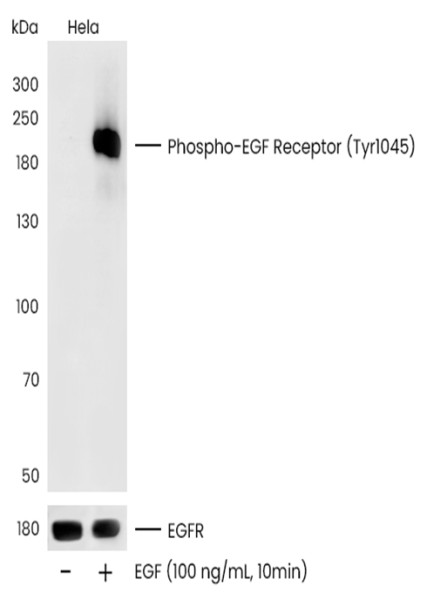
Anti-Phospho-EGF Receptor (Tyr1045) Monoclonal Recombinant Antibody

| Item number | Size | Datasheet | Manual | SDS | Delivery time | Quantity | Price |
|---|---|---|---|---|---|---|---|
| E-AN300010P.20 | 20 µl | - |
7 - 16 business days* |
182.00€
|
|||
| E-AN300010P.100 | 100 µl | - |
7 - 16 business days* |
462.00€
|
If you have any questions, please use our Contact Form.
You can also order by e-mail: info@biomol.com
Larger quantity required? Request bulk
You can also order by e-mail: info@biomol.com
Larger quantity required? Request bulk
The epidermal growth factor receptor (EGFR) subfamily of receptor tyrosine kinases comprises four... more
Product information "Anti-Phospho-EGF Receptor (Tyr1045) Monoclonal Recombinant Antibody"
The epidermal growth factor receptor (EGFR) subfamily of receptor tyrosine kinases comprises four members: EGFR (also known as HER1, ErbB1 or ErbB), ErbB2 (Neu, HER2), ErbB3 (HER3), and ErbB4 (HER4). All family members are type I transmembrane glycoproteins that have an extracellular domain which contains two cysteine-rich domains separated by a spacer region that is involved in ligand binding, and a cytoplasmic domain which has a membrane-proximal tyrosine kinase domain and a C-terminal tail with multiple tyrosine autophosphorylation sites. The human EGFR gene encodes a 1210 amino acid (aa) residue precursor with a 24 aa putative signal peptide, a 621 aa extracellular domain, a 23 aa transmembrane domain, and a 542 aa cytoplasmic domain. EGFR has been shown to bind a subset of the EGF family ligands, including EGF, amphiregulin, TGF-alpha, betacellulin, epiregulin, heparin-binding EGF and neuregulin-2 alpha in the absence of a co-receptor. Ligand binding induces EGFR homodimerization as well as heterodimerization with ErbB2, resulting in kinase activation, tyrosine phosphorylation and cell signaling. EGFR can also be recruited to form heterodimers with the ligand-activated ErbB3 or ErbB4. EGFR signaling has been shown to regulate multiple biological functions including cell proliferation, differentiation, motility and apoptosis. In addition, EGFR signaling has also been shown to play a role in carcinogenesis. Protein function: Receptor tyrosine kinase binding ligands of the EGF family and activating several signaling cascades to convert extracellular cues into appropriate cellular responses (PubMed:10805725, PubMed:27153536, PubMed:2790960, PubMed:35538033). Known ligands include EGF, TGFA/TGF- alpha, AREG, epigen/EPGN, BTC/betacellulin, epiregulin/EREG and HBEGF/heparin-binding EGF (PubMed:12297049, PubMed:15611079, PubMed:17909029, PubMed:20837704, PubMed:27153536, PubMed:2790960, PubMed:7679104, PubMed:8144591, PubMed:9419975). Ligand binding triggers receptor homo- and/or heterodimerization and autophosphorylation on key cytoplasmic residues. The phosphorylated receptor recruits adapter proteins like GRB2 which in turn activates complex downstream signaling cascades. Activates at least 4 major downstream signaling cascades including the RAS-RAF-MEK-ERK, PI3 kinase-AKT, PLCgamma-PKC and STATs modules (PubMed:27153536). May also activate the NF-kappa-B signaling cascade (PubMed:11116146). Also directly phosphorylates other proteins like RGS16, activating its GTPase activity and probably coupling the EGF receptor signaling to the G protein-coupled receptor signaling (PubMed:11602604). Also phosphorylates MUC1 and increases its interaction with SRC and CTNNB1/beta-catenin (PubMed:11483589). Positively regulates cell migration via interaction with CCDC88A/GIV which retains EGFR at the cell membrane following ligand stimulation, promoting EGFR signaling which triggers cell migration (PubMed:20462955). Plays a role in enhancing learning and memory performance. Plays a role in mammalian pain signaling (long-lasting hypersensitivity). [The UniProt Consortium]
| Keywords: | ERBB, EC=2.7.10.1, Proto-oncogene c-ErbB-1, Epidermal growth factor receptor, Receptor tyrosine-protein kinase erbB-1, Recombinant Phospho-EGF Receptor (Tyr1045) Monoclonal Antibody |
| Supplier: | Elabscience |
| Supplier-Nr: | E-AN300010P |
Properties
| Application: | WB |
| Antibody Type: | Monoclonal |
| Clone: | 2B13 |
| Conjugate: | No |
| Host: | Rabbit |
| Species reactivity: | human |
| Immunogen: | A synthetic phosphopeptide corresponding to residues around Tyr1045 of the Human Phospho-EGF Receptor |
| Format: | Purified |
Database Information
| KEGG ID : | K04361 | Matching products |
| UniProt ID : | P00533 | Matching products |
| Gene ID : | GeneID 1956 | Matching products |
Handling & Safety
| Storage: | +4°C (avoid repeat freezing and thawing cycles) |
| Shipping: | +4°C (International: +4°C) |
| Signal Word: | Warning |
| GHS Hazard Pictograms: |

|
| H Phrases: | H317 |
| P Phrases: | P261, P272, P280, P302+352, P333+313 |
Caution
Our products are for laboratory research use only: Not for administration to humans!
Our products are for laboratory research use only: Not for administration to humans!
Information about the product reference will follow.
more
You will get a certificate here
Viewed