
Cookie preferences
This website uses cookies, which are necessary for the technical operation of the website and are always set. Other cookies, which increase the comfort when using this website, are used for direct advertising or to facilitate interaction with other websites and social networks, are only set with your consent.
Configuration
Technically required
These cookies are necessary for the basic functions of the shop.
"Allow all cookies" cookie
"Decline all cookies" cookie
CSRF token
Cookie preferences
Currency change
Customer-specific caching
FACT-Finder tracking
Individual prices
Selected shop
Session
Comfort functions
These cookies are used to make the shopping experience even more appealing, for example for the recognition of the visitor.
Note
Show the facebook fanpage in the right blod sidebar
Statistics & Tracking
Affiliate program
Conversion and usertracking via Google Tag Manager
Track device being used




| Item number | Size | Datasheet | Manual | SDS | Delivery time | Quantity | Price |
|---|---|---|---|---|---|---|---|
| NSJ-FY12283 | 100 µg | - | - |
3 - 10 business days* |
790.00€
|
If you have any questions, please use our Contact Form.
You can also order by e-mail: info@biomol.com
Larger quantity required? Request bulk
You can also order by e-mail: info@biomol.com
Larger quantity required? Request bulk
Adding 0.2 ml of distilled water will yield a concentration of 500 ug/ml. PARG antibody detects... more
Product information "Anti-PARG / Poly(ADP-ribose) glycohydrolase"
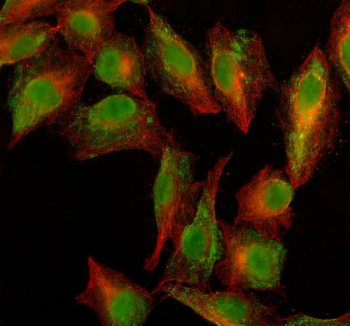
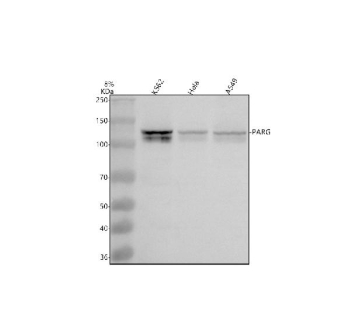
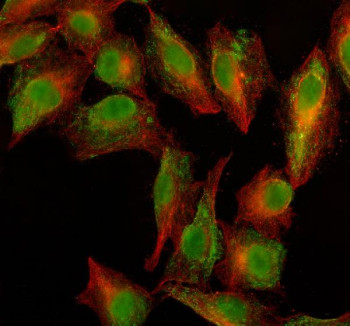
Adding 0.2 ml of distilled water will yield a concentration of 500 ug/ml. PARG antibody detects Poly(ADP-ribose) glycohydrolase, encoded by the PARG gene on chromosome 10q11.23. PARG antibody is widely used in DNA damage response, chromatin remodeling, and cancer biology research. PARG is the main enzyme responsible for degrading poly(ADP-ribose) chains, which are synthesized by PARP family enzymes in response to DNA breaks and stress signals. By hydrolyzing poly(ADP-ribose), PARG resets chromatin state and restores protein activity following PARP-mediated modifications.Structurally, PARG is a ~110 kDa enzyme with a macrodomain-containing catalytic region. It cleaves glycosidic ribose-ribose bonds in poly(ADP-ribose) chains, generating free ADP-ribose units. PARG localizes predominantly to the nucleus but is also found in cytoplasm and mitochondria, reflecting diverse roles in cellular stress responses. Alternative isoforms, including shorter forms, may localize differently and regulate specific processes.Functionally, PARG counteracts PARP activity to maintain balance in ADP-ribosylation signaling. After DNA damage, PARP1 rapidly polymerizes ADP-ribose chains that recruit DNA repair factors. PARG then degrades these chains to terminate signaling, recycle NAD+, and permit chromatin resetting. Dysregulation of PARG disrupts repair efficiency and genomic stability. Researchers use PARG antibody to study DNA repair, chromatin biology, and PARP inhibitor responses.Clinically, PARG is relevant in cancer therapy because PARP inhibitors exploit defective homologous recombination repair in tumors. PARG inhibition further sensitizes cancer cells to DNA damage, making it a therapeutic target. PARG dysregulation has also been implicated in neurodegeneration, where abnormal ADP-ribose metabolism contributes to cell death. NSJ Bioreagents supplies PARG antibody for research in DNA repair, cancer biology, and therapeutic development.Experimentally, PARG antibody is applied in western blotting to detect the ~110 kDa protein, in immunohistochemistry to study nuclear expression, and in enzymatic assays to monitor ADP-ribose metabolism. Co-immunoprecipitation with PARG antibody identifies complexes with PARP and DNA repair proteins.
| Keywords: | Anti-PARG, Anti-Poly(ADP-ribose) glycohydrolase, PARG Antibody / Poly(ADP-ribose) glycohydrolase |
| Supplier: | NSJ Bioreagents |
| Supplier-Nr: | FY12283 |
Properties
| Application: | WB, ICC/IF, FC, ELISA |
| Antibody Type: | Polyclonal |
| Conjugate: | No |
| Host: | Rabbit |
| Species reactivity: | human |
| Immunogen: | E.coli-derived human PARG recombinant protein (Position: D27-R854) |
| Format: | Purified |
Database Information
| KEGG ID : | K07759 | Matching products |
| UniProt ID : | Q86W56 | Matching products |
| Gene ID : | GeneID 8505 | Matching products |
Handling & Safety
| Storage: | +4°C |
| Shipping: | +4°C (International: +4°C) |
Caution
Our products are for laboratory research use only: Not for administration to humans!
Our products are for laboratory research use only: Not for administration to humans!
Information about the product reference will follow.
more
You will get a certificate here
Viewed