
Cookie preferences
This website uses cookies, which are necessary for the technical operation of the website and are always set. Other cookies, which increase the comfort when using this website, are used for direct advertising or to facilitate interaction with other websites and social networks, are only set with your consent.
Configuration
Technically required
These cookies are necessary for the basic functions of the shop.
"Allow all cookies" cookie
"Decline all cookies" cookie
CSRF token
Cookie preferences
Currency change
Customer-specific caching
FACT-Finder tracking
Individual prices
Selected shop
Session
Comfort functions
These cookies are used to make the shopping experience even more appealing, for example for the recognition of the visitor.
Note
Show the facebook fanpage in the right blod sidebar
Statistics & Tracking
Affiliate program
Conversion and usertracking via Google Tag Manager
Track device being used



| Item number | Size | Datasheet | Manual | SDS | Delivery time | Quantity | Price |
|---|---|---|---|---|---|---|---|
| NSJ-FY12106 | 100 µg | - | - |
3 - 10 business days* |
790.00€
|
If you have any questions, please use our Contact Form.
You can also order by e-mail: info@biomol.com
Larger quantity required? Request bulk
You can also order by e-mail: info@biomol.com
Larger quantity required? Request bulk
Adding 0.2 ml of distilled water will yield a concentration of 500 ug/ml. KEAP1 antibody is... more
Product information "Anti-KEAP1 / Kelch-like ECH-associated protein 1"
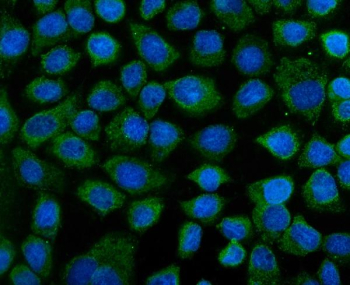
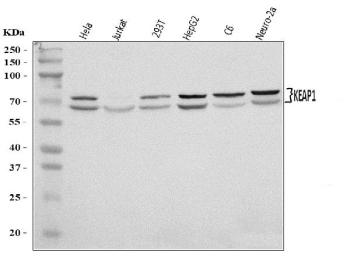
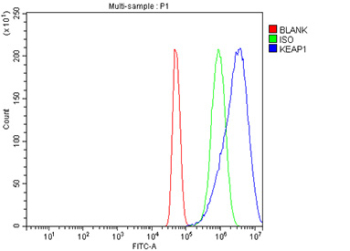
Adding 0.2 ml of distilled water will yield a concentration of 500 ug/ml. KEAP1 antibody is designed to target Kelch-like ECH-associated protein 1, a critical regulator of cellular redox balance and stress response. The KEAP1 protein functions as a substrate adaptor protein within a Cullin 3-based E3 ubiquitin ligase complex, where it plays a central role in mediating the ubiquitination and subsequent degradation of nuclear factor erythroid 2-related factor 2 (NFE2L2, also known as NRF2). Under basal conditions, KEAP1 binds NRF2 in the cytoplasm and promotes its proteasomal degradation. This ensures that NRF2 activity remains tightly controlled to prevent unnecessary transcriptional activation of antioxidant response genes. When oxidative or electrophilic stress occurs, modifications on reactive cysteine residues of KEAP1 disrupt its interaction with NRF2, allowing NRF2 to accumulate and translocate to the nucleus to activate protective transcriptional programs.The KEAP1 protein is highly conserved and contains several functional domains, including a Broad-Complex, Tramtrack, and Bric-a-brac (BTB) domain at its N-terminus, which mediates binding to Cullin 3, and multiple Kelch repeats at the C-terminus, which recognize and bind to NRF2. Structural studies have shown that mutations within these domains often impair NRF2 binding, leading to dysregulated antioxidant signaling. KEAP1 itself is encoded by the KEAP1 gene located on chromosome 19p13.2. Mutations and epigenetic changes in KEAP1 are frequently observed in various cancers, including lung adenocarcinoma, squamous cell carcinoma, and hepatocellular carcinoma. These alterations often result in constitutive NRF2 activation, which can confer growth advantages, metabolic adaptation, and chemoresistance to tumor cells.Beyond cancer, KEAP1 has been implicated in chronic diseases characterized by oxidative stress, such as chronic obstructive pulmonary disease, cardiovascular disease, and neurodegenerative disorders like Parkinson's and Alzheimer's disease. By serving as a redox sensor, KEAP1 ensures proper cellular adaptation to fluctuating environmental conditions. The study of KEAP1 and its regulatory loop with NRF2 is central to developing targeted therapeutics aimed at either inhibiting NRF2 in cancer settings or activating it in degenerative and inflammatory diseases. Research tools such as KEAP1 antibody are therefore valuable in exploring protein expression, localization, and interactions across a range of experimental systems, including western blot, immunohistochemistry, immunoprecipitation, and ELISA.In experimental models, KEAP1 levels are often analyzed to understand stress responses at the tissue level. For example, in liver samples, KEAP1 reduction is frequently correlated with increased NRF2 nuclear accumulation, providing insights into hepatoprotective pathways. Additionally, KEAP1 expression can be modulated by environmental toxins, diet, and pharmacological agents, making it a versatile biomarker in toxicology and pharmacology research. The use of reagents like this antibody, available from NSJ Bioreagents, supports cutting-edge investigations into oxidative stress biology and translational medicine.
| Keywords: | Anti-KEAP1, Anti-Kelch-like protein 19, Anti-Cytosolic inhibitor of Nrf2, Anti-Kelch-like ECH-associated protein 1, KEAP1 Antibody / Kelch-like ECH-associated protein 1 |
| Supplier: | NSJ Bioreagents |
| Supplier-Nr: | FY12106 |
Properties
| Application: | WB, ICC, IF, FC, ELISA |
| Antibody Type: | Polyclonal |
| Conjugate: | No |
| Host: | Rabbit |
| Species reactivity: | human, mouse, rat |
| Immunogen: | E.coli-derived human KEAP1 recombinant protein (Position: K84-K312) |
| Format: | Purified |
Database Information
| KEGG ID : | K10456 | Matching products |
| UniProt ID : | Q14145 | Matching products |
| Gene ID : | GeneID 9817 | Matching products |
Handling & Safety
| Storage: | +4°C |
| Shipping: | +4°C (International: +4°C) |
Caution
Our products are for laboratory research use only: Not for administration to humans!
Our products are for laboratory research use only: Not for administration to humans!
Information about the product reference will follow.
more
You will get a certificate here
Viewed