
Cookie preferences
This website uses cookies, which are necessary for the technical operation of the website and are always set. Other cookies, which increase the comfort when using this website, are used for direct advertising or to facilitate interaction with other websites and social networks, are only set with your consent.
Configuration
Technically required
These cookies are necessary for the basic functions of the shop.
"Allow all cookies" cookie
"Decline all cookies" cookie
CSRF token
Cookie preferences
Currency change
Customer-specific caching
FACT-Finder tracking
Individual prices
Selected shop
Session
Comfort functions
These cookies are used to make the shopping experience even more appealing, for example for the recognition of the visitor.
Note
Show the facebook fanpage in the right blod sidebar
Statistics & Tracking
Affiliate program
Conversion and usertracking via Google Tag Manager
Track device being used


| Item number | Size | Datasheet | Manual | SDS | Delivery time | Quantity | Price |
|---|---|---|---|---|---|---|---|
| NSJ-FY13315 | 100 µg | - | - |
3 - 10 business days* |
790.00€
|
If you have any questions, please use our Contact Form.
You can also order by e-mail: info@biomol.com
Larger quantity required? Request bulk
You can also order by e-mail: info@biomol.com
Larger quantity required? Request bulk
Adding 0.2 ml of distilled water will yield a concentration of 500 ug/ml. GPR35 antibody detects... more
Product information "Anti-GPR35 / G protein-coupled receptor 35"
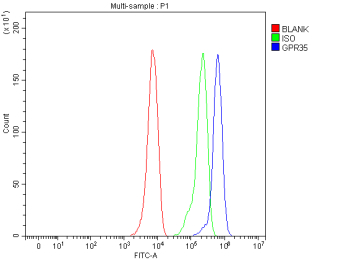
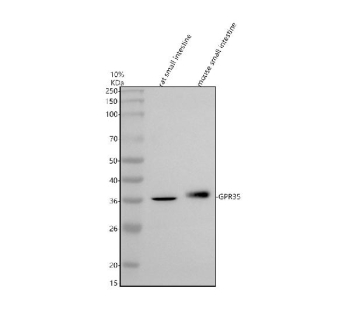
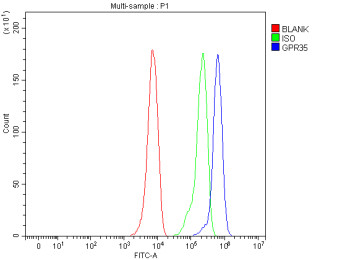
Adding 0.2 ml of distilled water will yield a concentration of 500 ug/ml. GPR35 antibody detects G protein-coupled receptor 35, a seven-transmembrane receptor encoded by the GPR35 gene on chromosome 2q37.3. GPR35 is a member of the rhodopsin-like class A GPCR family and functions as a receptor for kynurenic acid and related endogenous metabolites. This receptor localizes primarily to the plasma membrane of immune cells, gastrointestinal epithelium, and vascular endothelium, where it modulates immune responses, inflammation, and cell signaling. Activation of GPR35 triggers coupling to Galphai/o proteins, leading to inhibition of adenylyl cyclase and reduced cAMP production.GPR35 antibody identifies a receptor that participates in multiple physiological and pathophysiological processes, including immune regulation, nociception, and gastrointestinal motility. It is expressed in leukocytes, monocytes, intestinal epithelial cells, and cardiomyocytes. The receptor also plays a role in chemotaxis and inflammatory signaling by regulating cytokine release and leukocyte migration. Ligand binding to GPR35 activates downstream pathways such as ERK1/2, RhoA, and PI3K-AKT, integrating metabolic and immune responses.Structurally, GPR35 contains conserved transmembrane helices typical of GPCRs, an intracellular C-terminal tail that mediates beta-arrestin binding, and an extracellular N-terminal glycosylated region important for ligand recognition. The receptor's pharmacology has been extensively studied, and various endogenous and synthetic agonists-including kynurenic acid, lysophosphatidic acid, and zaprinast-have been identified. These ligands link GPR35 signaling to tryptophan metabolism and vascular regulation.Clinically, GPR35 is associated with inflammatory and metabolic disorders. Genetic variants in the GPR35 gene are linked to inflammatory bowel disease (IBD), ulcerative colitis, and primary sclerosing cholangitis. In the cardiovascular system, GPR35 activation induces vasodilation and cardioprotective signaling, suggesting therapeutic potential for hypertension and ischemic injury. Conversely, aberrant activation has been implicated in cancer progression, particularly in gastric and colorectal carcinoma, where GPR35 may promote cell proliferation and migration.Pathway analysis indicates that GPR35 functions within GPCR signaling networks, regulating MAPK and calcium-dependent pathways that affect cytokine expression and metabolic reprogramming. In the nervous system, it may influence pain sensitivity through modulation of sensory neuron excitability. The receptor's dual roles in immune and metabolic regulation position it as a promising drug target for inflammation and cardiovascular disease.Immunohistochemical analysis using GPR35 antibody reveals membrane and cytoplasmic staining in immune and epithelial tissues, consistent with GPCR localization. The GPR35 antibody from NSJ Bioreagents is ideal for investigating G protein-coupled receptor signaling, immune regulation, and disease mechanisms related to inflammation and metabolism.
| Keywords: | Anti-GPR35, Anti-Kynurenic acid receptor, Anti-G-protein coupled receptor 35, GPR35 Antibody / G protein-coupled receptor 35 |
| Supplier: | NSJ Bioreagents |
| Supplier-Nr: | FY13315 |
Properties
| Application: | WB, FC |
| Antibody Type: | Polyclonal |
| Conjugate: | No |
| Host: | Rabbit |
| Species reactivity: | human, mouse, rat |
| Immunogen: | A synthetic peptide corresponding to a sequence at the C-terminus of human GPR35 |
| Format: | Purified |
Database Information
| KEGG ID : | K04276 | Matching products |
| UniProt ID : | Q9HC97 | Matching products |
| Gene ID : | GeneID 2859 | Matching products |
Handling & Safety
| Storage: | +4°C |
| Shipping: | +4°C (International: +4°C) |
Caution
Our products are for laboratory research use only: Not for administration to humans!
Our products are for laboratory research use only: Not for administration to humans!
Information about the product reference will follow.
more
You will get a certificate here
Viewed