
Cookie preferences
This website uses cookies, which are necessary for the technical operation of the website and are always set. Other cookies, which increase the comfort when using this website, are used for direct advertising or to facilitate interaction with other websites and social networks, are only set with your consent.
Configuration
Technically required
These cookies are necessary for the basic functions of the shop.
"Allow all cookies" cookie
"Decline all cookies" cookie
CSRF token
Cookie preferences
Currency change
Customer-specific caching
FACT-Finder tracking
Individual prices
Selected shop
Session
Comfort functions
These cookies are used to make the shopping experience even more appealing, for example for the recognition of the visitor.
Note
Show the facebook fanpage in the right blod sidebar
Statistics & Tracking
Affiliate program
Conversion and usertracking via Google Tag Manager
Track device being used

NEW
| Item number | Size | Datasheet | Manual | SDS | Delivery time | Quantity | Price |
|---|---|---|---|---|---|---|---|
| NSJ-RQ5044 | 100 µg | - | - |
3 - 10 business days* |
790.00€
|
If you have any questions, please use our Contact Form.
You can also order by e-mail: info@biomol.com
Larger quantity required? Request bulk
You can also order by e-mail: info@biomol.com
Larger quantity required? Request bulk
0.5mg/ml if reconstituted with 0.2ml sterile DI water. GPD1L antibody targets... more
Product information "Anti-GPD1L / Glycerol-3-phosphate dehydrogenase 1-like protein"
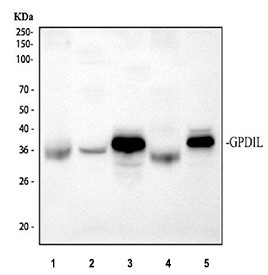
0.5mg/ml if reconstituted with 0.2ml sterile DI water. GPD1L antibody targets Glycerol-3-phosphate dehydrogenase 1-like protein, encoded by the GPD1L gene. GPD1L is a cytosolic enzyme that is structurally related to glycerol-3-phosphate dehydrogenase and participates in cellular redox balance and metabolic regulation. Although closely related to classical glycerol-3-phosphate dehydrogenases, GPD1L has distinct regulatory roles and is not considered a primary glycolytic enzyme. Its activity links cellular metabolism with redox-sensitive signaling pathways and protein regulation.Functionally, Glycerol-3-phosphate dehydrogenase 1-like protein has been shown to influence intracellular NADH and NAD+ balance and modulate downstream signaling processes. One well-characterized role of GPD1L is its regulation of ion channel function through redox-dependent mechanisms, particularly affecting sodium channel activity. Through these actions, GPD1L serves as a metabolic sensor that connects cellular energy state to electrophysiological and signaling outcomes. A GPD1L antibody supports studies focused on metabolic regulation and redox-dependent signaling.GPD1L is expressed in multiple tissues, with notable relevance in cardiac tissue and other metabolically active cells. Expression patterns reflect its involvement in maintaining cellular homeostasis under varying metabolic conditions. GPD1L can interact directly or indirectly with signaling proteins and channels, enabling fine control of cellular responses to metabolic stress. These interactions position GPD1L at the intersection of metabolism, signaling, and cellular excitability.From a disease-relevance perspective, GPD1L has been strongly associated with cardiac arrhythmia syndromes. Mutations in GPD1L have been linked to Brugada syndrome and sudden cardiac death, where altered regulation of cardiac sodium channels leads to impaired electrical conduction. GPD1L dysfunction has also been investigated in the context of metabolic stress responses and hypoxia-related signaling, expanding its relevance beyond cardiac physiology. These associations make GPD1L an important target for studies of metabolism-linked disease mechanisms.At the molecular level, Glycerol-3-phosphate dehydrogenase 1-like protein contains conserved enzymatic motifs and regulatory regions that enable interaction with cofactors and partner proteins. Post-translational modifications and cellular redox state can influence its activity and apparent behavior on SDS-PAGE without implying changes in primary sequence. A GPD1L antibody supports research applications focused on metabolic signaling, redox regulation, and disease-associated alterations in cellular homeostasis, with NSJ Bioreagents providing reagents intended for research use.
| Keywords: | Anti-GPD1L, Anti-Glycerol-3-phosphate dehydrogenase 1-like protein, GPD1L Antibody / Glycerol-3-phosphate dehydrogenase 1-like protein |
| Supplier: | NSJ Bioreagents |
| Supplier-Nr: | RQ5044 |
Properties
| Application: | WB, Direct ELISA |
| Antibody Type: | Polyclonal |
| Conjugate: | No |
| Host: | Rabbit |
| Species reactivity: | human, mouse, rat |
| Immunogen: | Amino acids A19-T351 from the human protein |
| Format: | Purified |
Database Information
| KEGG ID : | K00006 | Matching products |
| UniProt ID : | Q8N335 | Matching products |
| Gene ID : | GeneID 23171 | Matching products |
Handling & Safety
| Storage: | +4°C |
| Shipping: | +4°C (International: +4°C) |
Caution
Our products are for laboratory research use only: Not for administration to humans!
Our products are for laboratory research use only: Not for administration to humans!
Information about the product reference will follow.
more
You will get a certificate here
Viewed