
Cookie preferences
This website uses cookies, which are necessary for the technical operation of the website and are always set. Other cookies, which increase the comfort when using this website, are used for direct advertising or to facilitate interaction with other websites and social networks, are only set with your consent.
Configuration
Technically required
These cookies are necessary for the basic functions of the shop.
"Allow all cookies" cookie
"Decline all cookies" cookie
CSRF token
Cookie preferences
Currency change
Customer-specific caching
FACT-Finder tracking
Individual prices
Selected shop
Session
Comfort functions
These cookies are used to make the shopping experience even more appealing, for example for the recognition of the visitor.
Note
Show the facebook fanpage in the right blod sidebar
Statistics & Tracking
Affiliate program
Conversion and usertracking via Google Tag Manager
Track device being used




| Item number | Size | Datasheet | Manual | SDS | Delivery time | Quantity | Price |
|---|---|---|---|---|---|---|---|
| NSJ-FY12118 | 100 µg | - | - |
3 - 10 business days* |
790.00€
|
If you have any questions, please use our Contact Form.
You can also order by e-mail: info@biomol.com
Larger quantity required? Request bulk
You can also order by e-mail: info@biomol.com
Larger quantity required? Request bulk
Adding 0.2 ml of distilled water will yield a concentration of 500 ug/ml. GART antibody detects... more
Product information "Anti-GART / Phosphoribosylglycinamide formyltransferase"
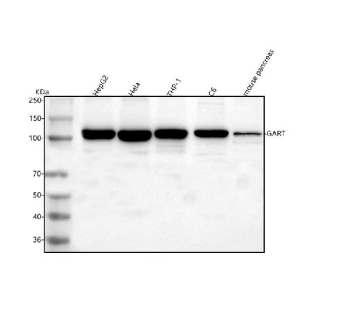
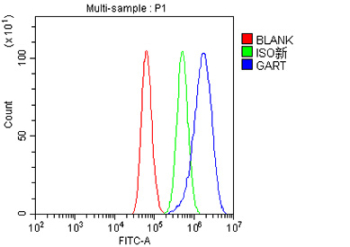
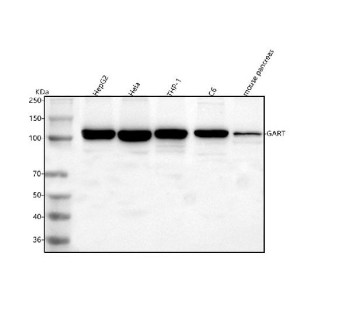
Adding 0.2 ml of distilled water will yield a concentration of 500 ug/ml. GART antibody detects Phosphoribosylglycinamide formyltransferase, also known as trifunctional purine biosynthetic protein adenosine-3, encoded by the GART gene on chromosome 21q22.11. GART is a multifunctional enzyme of the de novo purine biosynthesis pathway, responsible for catalyzing three distinct steps in the conversion of phosphoribosylamine to inosine monophosphate (IMP). This trifunctional protein includes glycinamide ribonucleotide transformylase, aminoimidazole ribonucleotide synthase, and glycinamide ribonucleotide synthetase domains. By integrating multiple catalytic activities into a single polypeptide, GART coordinates metabolic flux through the purine biosynthetic pathway, ensuring efficient nucleotide production required for DNA, RNA, and energy metabolism.Functionally, GART is critical for rapidly dividing cells that require high nucleotide synthesis rates. The enzyme is localized in the cytoplasm and often organizes into dynamic purinosome complexes when purine demand is elevated. GART activity is tightly regulated, and its expression increases in proliferating cells, including embryonic tissues and tumors. Dysregulation of GART has been associated with cancer metabolism, where enhanced nucleotide biosynthesis supports uncontrolled proliferation. Additionally, its genomic location on chromosome 21 links GART to Down syndrome pathophysiology, since increased gene dosage contributes to altered purine metabolism in trisomy 21.Biochemically, GART catalyzes the formylation of glycinamide ribonucleotide using 10-formyltetrahydrofolate, forming formylglycinamide ribonucleotide, a crucial intermediate in IMP synthesis. Mutations or inhibition of GART disrupt purine biosynthesis, leading to impaired cell growth and potential embryonic lethality. Small molecule inhibitors of GART and other purinosome enzymes are being explored as antiproliferative agents in oncology.Experimentally, GART antibody is used to track enzyme expression in normal and cancerous tissues, evaluate purinosome assembly, and study folate-dependent metabolism. Applications include western blotting, immunofluorescence microscopy, and immunohistochemistry. In cancer research, GART antibody helps evaluate metabolic reprogramming, while in developmental biology it provides insights into nucleotide demand during embryogenesis. NSJ Bioreagents supplies GART antibody to support these diverse research fields, ensuring reliable detection of this multifunctional enzyme.
| Keywords: | Anti-GART, Anti-Trifunctional purine biosynthetic protein adenosine-3, GART Antibody / Phosphoribosylglycinamide formyltransferase |
| Supplier: | NSJ Bioreagents |
| Supplier-Nr: | FY12118 |
Properties
| Application: | WB, FC, ELISA |
| Antibody Type: | Polyclonal |
| Conjugate: | No |
| Host: | Rabbit |
| Species reactivity: | human, mouse, rat |
| Immunogen: | E.coli-derived human GART recombinant protein (Position: E68-E1010) |
| Format: | Purified |
Database Information
| KEGG ID : | K11787 | Matching products |
| UniProt ID : | P22102 | Matching products |
| Gene ID : | GeneID 2618 | Matching products |
Handling & Safety
| Storage: | +4°C |
| Shipping: | +4°C (International: +4°C) |
Caution
Our products are for laboratory research use only: Not for administration to humans!
Our products are for laboratory research use only: Not for administration to humans!
Information about the product reference will follow.
more
You will get a certificate here
Viewed