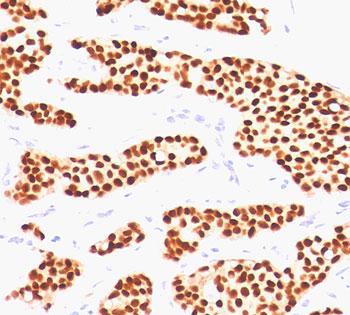
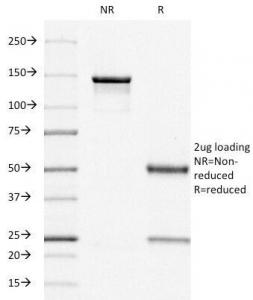
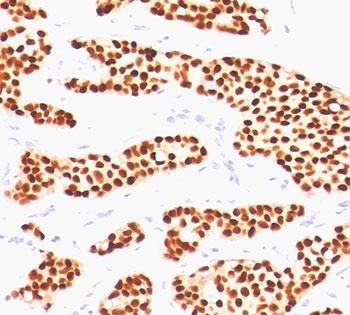
Anti-Estrogen Receptor, clone ER505

Item number Size Datasheet Manual SDS Delivery time Quantity Price
NSJ-V2112-20UG 20 µg - -

3 - 10 business days*

375.00€
NSJ-V2112-100UG 100 µg - -

3 - 10 business days*

810.00€
 
0.2 mg/ml with 0.1 mg/ml BSA (US sourced), 0.05% sodium azide. Estrogen receptor (ER) is an... more
Product information "Anti-Estrogen Receptor, clone ER505"
0.2 mg/ml with 0.1 mg/ml BSA (US sourced), 0.05% sodium azide. Estrogen receptor (ER) is an important regulator of growth and differentiation in the mammary gland. It is found in two forms, alpha and beta. Both forms are widely expressed, however, alpha is the predominant form in endometrium and breast cancer cells, and beta is more highly expressed in brain, kidney, heart, lung and bone. Activated estrogen receptor dimerizes and forms both homo- and heterodimers. ER contains five domains: A-F. The A and B domain are able to weakly activate ER in the absence of ligand. The C domain binds DNA and the E domain contains the ligand binding site. Presence of ER in breast tumors indicates an increased likelihood of response to anti-estrogen (e.g. tamoxifen) therapy. This antibody is specific to estrogen receptor alpha and shows minimal cross-reaction with other members of the family. Protein function: Nuclear hormone receptor. The steroid hormones and their receptors are involved in the regulation of eukaryotic gene expression and affect cellular proliferation and differentiation in target tissues. Ligand-dependent nuclear transactivation involves either direct homodimer binding to a palindromic estrogen response element (ERE) sequence or association with other DNA- binding transcription factors, such as AP-1/c-Jun, c-Fos, ATF-2, Sp1 and Sp3, to mediate ERE-independent signaling. Ligand binding induces a conformational change allowing subsequent or combinatorial association with multiprotein coactivator complexes through LXXLL motifs of their respective components. Mutual transrepression occurs between the estrogen receptor (ER) and NF- kappa-B in a cell-type specific manner. Decreases NF-kappa-B DNA- binding activity and inhibits NF-kappa-B-mediated transcription from the IL6 promoter and displace RELA/p65 and associated coregulators from the promoter. Recruited to the NF-kappa-B response element of the CCL2 and IL8 promoters and can displace CREBBP. Present with NF-kappa-B components RELA/p65 and NFKB1/p50 on ERE sequences. Can also act synergistically with NF-kappa-B to activate transcription involving respective recruitment adjacent response elements, the function involves CREBBP. Can activate the transcriptional activity of TFF1. Also mediates membrane-initiated estrogen signaling involving various kinase cascades. Isoform 3 is involved in activation of NOS3 and endothelial nitric oxide production. Isoforms lacking one or several functional domains are thought to modulate transcriptional activity by competitive ligand or DNA binding and/or heterodimerization with the full length receptor. Essential for MTA1-mediated transcriptional regulation of BRCA1 and BCAS3. Isoform 3 can bind to ERE and inhibit isoform 1. [The UniProt Consortium]
Keywords: Anti-ER, Anti-ESR, Anti-ESR1, Anti-ER-alpha, Anti-Estrogen receptor, Anti-Estradiol receptor, Anti-Nuclear receptor subfamily 3 group A member 1, Estrogen Receptor Antibody
Supplier: NSJ Bioreagents
Supplier-Nr: V2112

Properties

Application: WB, IHC
Antibody Type: Monoclonal
Clone: ER505
Conjugate: No
Host: Mouse
Species reactivity: human
Immunogen: Recombinant human Estrogen Receptor alpha protein (aa 2-185) was used as the immunogen for this antibody.
Format: Purified

Handling & Safety

Storage: +4°C
Shipping: +4°C (International: +4°C)
Caution
Our products are for laboratory research use only: Not for administration to humans!
You will get a certificate here
or to request a certificate of analysis.
Read, write and discuss reviews... more
Customer review for "Anti-Estrogen Receptor, clone ER505"
Write a review
or to review a product.
Viewed