
Cookie preferences
This website uses cookies, which are necessary for the technical operation of the website and are always set. Other cookies, which increase the comfort when using this website, are used for direct advertising or to facilitate interaction with other websites and social networks, are only set with your consent.
Configuration
Technically required
These cookies are necessary for the basic functions of the shop.
"Allow all cookies" cookie
"Decline all cookies" cookie
CSRF token
Cookie preferences
Currency change
Customer-specific caching
FACT-Finder tracking
Individual prices
Selected shop
Session
Comfort functions
These cookies are used to make the shopping experience even more appealing, for example for the recognition of the visitor.
Note
Show the facebook fanpage in the right blod sidebar
Statistics & Tracking
Affiliate program
Conversion and usertracking via Google Tag Manager
Track device being used


| Item number | Size | Datasheet | Manual | SDS | Delivery time | Quantity | Price |
|---|---|---|---|---|---|---|---|
| ARG43395.100 | 100 µl | - | - |
10 - 15 business days* |
658.00€
|
If you have any questions, please use our Contact Form.
You can also order by e-mail: info@biomol.com
Larger quantity required? Request bulk
You can also order by e-mail: info@biomol.com
Larger quantity required? Request bulk
Protein function: Nuclear hormone receptor. The steroid hormones and their receptors are involved... more
Product information "Anti-Estrogen Receptor alpha"
Protein function: Nuclear hormone receptor. The steroid hormones and their receptors are involved in the regulation of eukaryotic gene expression and affect cellular proliferation and differentiation in target tissues. Ligand-dependent nuclear transactivation involves either direct homodimer binding to a palindromic estrogen response element (ERE) sequence or association with other DNA-binding transcription factors, such as AP-1/c-Jun, c-Fos, ATF-2, Sp1 and Sp3, to mediate ERE- independent signaling. Ligand binding induces a conformational change allowing subsequent or combinatorial association with multiprotein coactivator complexes through LXXLL motifs of their respective components. Mutual transrepression occurs between the estrogen receptor (ER) and NF-kappa-B in a cell-type specific manner. Decreases NF-kappa- B DNA-binding activity and inhibits NF-kappa-B-mediated transcription from the IL6 promoter and displace RELA/p65 and associated coregulators from the promoter. Recruited to the NF-kappa-B response element of the CCL2 and IL8 promoters and can displace CREBBP. Present with NF-kappa-B components RELA/p65 and NFKB1/p50 on ERE sequences. Can also act synergistically with NF-kappa-B to activate transcription involving respective recruitment adjacent response elements, the function involves CREBBP. Can activate the transcriptional activity of TFF1. Also mediates membrane-initiated estrogen signaling involving various kinase cascades. Isoform 3 is involved in activation of NOS3 and endothelial nitric oxide production. Isoforms lacking one or several functional domains are thought to modulate transcriptional activity by competitive ligand or DNA binding and/or heterodimerization with the full-length receptor. Essential for MTA1-mediated transcriptional regulation of BRCA1 and BCAS3. Isoform 3 can bind to ERE and inhibit isoform 1. {ECO:0000269, PubMed:10681512, ECO:0000269, PubMed:10816575, ECO:0000269, PubMed:11477071, ECO:0000269, PubMed:11682626, ECO:0000269, PubMed:14764652, ECO:0000269, PubMed:15078875, ECO:0000269, PubMed:15891768, ECO:0000269, PubMed:16043358, ECO:0000269, PubMed:16617102, ECO:0000269, PubMed:16684779, ECO:0000269, PubMed:17922032, ECO:0000269, PubMed:17932106, ECO:0000269, PubMed:18247370, ECO:0000269, PubMed:19350539, ECO:0000269, PubMed:20074560, ECO:0000269, PubMed:20705611, ECO:0000269, PubMed:21330404, ECO:0000269, PubMed:22083956, ECO:0000269, PubMed:7651415, ECO:0000269, PubMed:9328340}. [The UniProt Consortium]
| Keywords: | Anti-ER, Anti-ER, Anti-ESR, Anti-ESR1, Anti-ER-alpha, Anti-ER-alpha, Anti-Estrogen receptor, Anti-Estrogen receptor, Anti-Estradiol receptor, Anti-Estradiol receptor, Anti-Nuclear receptor subfamily 3 group A member 1, Anti-Nuclear receptor subfamily 3 gr |
| Supplier: | Arigo Biolaboratories |
| Supplier-Nr: | ARG43395 |
Properties
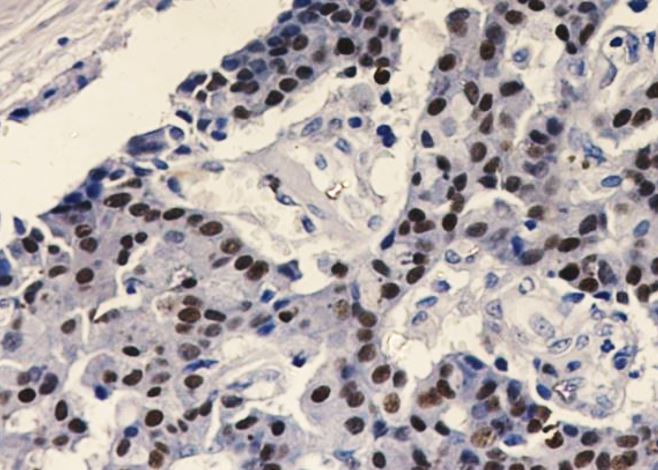
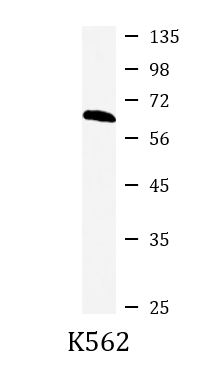
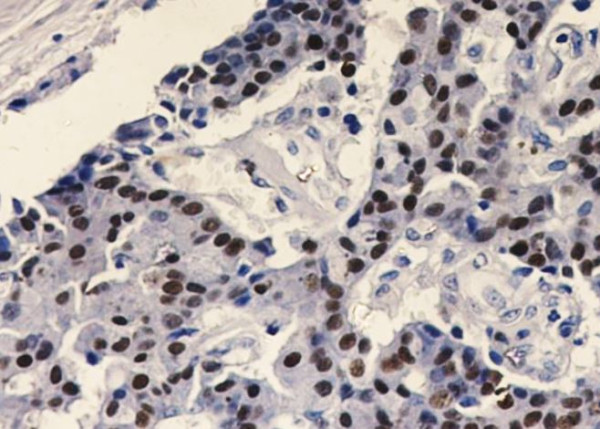
| Application: | ChIP, FC, ICC, IF, IHC (paraffin), IP, WB |
| Antibody Type: | Polyclonal |
| Conjugate: | No |
| Host: | Rabbit |
| Species reactivity: | human, mouse, rat |
| Immunogen: | Synthetic peptide of Human Estrogen Receptor alpha |
| MW: | 66 kD |
| Format: | Affinity Purified |
Database Information
| KEGG ID : | K08550 | Matching products |
| UniProt ID : | P03372 | Matching products |
| Gene ID : | GeneID 2099 | Matching products |
Handling & Safety
| Storage: | -20°C |
| Shipping: | +4°C (International: °C) |
Caution
Our products are for laboratory research use only: Not for administration to humans!
Our products are for laboratory research use only: Not for administration to humans!
Information about the product reference will follow.
more
You will get a certificate here
Viewed