
Cookie preferences
This website uses cookies, which are necessary for the technical operation of the website and are always set. Other cookies, which increase the comfort when using this website, are used for direct advertising or to facilitate interaction with other websites and social networks, are only set with your consent.
Configuration
Technically required
These cookies are necessary for the basic functions of the shop.
"Allow all cookies" cookie
"Decline all cookies" cookie
CSRF token
Cookie preferences
Currency change
Customer-specific caching
FACT-Finder tracking
Individual prices
Selected shop
Session
Comfort functions
These cookies are used to make the shopping experience even more appealing, for example for the recognition of the visitor.
Note
Show the facebook fanpage in the right blod sidebar
Statistics & Tracking
Affiliate program
Conversion and usertracking via Google Tag Manager
Track device being used

| Item number | Size | Datasheet | Manual | SDS | Delivery time | Quantity | Price |
|---|---|---|---|---|---|---|---|
| ATA-HPA064895.25 | 25 µl | - |
7 - 10 business days* |
330.00€
|
|||
| ATA-HPA064895.100 | 100 µl | - |
7 - 10 business days* |
463.00€
|
If you have any questions, please use our Contact Form.
You can also order by e-mail: info@biomol.com
Larger quantity required? Request bulk
You can also order by e-mail: info@biomol.com
Larger quantity required? Request bulk
Protein function: Prolyl hydroxylase that mediates hydroxylation of proline residues in target... more
Product information "Anti-EGLN3"
Protein function: Prolyl hydroxylase that mediates hydroxylation of proline residues in target proteins, such as PKM, TELO2, ATF4 and HIF1A (PubMed:19584355, PubMed:21620138, PubMed:21483450, PubMed:22797300, PubMed:20978507, PubMed:21575608). Target proteins are preferentially recognized via a LXXLAP motif. Cellular oxygen sensor that catalyzes, under normoxic conditions, the post-translational formation of 4- hydroxyproline in hypoxia-inducible factor (HIF) alpha proteins (PubMed:11595184, PubMed:12181324). Hydroxylates a specific proline found in each of the oxygen-dependent degradation (ODD) domains (N- terminal, NODD, and C-terminal, CODD) of HIF1A (PubMed:11595184, PubMed:12181324). Also hydroxylates HIF2A (PubMed:11595184, PubMed:12181324). Has a preference for the CODD site for both HIF1A and HIF2A (PubMed:11595184, PubMed:12181324). Hydroxylation on the NODD site by EGLN3 appears to require prior hydroxylation on the CODD site (PubMed:11595184, PubMed:12181324). Hydroxylated HIFs are then targeted for proteasomal degradation via the von Hippel-Lindau ubiquitination complex (PubMed:11595184, PubMed:12181324). Under hypoxic conditions, the hydroxylation reaction is attenuated allowing HIFs to escape degradation resulting in their translocation to the nucleus, heterodimerization with HIF1B, and increased expression of hypoxy- inducible genes (PubMed:11595184, PubMed:12181324). ELGN3 is the most important isozyme in limiting physiological activation of HIFs (particularly HIF2A) in hypoxia. Also hydroxylates PKM in hypoxia, limiting glycolysis (PubMed:21620138, PubMed:21483450). Under normoxia, hydroxylates and regulates the stability of ADRB2 (PubMed:19584355). Regulator of cardiomyocyte and neuronal apoptosis. In cardiomyocytes, inhibits the anti-apoptotic effect of BCL2 by disrupting the BAX-BCL2 complex (PubMed:20849813). In neurons, has a NGF-induced proapoptotic effect, probably through regulating CASP3 activity (PubMed:16098468). Also essential for hypoxic regulation of neutrophilic inflammation (PubMed:21317538). Plays a crucial role in DNA damage response (DDR) by hydroxylating TELO2, promoting its interaction with ATR which is required for activation of the ATR/CHK1/p53 pathway (PubMed:22797300). Also mediates hydroxylation of ATF4, leading to decreased protein stability of ATF4 (Probable). [The UniProt Consortium] Buffer: 40% glycerol and PBS (pH 7.2). 0.02% sodium azide is added as preservative. Highest antigen sequence identity to mouse: 93% and to rat: 93%
| Keywords: | Anti-PHD3, Anti-HPH-3, Anti-HPH-1, Anti-HIF-PH3, Anti-Egl nine homolog 3, Anti-Prolyl hydroxylase EGLN3, Anti-HIF-prolyl hydroxylase 3, Anti-Hypoxia-inducible factor prolyl hydroxylase 3, Anti-Prolyl hydroxylase domain-containing protein 3 |
| Supplier: | Atlas Antibodies |
| Supplier-Nr: | HPA064895 |
Properties
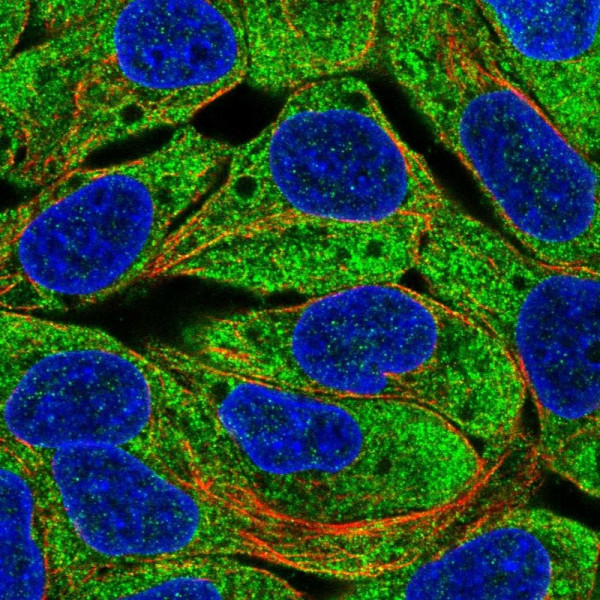
| Application: | ICC |
| Antibody Type: | Polyclonal |
| Conjugate: | No |
| Host: | Rabbit |
| Species reactivity: | human |
| Immunogen: | Recombinant Protein Epitope Signature Tag (PrEST) antigen sequence: YFDAEERAEA KKKFRNLTRK TESALTED (ATA-APrEST92513) |
Database Information
| KEGG ID : | K09592 | Matching products |
| UniProt ID : | Q9H6Z9 | Matching products |
| Gene ID : | GeneID 112399 | Matching products |
| Protein Atlas Nr. : | ENSG00000129521 |
Handling & Safety
| Storage: | -20°C |
| Shipping: | +20°C (International: +20°C) |
Caution
Our products are for laboratory research use only: Not for administration to humans!
Our products are for laboratory research use only: Not for administration to humans!
Information about the product reference will follow.
more
You will get a certificate here
Viewed