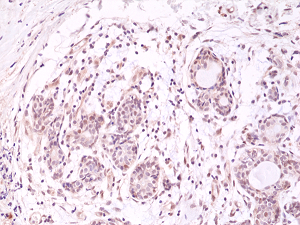
Anti-AKT (PH domain) (human), Rabbit Monoclonal (RM316)

Anti-AKT (PH domain) (human), Rabbit Monoclonal (RM316)

Item number Size Datasheet Manual SDS Delivery time Quantity Price
REV-31-1202-00-R100 100 µl - -

3 - 9 business days*

541.00€
 
Recombinant Antibody. This antibody reacts to human AKT (PH domain). It may also react to mouse... more
Product information "Anti-AKT (PH domain) (human), Rabbit Monoclonal (RM316)"
Recombinant Antibody. This antibody reacts to human AKT (PH domain). It may also react to mouse or rat AKT, as predicted by immunogen homology. Applications: WB, IHC. Source: Rabbit. Liquid. 50% Glycerol/PBS with 1% BSA and 0.09% sodium azide. Akt, also referred to as PKB or Rac, plays a critical role in controlling survival and apoptosis. This protein kinase is activated at 2 phosphorylation sites Thr308 and Ser473. Akt promotes cell survival by inhibiting apoptosis through phosphorylation and inactivation of several targets, including Bad, forkhead transcription factors, c-Raf and caspase-9. In addition to its role in survival and glycogen synthesis, Akt is involved in cell cycle regulation. Akt also plays a critical role in cell growth by directly phosphorylating mTOR in a rapamycin-sensitive complex containing raptor. Mutation of the glutamic acid at residue 17 to lysine (E17K) of Akt was initially identified in human breast, colorectal and ovarian cancers. This conserved glutamic acid residue is located at the lipid-binding pocket of the Akt plextrin homology domain. The E17K mutation increases the affinity between Akt and phospholipids at the plasma membrane, leading to increased Akt recruitment, super-activation of the Akt pathway, cellular transformation and tumor formation. Additional studies detect the presence of the Akt (E17K) mutation in multiple cancers, including lung cancer, prostate cancer, endometrial carcinoma and several melanomas. AKT has a Group 3 pleckstrin homology domain (PH) that recognize PtdIns(3,4)P2 and PtdIns(3,4,5)P3. PH domains are a protein domain of approximately 120 amino acids that occurs in a wide range of proteins involved in intracellular signaling or as constituents of the cytoskeleton. This domain can bind phosphatidylinositol lipids within biological membranes, proteins such as the betagamma-subunits of heterotrimeric G proteins and protein kinase C. Through these interactions, PH domains play a role in recruiting proteins to different membranes, thus targeting them to appropriate cellular compartments or enabling them to interact with other components of the signal transduction pathways.
Keywords: PKB, AKT1, PKB alpha, EC=2.7.11.1, RAC-PK-alpha, Protein Kinase B, Proto-Oncogene c-Akt, Protein Kinase B alpha, PKBG, AKT3, STK-2, PKB gamma, RAC-PK-gamma, Protein Kinase Akt-3, Protein Kinase B gamma, AKT2, PKB beta, RAC-PK-beta, Protein
Supplier: RevMAb Biosciences
Supplier-Nr: 31-1202-00

Properties

Application: WB, IHC
Antibody Type: Monoclonal
Clone: RM316
Conjugate: No
Host: Rabbit
Species reactivity: human
Format: Purified

Handling & Safety

Storage: -20°C
Shipping: +4°C (International: +4°C)
Caution
Our products are for laboratory research use only: Not for administration to humans!
You will get a certificate here
or to request a certificate of analysis.
Read, write and discuss reviews... more
Customer review for "Anti-AKT (PH domain) (human), Rabbit Monoclonal (RM316)"
Write a review
or to review a product.
Viewed