
Cookie preferences
This website uses cookies, which are necessary for the technical operation of the website and are always set. Other cookies, which increase the comfort when using this website, are used for direct advertising or to facilitate interaction with other websites and social networks, are only set with your consent.
Configuration
Technically required
These cookies are necessary for the basic functions of the shop.
"Allow all cookies" cookie
"Decline all cookies" cookie
CSRF token
Cookie preferences
Currency change
Customer-specific caching
FACT-Finder tracking
Individual prices
Selected shop
Session
Comfort functions
These cookies are used to make the shopping experience even more appealing, for example for the recognition of the visitor.
Note
Show the facebook fanpage in the right blod sidebar
Statistics & Tracking
Affiliate program
Conversion and usertracking via Google Tag Manager
Track device being used

| Item number | Size | Datasheet | Manual | SDS | Delivery time | Quantity | Price |
|---|---|---|---|---|---|---|---|
| NSJ-FY13421 | 100 µl | - | - |
7 - 12 business days* |
790.00€
|
If you have any questions, please use our Contact Form.
You can also order by e-mail: info@biomol.com
Larger quantity required? Request bulk
You can also order by e-mail: info@biomol.com
Larger quantity required? Request bulk
Rabbit IgG in phosphate buffered saline, pH 7.4, 150mM NaCl, 0.02% sodium azide and 50% glycerol,... more
Product information "Anti-AKR1C3 / Aldo-keto reductase family 1 member C3, clone 21A20"
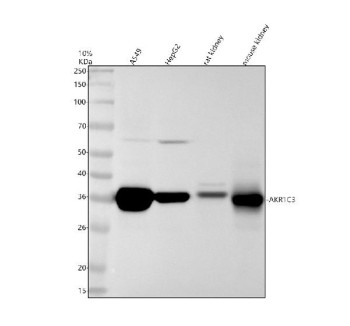
Rabbit IgG in phosphate buffered saline, pH 7.4, 150mM NaCl, 0.02% sodium azide and 50% glycerol, 0.4-0.5mg/ml BSA. AKR1C3 antibody targets Aldo-keto reductase family 1 member C3 (AKR1C3), a cytosolic oxidoreductase enzyme that plays a key role in steroid hormone metabolism, prostaglandin signaling, and cellular redox balance. AKR1C3 belongs to the aldo-keto reductase superfamily and catalyzes the NADPH-dependent reduction of aldehydes and ketones to their corresponding alcohols. The protein is primarily localized in the cytoplasm, where it functions as a metabolic regulator linking enzymatic redox activity to hormone signaling pathways.Functionally, AKR1C3 is best known for its involvement in androgen and estrogen metabolism. It catalyzes the conversion of weak steroid precursors into more active hormones, thereby modulating local hormone availability within tissues. Through this activity, AKR1C3 can influence cell proliferation, differentiation, and survival, particularly in hormone-responsive tissues. AKR1C3 also participates in prostaglandin metabolism, contributing to inflammatory signaling and cellular responses to stress. An AKR1C3 antibody supports research examining how steroid and lipid metabolism intersect with signaling pathways that regulate cell fate.AKR1C3 expression is observed in a variety of tissues, including liver, prostate, mammary tissue, and hematopoietic cells. Its expression is often elevated in rapidly proliferating or metabolically active cells, reflecting its role in maintaining redox homeostasis and hormone balance. AKR1C3 levels can be dynamically regulated by hormonal cues, inflammatory stimuli, and metabolic stress, making it a useful marker for studying adaptive metabolic responses. Analysis of AKR1C3 expression provides insight into tissue-specific steroid metabolism and its impact on cellular physiology.From a disease relevance perspective, AKR1C3 has been extensively studied in cancer biology, particularly in prostate and breast cancer, where altered steroid metabolism can drive tumor growth and therapy resistance. Elevated AKR1C3 expression has also been reported in certain leukemias and solid tumors, linking the enzyme to dysregulated redox and inflammatory signaling. Beyond oncology, AKR1C3 is implicated in metabolic and inflammatory disorders due to its role in prostaglandin and lipid metabolism. Investigating AKR1C3 expression with a AKR1C3 antibody is therefore relevant to studies of hormone-driven disease, inflammation, and metabolic regulation.At the molecular level, the AKR1C3 gene encodes a protein of approximately 37 kDa that contains conserved catalytic residues characteristic of aldo-keto reductases. The enzymatic activity of AKR1C3 depends on NADPH binding and proper folding of its catalytic domain. Subtle changes in AKR1C3 expression or activity can significantly alter local steroid and prostaglandin levels, leading to downstream effects on signaling pathways. An AKR1C3 antibody enables detection and analysis of AKR1C3 expression in research applications focused on metabolism, hormone signaling, and disease-associated redox biology, with NSJ Bioreagents providing reagents intended for research use.
| Keywords: | Anti-HA1753, Anti-AKR1C3, Anti-Prostaglandin F synthase, Anti-3-alpha-HSD type II, brain, Anti-Dihydrodiol dehydrogenase 3, Anti-Dihydrodiol dehydrogenase type I, Anti-Chlordecone reductase homolog HAKRb, Anti-Testosterone 17-beta-dehydrogenase 5, Anti-Al |
| Supplier: | NSJ Bioreagents |
| Supplier-Nr: | FY13421 |
Properties
| Application: | WB |
| Antibody Type: | Monoclonal |
| Clone: | 21A20 |
| Conjugate: | No |
| Host: | Rabbit |
| Species reactivity: | human, mouse, rat |
| Immunogen: | Synthesized peptide derived from human Aldo-keto reductase family 1 member C3 protein |
| Format: | Affinity Purified |
Database Information
| KEGG ID : | K04119 | Matching products |
| UniProt ID : | P42330 | Matching products |
| Gene ID : | GeneID 8644 | Matching products |
Handling & Safety
| Storage: | -20°C |
| Shipping: | -20°C (International: -20°C) |
Caution
Our products are for laboratory research use only: Not for administration to humans!
Our products are for laboratory research use only: Not for administration to humans!
Information about the product reference will follow.
more
You will get a certificate here
Viewed