
Cookie preferences
This website uses cookies, which are necessary for the technical operation of the website and are always set. Other cookies, which increase the comfort when using this website, are used for direct advertising or to facilitate interaction with other websites and social networks, are only set with your consent.
Configuration
Technically required
These cookies are necessary for the basic functions of the shop.
"Allow all cookies" cookie
"Decline all cookies" cookie
CSRF token
Cookie preferences
Currency change
Customer-specific caching
FACT-Finder tracking
Individual prices
Selected shop
Session
Comfort functions
These cookies are used to make the shopping experience even more appealing, for example for the recognition of the visitor.
Note
Show the facebook fanpage in the right blod sidebar
Statistics & Tracking
Affiliate program
Conversion and usertracking via Google Tag Manager
Track device being used



| Item number | Size | Datasheet | Manual | SDS | Delivery time | Quantity | Price |
|---|---|---|---|---|---|---|---|
| NSJ-FY12873 | 100 µg | - | - |
3 - 10 business days* |
790.00€
|
If you have any questions, please use our Contact Form.
You can also order by e-mail: info@biomol.com
Larger quantity required? Request bulk
You can also order by e-mail: info@biomol.com
Larger quantity required? Request bulk
Adding 0.2 ml of distilled water will yield a concentration of 500 ug/ml. ACSL5 antibody detects... more
Product information "Anti-ACSL5 / Long chain fatty acid CoA ligase 5"
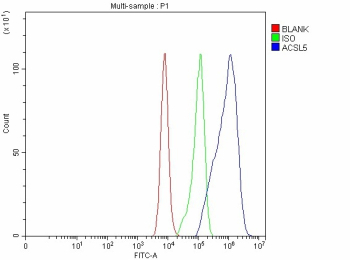
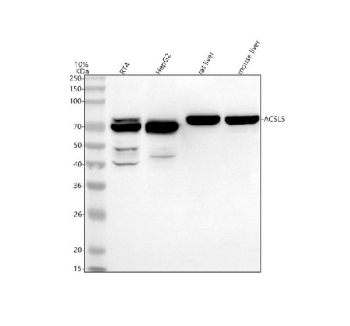
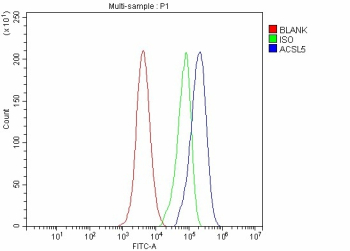
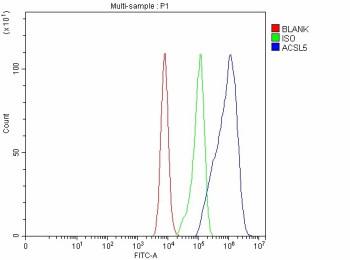
Adding 0.2 ml of distilled water will yield a concentration of 500 ug/ml. ACSL5 antibody detects Long chain fatty acid CoA ligase 5, an enzyme that activates long chain fatty acids for lipid metabolism, beta oxidation, and membrane synthesis. Encoded by the ACSL5 gene on chromosome 10q25.2, this enzyme belongs to the acyl CoA synthetase family, which catalyzes the conversion of free fatty acids to fatty acyl CoA thioesters using ATP and Coenzyme A. ACSL5 functions as a metabolic gatekeeper, determining whether lipids are directed toward energy production or anabolic pathways such as triglyceride and phospholipid synthesis.Structurally, ACSL5 is an approximately 76 kilodalton enzyme localized to the outer mitochondrial membrane and the endoplasmic reticulum. It contains conserved AMP binding and acyl adenylate forming motifs required for catalysis of long chain fatty acids, typically those containing 12 to 20 carbon atoms. ACSL5 expression is highest in metabolically active tissues such as the small intestine, liver, and brown adipose tissue, where rapid fatty acid activation supports energy production during fasting, thermogenesis, and lipid absorption.The ACSL5 antibody is widely used in metabolism, mitochondrial biology, and lipid biochemistry research to study fatty acid activation, transport, and oxidation. Western blot analysis detects a 76 kilodalton band corresponding to ACSL5, while immunofluorescence reveals perinuclear and mitochondrial membrane localization. This antibody provides a dependable tool for assessing lipid metabolic flux, energy homeostasis, and fatty acid utilization under physiological and pathological conditions.Functionally, ACSL5 determines the metabolic fate of long chain fatty acids by channeling activated fatty acyl CoA into either mitochondrial beta oxidation for ATP production or endoplasmic reticulum based lipid synthesis. It interacts with key metabolic regulators such as carnitine palmitoyltransferase 1 (CPT1) and peroxisome proliferator activated receptor alpha (PPAR alpha), coordinating lipid oxidation and storage. Dysregulation of ACSL5 expression has been linked to obesity, insulin resistance, and nonalcoholic fatty liver disease, where altered fatty acid channeling contributes to lipid accumulation and oxidative stress. In intestinal epithelial cells, ACSL5 also plays a role in apoptosis regulation, reflecting its broader function in energy balance and cell survival.Beyond energy metabolism, ACSL5 participates in mitochondrial dynamics and lipid signaling by influencing the composition of phospholipids that form mitochondrial membranes. Its activity affects membrane curvature and permeability, which can impact mitochondrial fission and fusion processes. Increased ACSL5 expression under stress conditions may enhance beta oxidation and reactive oxygen species production, whereas reduced expression limits fatty acid utilization and leads to metabolic inflexibility. The ACSL5 antibody allows detailed exploration of these adaptive responses and facilitates research into metabolic disorders, energy regulation, and mitochondrial health.NSJ Bioreagents provides a validated ACSL5 antibody optimized for western blotting, immunohistochemistry, and immunofluorescence. This antibody enables sensitive and specific detection of Long chain fatty acid CoA ligase 5 across multiple tissues and experimental systems, supporting studies in lipid metabolism, energy signaling, and mitochondrial physiology.
| Keywords: | Anti-ACSL5, Anti-Arachidonate--CoA ligase, Anti-Long-chain acyl-CoA synthetase 5, Anti-Long-chain-fatty-acid--CoA ligase 5, ACSL5 Antibody / Long chain fatty acid CoA ligase 5 |
| Supplier: | NSJ Bioreagents |
| Supplier-Nr: | FY12873 |
Properties
| Application: | WB, FC, ELISA |
| Antibody Type: | Polyclonal |
| Conjugate: | No |
| Host: | Rabbit |
| Species reactivity: | human, mouse, rat |
| Immunogen: | E.coli-derived human ACSL5 recombinant protein (Position: Y108-D683) |
| Format: | Purified |
Database Information
| KEGG ID : | K01897 | Matching products |
| UniProt ID : | Q9ULC5 | Matching products |
| Gene ID : | GeneID 51703 | Matching products |
Handling & Safety
| Storage: | +4°C |
| Shipping: | +4°C (International: +4°C) |
Caution
Our products are for laboratory research use only: Not for administration to humans!
Our products are for laboratory research use only: Not for administration to humans!
Information about the product reference will follow.
more
You will get a certificate here
Viewed