
Cookie preferences
This website uses cookies, which are necessary for the technical operation of the website and are always set. Other cookies, which increase the comfort when using this website, are used for direct advertising or to facilitate interaction with other websites and social networks, are only set with your consent.
Configuration
Technically required
These cookies are necessary for the basic functions of the shop.
"Allow all cookies" cookie
"Decline all cookies" cookie
CSRF token
Cookie preferences
Currency change
Customer-specific caching
FACT-Finder tracking
Individual prices
Selected shop
Session
Comfort functions
These cookies are used to make the shopping experience even more appealing, for example for the recognition of the visitor.
Note
Show the facebook fanpage in the right blod sidebar
Statistics & Tracking
Affiliate program
Conversion and usertracking via Google Tag Manager
Track device being used

| Item number | Size | Datasheet | Manual | SDS | Delivery time | Quantity | Price |
|---|---|---|---|---|---|---|---|
| NSJ-FY13312 | 100 µl | - | - |
3 - 10 business days* |
790.00€
|
If you have any questions, please use our Contact Form.
You can also order by e-mail: info@biomol.com
Larger quantity required? Request bulk
You can also order by e-mail: info@biomol.com
Larger quantity required? Request bulk
Rabbit IgG in phosphate buffered saline, pH 7.4, 150mM NaCl, 0.02% sodium azide and 50% glycerol,... more
Product information "Anti-phospho-p120 Catenin (Tyr228) / CTNND1, clone 32C33"
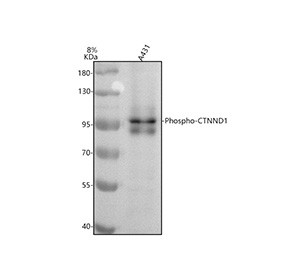
Rabbit IgG in phosphate buffered saline, pH 7.4, 150mM NaCl, 0.02% sodium azide and 50% glycerol, 0.4-0.5mg/ml BSA. Phospho-p120 Catenin (Tyr228) antibody detects p120 Catenin phosphorylated at tyrosine 228, encoded by the CTNND1 gene. p120 Catenin is an armadillo repeat protein that functions as a critical regulator of cell-cell adhesion, cytoskeletal organization, and intracellular signaling. Phosphorylation at tyrosine 228 is an important post-translational modification that influences its interaction with cadherins, small GTPases, and signaling pathways. Phospho-p120 Catenin (Tyr228) antibody provides researchers with a highly specific reagent for dissecting the regulation of adherens junctions and downstream signaling events.p120 Catenin was first identified as a substrate of Src family kinases and is now recognized as a central adaptor in adherens junctions, where it binds directly to the juxtamembrane domain of classical cadherins. Research using Phospho-p120 Catenin (Tyr228) antibody has shown that phosphorylation at Tyr228 modifies its cadherin-binding affinity, affecting junction stability and turnover. This phosphorylation also alters signaling through Rho family GTPases, impacting actin cytoskeleton dynamics and cell motility.Studies with Phospho-p120 Catenin (Tyr228) antibody have revealed that the Tyr228 site is phosphorylated in response to growth factor stimulation, mechanical stress, and oncogenic signaling. Src and receptor tyrosine kinases mediate this modification, linking extracellular cues to junction remodeling. By regulating cell-cell adhesion, phosphorylation at Tyr228 influences epithelial-mesenchymal transition, tissue morphogenesis, and tumor invasion.In cancer biology, aberrant phosphorylation of p120 Catenin contributes to disease progression. Research using Phospho-p120 Catenin (Tyr228) antibody has shown that elevated phosphorylation disrupts cadherin-mediated adhesion, enabling tumor cells to detach and migrate. At the same time, phosphorylation-dependent regulation of Rho family proteins promotes cytoskeletal reorganization and invasiveness. These findings highlight p120 Catenin Tyr228 phosphorylation as a potential biomarker of metastasis and therapeutic target.Beyond cancer, p120 Catenin phosphorylation influences cardiovascular and developmental processes. Studies with Phospho-p120 Catenin (Tyr228) antibody have revealed roles in vascular integrity, cardiac morphogenesis, and neural crest development. Dysregulation of this pathway may contribute to congenital defects and vascular diseases. Because p120 Catenin integrates adhesive and signaling functions, its phosphorylation status provides insight into multiple physiological and pathological processes.Phospho-p120 Catenin (Tyr228) antibody is widely used in western blotting, immunohistochemistry, and immunofluorescence. Western blotting distinguishes phosphorylated from non-phosphorylated forms, immunohistochemistry identifies activated signaling regions in tissues, and immunofluorescence demonstrates subcellular distribution of phosphorylated protein at junctions and in the cytoplasm. These applications make the antibody valuable in adhesion and signaling research.By providing validated Phospho-p120 Catenin (Tyr228) antibody reagents, NSJ Bioreagents supports research into cell-cell adhesion, signal transduction, and cancer biology. Detection of p120 Catenin phosphorylated at tyrosine 228 offers a precise marker for junctional remodeling and signaling activation.
| Keywords: | Anti-phospho-CTNND1, Anti-phospho-p120(cas), Anti-phospho-p120 catenin, Anti-phospho-Catenin delta-1, Anti-phospho-Cadherin-associated Src substrate, Phospho-p120 Catenin (Tyr228) Antibody / CTNND1 |
| Supplier: | NSJ Bioreagents |
| Supplier-Nr: | FY13312 |
Properties
| Application: | WB, IHC |
| Antibody Type: | Monoclonal |
| Clone: | 32C33 |
| Conjugate: | No |
| Host: | Rabbit |
| Species reactivity: | human, mouse, rat |
| Immunogen: | A synthesized peptide derived from human Phospho-CTNND1 (Y228) |
| Format: | Affinity Purified |
Database Information
| KEGG ID : | K05690 | Matching products |
| UniProt ID : | O60716 | Matching products |
| Gene ID : | GeneID 1500 | Matching products |
Handling & Safety
| Storage: | -20°C |
| Shipping: | -20°C (International: -20°C) |
Caution
Our products are for laboratory research use only: Not for administration to humans!
Our products are for laboratory research use only: Not for administration to humans!
Information about the product reference will follow.
more
You will get a certificate here
Viewed