
Cookie preferences
This website uses cookies, which are necessary for the technical operation of the website and are always set. Other cookies, which increase the comfort when using this website, are used for direct advertising or to facilitate interaction with other websites and social networks, are only set with your consent.
Configuration
Technically required
These cookies are necessary for the basic functions of the shop.
"Allow all cookies" cookie
"Decline all cookies" cookie
CSRF token
Cookie preferences
Currency change
Customer-specific caching
FACT-Finder tracking
Individual prices
Selected shop
Session
Comfort functions
These cookies are used to make the shopping experience even more appealing, for example for the recognition of the visitor.
Note
Show the facebook fanpage in the right blod sidebar
Statistics & Tracking
Affiliate program
Conversion and usertracking via Google Tag Manager
Track device being used

| Item number | Size | Datasheet | Manual | SDS | Delivery time | Quantity | Price |
|---|---|---|---|---|---|---|---|
| NSJ-FY12568 | 100 µl | - | - |
3 - 10 business days* |
790.00€
|
If you have any questions, please use our Contact Form.
You can also order by e-mail: info@biomol.com
Larger quantity required? Request bulk
You can also order by e-mail: info@biomol.com
Larger quantity required? Request bulk
Rabbit IgG in phosphate buffered saline, pH 7.4, 150mM NaCl, 0.02% sodium azide and 50% glycerol,... more
Product information "Anti-phospho-c-Jun/JunD (Ser73/Ser100), clone 30J61"
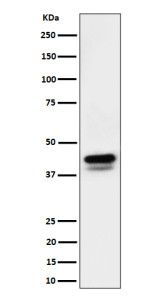
Rabbit IgG in phosphate buffered saline, pH 7.4, 150mM NaCl, 0.02% sodium azide and 50% glycerol, 0.4-0.5mg/ml BSA. Phospho-c-Jun/JunD (Ser73/Ser100) antibody detects the phosphorylated forms of c-Jun and JunD, transcription factors belonging to the activator protein 1 (AP-1) family. c-Jun, encoded by the JUN gene, and JunD, encoded by the JUND gene, regulate gene expression in response to growth factors, stress signals, and cytokines. Phosphorylation at serine 73 in c-Jun and serine 100 in JunD is mediated by JNK kinases, enhancing transcriptional activity by promoting interaction with co-activators and stabilization of AP-1 complexes. These phosphorylation events are critical for cell proliferation, apoptosis, and stress responses.Phospho-c-Jun/JunD (Ser73/Ser100) antibody is widely applied in cancer biology, immunology, and stress signaling research. Detection of phosphorylated AP-1 proteins provides insight into MAPK signaling cascades that drive transcriptional reprogramming. Abnormal AP-1 activation contributes to oncogenesis, inflammation, and neurodegeneration. By detecting phosphorylated c-Jun and JunD, researchers can examine how stress-activated kinases influence gene regulation and disease progression. Western blot assays reveal phosphorylated isoforms distinct from non-phosphorylated proteins. Immunohistochemistry maps AP-1 activation across tissues, while immunofluorescence highlights nuclear localization of phosphorylated c-Jun and JunD. These techniques allow high-resolution tracking of transcription factor activation in diverse biological contexts.Phosphorylation of c-Jun and JunD integrates signals from growth factors, UV radiation, oxidative stress, and cytokines. Sustained phosphorylation is often linked to tumorigenesis and resistance to therapy, while transient activation supports adaptive responses. By applying Phospho-c-Jun/JunD (Ser73/Ser100) antibody, scientists can evaluate pathway dynamics and investigate therapeutic strategies targeting JNK-AP1 signaling in cancer and inflammation.Beyond oncology, phosphorylated AP-1 proteins play roles in embryonic development, neuronal plasticity, and immune activation. Their regulation of genes involved in apoptosis, differentiation, and repair underscores their biological importance. The phospho-specific antibody therefore provides a versatile reagent for dissecting cellular responses to external and internal cues.Phospho-c-Jun/JunD (Ser73/Ser100) antibody from NSJ Bioreagents delivers reliable specificity for studying AP-1 phosphorylation events. Its strong performance across multiple assays makes it a valuable tool for laboratories investigating stress signaling and transcriptional control.
| Keywords: | Anti-phospho-p39, Anti-phospho-JUN, Anti-phospho-Activator protein 1, Anti-phospho-Proto-oncogene c-Jun, Anti-phospho-Transcription factor Jun, Anti-phospho-Transcription factor AP-1 subunit Jun, Anti-phospho-V-jun avian sarcoma virus 17 oncogene homolog, |
| Supplier: | NSJ Bioreagents |
| Supplier-Nr: | FY12568 |
Properties
| Application: | WB, IHC, IP |
| Antibody Type: | Monoclonal |
| Clone: | 30J61 |
| Conjugate: | No |
| Host: | Rabbit |
| Species reactivity: | human, mouse |
| Immunogen: | A synthesized peptide derived from human Phospho-c-Jun (S73)+JunD (S100) |
| Format: | Purified |
Database Information
| KEGG ID : | K04448 | Matching products |
| UniProt ID : | P05412 | Matching products |
| Gene ID : | GeneID 3725 | Matching products |
Handling & Safety
| Storage: | -20°C |
| Shipping: | -20°C (International: -20°C) |
Caution
Our products are for laboratory research use only: Not for administration to humans!
Our products are for laboratory research use only: Not for administration to humans!
Information about the product reference will follow.
more
You will get a certificate here
Viewed