
Cookie preferences
This website uses cookies, which are necessary for the technical operation of the website and are always set. Other cookies, which increase the comfort when using this website, are used for direct advertising or to facilitate interaction with other websites and social networks, are only set with your consent.
Configuration
Technically required
These cookies are necessary for the basic functions of the shop.
"Allow all cookies" cookie
"Decline all cookies" cookie
CSRF token
Cookie preferences
Currency change
Customer-specific caching
FACT-Finder tracking
Individual prices
Selected shop
Session
Comfort functions
These cookies are used to make the shopping experience even more appealing, for example for the recognition of the visitor.
Note
Show the facebook fanpage in the right blod sidebar
Statistics & Tracking
Affiliate program
Conversion and usertracking via Google Tag Manager
Track device being used



| Item number | Size | Datasheet | Manual | SDS | Delivery time | Quantity | Price |
|---|---|---|---|---|---|---|---|
| NSJ-FY12226 | 100 µg | - | - |
3 - 10 business days* |
790.00€
|
If you have any questions, please use our Contact Form.
You can also order by e-mail: info@biomol.com
Larger quantity required? Request bulk
You can also order by e-mail: info@biomol.com
Larger quantity required? Request bulk
Adding 0.2 ml of distilled water will yield a concentration of 500 ug/ml. YWHAH antibody detects... more
Product information "Anti-YWHAH / 14-3-3 eta"
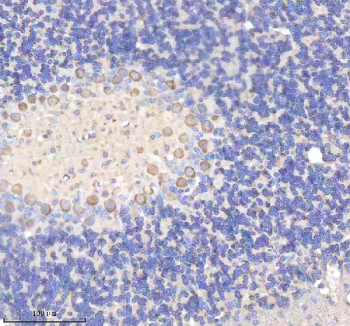
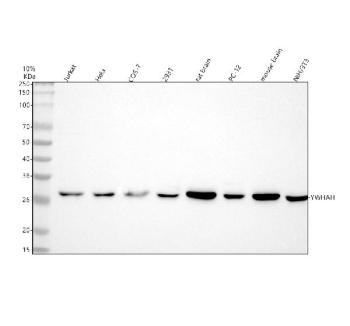
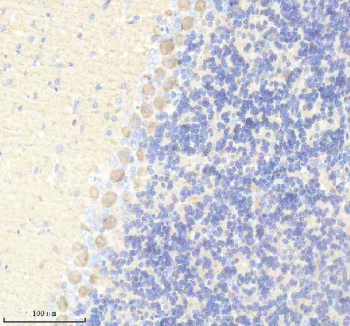
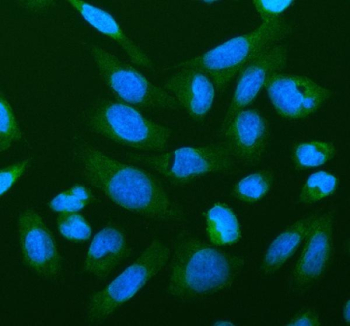
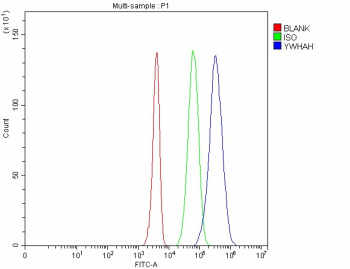
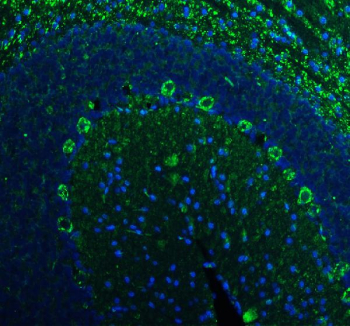
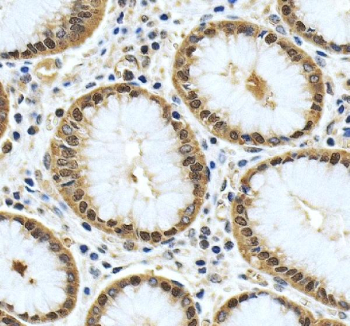
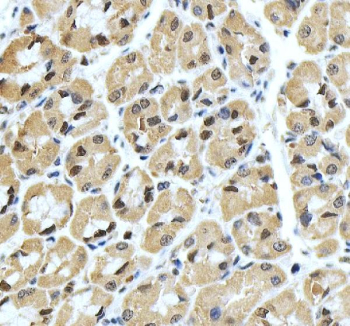
Adding 0.2 ml of distilled water will yield a concentration of 500 ug/ml. YWHAH antibody detects 14-3-3 protein eta, encoded by the YWHAH gene on chromosome 22q12.3. YWHAH antibody is widely applied in studies of signaling, apoptosis, and neurological disorders. YWHAH belongs to the 14-3-3 family of conserved regulatory proteins that bind phosphoserine-containing motifs on target proteins. Through these interactions, YWHAH regulates a wide range of cellular processes including cell cycle progression, apoptosis, signal transduction, and cytoskeletal organization.Structurally, YWHAH is a ~28 kDa acidic protein that forms homo- or heterodimers with other 14-3-3 family members. Its structure consists of nine alpha-helices that create an amphipathic groove, enabling binding of phosphorylated motifs. These interactions influence localization, stability, and activity of client proteins. YWHAH is ubiquitously expressed, but highest in brain, reflecting its importance in neuronal signaling.Functionally, YWHAH participates in multiple signaling cascades, including MAPK, PI3K-Akt, and apoptotic pathways. By binding pro-apoptotic proteins like BAD, YWHAH sequesters them in the cytoplasm to promote cell survival. It also modulates cytoskeletal dynamics by interacting with actin- and microtubule-regulatory proteins. YWHAH is involved in dopamine signaling by regulating proteins downstream of dopamine receptors. Researchers use YWHAH antibody to study signal transduction, apoptosis, and neurodegeneration.Clinically, YWHAH is linked to neurological and psychiatric disorders. Genetic variants have been associated with schizophrenia, bipolar disorder, and Parkinson's disease. Its dysregulation is observed in neurodegenerative diseases such as Alzheimer's, where altered phosphorylation-dependent binding disrupts signaling. YWHAH is also studied in cancer, where its interactions influence cell proliferation and resistance to apoptosis. NSJ Bioreagents supplies YWHAH antibody to support signaling, neuroscience, and oncology research.Experimentally, YWHAH antibody is used in western blotting to detect the ~28 kDa protein, in immunohistochemistry to analyze brain expression, and in immunofluorescence microscopy to visualize cytoplasmic localization. Co-immunoprecipitation with YWHAH antibody identifies client proteins across multiple pathways.
| Keywords: | Anti-YWHAH, Anti-Protein AS1, Anti-14-3-3 protein eta, YWHAH Antibody / 14-3-3 eta |
| Supplier: | NSJ Bioreagents |
| Supplier-Nr: | FY12226 |
Properties
| Application: | WB, IHC, ICC, IF, FC |
| Antibody Type: | Polyclonal |
| Conjugate: | No |
| Host: | Rabbit |
| Species reactivity: | human, monkey, mouse, rat |
| Immunogen: | A synthetic peptide corresponding to a sequence at the C-terminus of human YWHAH |
| Format: | Purified |
Database Information
| KEGG ID : | K16198 | Matching products |
| UniProt ID : | Q04917 | Matching products |
| Gene ID : | GeneID 7533 | Matching products |
Handling & Safety
| Storage: | +4°C |
| Shipping: | +4°C (International: +4°C) |
Caution
Our products are for laboratory research use only: Not for administration to humans!
Our products are for laboratory research use only: Not for administration to humans!
Information about the product reference will follow.
more
You will get a certificate here
Viewed