
Cookie preferences
This website uses cookies, which are necessary for the technical operation of the website and are always set. Other cookies, which increase the comfort when using this website, are used for direct advertising or to facilitate interaction with other websites and social networks, are only set with your consent.
Configuration
Technically required
These cookies are necessary for the basic functions of the shop.
"Allow all cookies" cookie
"Decline all cookies" cookie
CSRF token
Cookie preferences
Currency change
Customer-specific caching
FACT-Finder tracking
Individual prices
Selected shop
Session
Comfort functions
These cookies are used to make the shopping experience even more appealing, for example for the recognition of the visitor.
Note
Show the facebook fanpage in the right blod sidebar
Statistics & Tracking
Affiliate program
Conversion and usertracking via Google Tag Manager
Track device being used

| Item number | Size | Datasheet | Manual | SDS | Delivery time | Quantity | Price |
|---|---|---|---|---|---|---|---|
| ABS-KC-41709.50 | 50 µl | - | - |
10 - 15 business days* |
232.00€
|
||
| ABS-KC-41709.100 | 100 µl | - | - |
10 - 15 business days* |
332.00€
|
If you have any questions, please use our Contact Form.
You can also order by e-mail: info@biomol.com
Larger quantity required? Request bulk
You can also order by e-mail: info@biomol.com
Larger quantity required? Request bulk
Formulation: Phosphate-buffered saline (PBS) with 50% glycerol, 0.5% BSA and 0.09% sodium azide.... more
Product information "Anti-USP20"
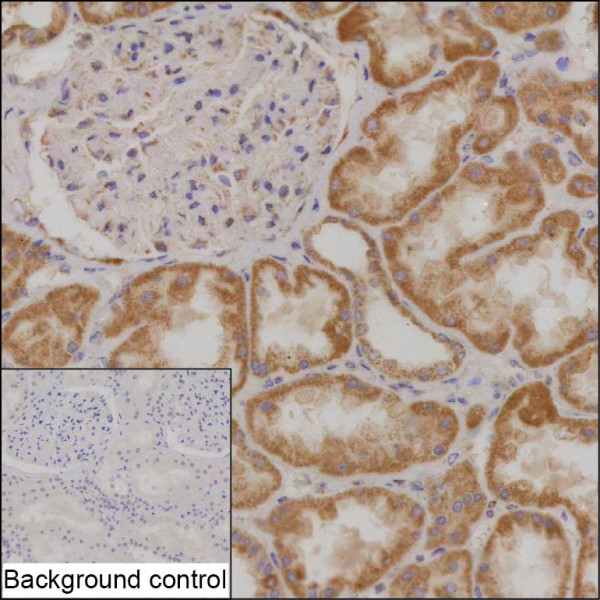
Formulation: Phosphate-buffered saline (PBS) with 50% glycerol, 0.5% BSA and 0.09% sodium azide. Identity-Mouse (%): 91%. Homologies: Highest antigen sequence identity to the following orthologs: Mouse - 91%, Rat - 36%, Pig - 94%, Cynomolgus monkey - 97%. IHC Verification: succeed. WB Verification: Fail (Raji). IP Verification: -. IF Verification: -. FC Verification: -. IP-MS Verification: -. Cross reactivity: Not tested. Sandwich ELISA Verification: -. Antigen ID: ABS-PP-7431. Core Sequence: AKRRRIEIDT FIKLNKAFQA EESPGVIYCI SMQWFREWEA FVKGKDNEPP GPIDNSRIAQ VKGSGHVQLK QGADYGQISE ETWTYLNSLY GGGPEIAIRQ SVAQPLGPEN. Recombinant Antibody: Protein Function: Deubiquitinating enzyme that plays a role in many cellular processes including autophagy, cellular antiviral response or membrane protein biogenesis (PubMed:27801882, PubMed:29487085). Attenuates TLR4-mediated NF-kappa-B signaling by cooperating with beta-arrestin-2/ARRB2 and inhibiting TRAF6 autoubiquitination (PubMed:26839314). Promotes cellular antiviral responses by deconjugating 'Lys-33' and 'Lys-48'-linked ubiquitination of STING1 leading to its stabilization (PubMed:27801882). Plays an essential role in autophagy induction by regulating the ULK1 stability through deubiquitination of ULK1 (PubMed:29487085). Acts as a positive regulator for NF-kappa-B activation by TNF-alpha through deubiquitinating 'Lys-48'-linked polyubiquitination of SQSTM1, leading to its increased stability (PubMed:32354117). Acts as a regulator of G-protein coupled receptor (GPCR) signaling by mediating the deubiquitination beta-2 adrenergic receptor (ADRB2) (PubMed:19424180). Plays a central role in ADRB2 recycling and resensitization after prolonged agonist stimulation by constitutively binding ADRB2, mediating deubiquitination of ADRB2 and inhibiting lysosomal trafficking of ADRB2. Upon dissociation, it is probably transferred to the translocated beta-arrestins, possibly leading to beta-arrestins deubiquitination and disengagement from ADRB2 (PubMed:19424180). This suggests the existence of a dynamic exchange between the ADRB2 and beta-arrestins. Deubiquitinates DIO2, thereby regulating thyroid hormone regulation. Deubiquitinates HIF1A, leading to stabilize HIF1A and enhance HIF1A-mediated activity (PubMed:15776016). Deubiquitinates MCL1, a pivotal member of the anti-apoptotic Bcl-2 protein family to regulate its stability (PubMed:35063767). Within the endoplasmic reticulum, participates with USP33 in the rescue of post-translationally targeted membrane proteins that are inappropriately ubiquitinated by the cytosolic protein quality control in the cytosol (PubMed:33792613) [The Uniprot Consortium]
| Keywords: | Anti-USP20, Anti-Ubiquitin thioesterase 20, Anti-Deubiquitinating enzyme 20, Anti-Ubiquitin carboxyl-terminal hydrolase 20, Anti-Ubiquitin-specific-processing protease 20, Anti-VHL-interacting deubiquitinating enzyme 2, USP20 Antibody |
| Supplier: | Absea |
| Supplier-Nr: | KC-41709 |
Properties
| Application: | IHC |
| Antibody Type: | Monoclonal |
| Clone: | KCA020_8F9 |
| Conjugate: | No |
| Host: | Mouse |
| Species reactivity: | human |
| Immunogen: | Recombinant human USP20 |
| Purity: | >85% |
| Format: | Solution |
Database Information
| KEGG ID : | K11848 | Matching products |
| UniProt ID : | Q9Y2K6 | Matching products |
| Gene ID : | GeneID 10868 | Matching products |
Handling & Safety
| Storage: | +4°C (-20 °C for long term storage) |
| Shipping: | +4°C (International: +4°C) |
Caution
Our products are for laboratory research use only: Not for administration to humans!
Our products are for laboratory research use only: Not for administration to humans!
You will get a certificate here
Viewed