
Cookie preferences
This website uses cookies, which are necessary for the technical operation of the website and are always set. Other cookies, which increase the comfort when using this website, are used for direct advertising or to facilitate interaction with other websites and social networks, are only set with your consent.
Configuration
Technically required
These cookies are necessary for the basic functions of the shop.
"Allow all cookies" cookie
"Decline all cookies" cookie
CSRF token
Cookie preferences
Currency change
Customer-specific caching
FACT-Finder tracking
Individual prices
Selected shop
Session
Comfort functions
These cookies are used to make the shopping experience even more appealing, for example for the recognition of the visitor.
Note
Show the facebook fanpage in the right blod sidebar
Statistics & Tracking
Affiliate program
Conversion and usertracking via Google Tag Manager
Track device being used


| Item number | Size | Datasheet | Manual | SDS | Delivery time | Quantity | Price |
|---|---|---|---|---|---|---|---|
| NSJ-FY13415 | 100 µl | - | - |
3 - 10 business days* |
790.00€
|
If you have any questions, please use our Contact Form.
You can also order by e-mail: info@biomol.com
Larger quantity required? Request bulk
You can also order by e-mail: info@biomol.com
Larger quantity required? Request bulk
Rabbit IgG in phosphate buffered saline, pH 7.4, 150mM NaCl, 0.02% sodium azide and 50% glycerol,... more
Product information "Anti-USP14 / Ubiquitin carboxyl-terminal hydrolase 14, clone ABGI-21"
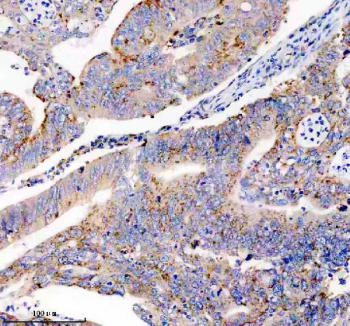
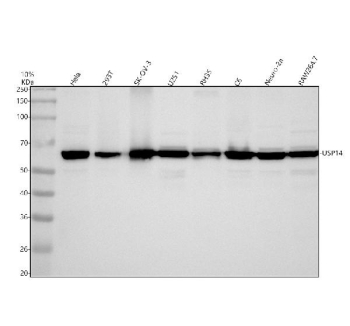
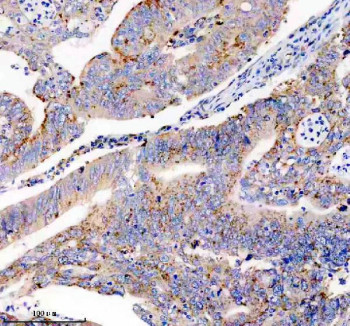
Rabbit IgG in phosphate buffered saline, pH 7.4, 150mM NaCl, 0.02% sodium azide and 50% glycerol, 0.4-0.5mg/ml BSA. USP14 antibody targets Ubiquitin carboxyl-terminal hydrolase 14 (USP14), a deubiquitinating enzyme that regulates protein turnover by removing ubiquitin chains from substrates prior to proteasomal degradation. USP14 localizes predominantly to the cytoplasm and is tightly associated with the 26S proteasome, where it modulates proteasome activity and substrate processing. As a member of the ubiquitin-specific protease family, USP14 plays a critical role in maintaining protein homeostasis by fine-tuning ubiquitin-dependent degradation pathways. Its proteasome-associated function positions USP14 as an important checkpoint in cellular protein quality control.Functionally, USP14 acts as a regulator of proteasomal degradation by trimming ubiquitin chains from proteins as they engage the proteasome. This activity can delay or alter substrate degradation, allowing cells to control the timing and extent of protein turnover. Through this mechanism, USP14 influences diverse cellular processes including signal transduction, cell cycle regulation, and stress responses. Because ubiquitination governs the stability of many regulatory proteins, USP14 contributes to the dynamic balance between protein synthesis and degradation. A USP14 antibody supports studies examining ubiquitin signaling and proteasome-mediated proteolysis.USP14 expression is broadly observed across tissues, reflecting the universal requirement for regulated protein degradation in eukaryotic cells. Its activity is particularly relevant in cells with high proteasome demand, such as neurons and rapidly dividing cells. Analysis of USP14 localization and abundance provides insight into how cells adapt proteasomal function under conditions of proteotoxic stress or altered metabolic state. Changes in USP14 activity can influence the accumulation or clearance of ubiquitinated proteins, impacting overall cellular homeostasis.From a biological and disease-relevance perspective, USP14 has been studied extensively in neurobiology and cancer research. Dysregulation of proteasome-associated deubiquitination has been linked to neurodegenerative disorders characterized by protein aggregation, as well as to altered signaling pathways in cancer. USP14 activity can modulate the degradation of key regulatory proteins, making it an important factor in disease-associated changes in protein stability. Understanding USP14 regulation contributes to broader investigations of ubiquitin-proteasome system function in health and disease.At the molecular level, USP14 is encoded by the USP14 gene and produces a protein of approximately 56 kDa. The enzyme contains a conserved catalytic domain required for ubiquitin cleavage and regulatory regions that mediate interaction with the proteasome. USP14 activity is influenced by proteasome binding and cellular signaling context. A USP14 antibody supports research applications focused on ubiquitin biology, proteasome regulation, and protein degradation pathways, with NSJ Bioreagents providing reagents intended for research use.
| Keywords: | Anti-USP14, Anti-Ubiquitin thioesterase 14, Anti-Deubiquitinating enzyme 14, Anti-Ubiquitin carboxyl-terminal hydrolase 14, Anti-Ubiquitin-specific-processing protease 14, USP14 Antibody / Ubiquitin carboxyl-terminal hydrolase 14 |
| Supplier: | NSJ Bioreagents |
| Supplier-Nr: | FY13415 |
Properties
| Application: | WB, IHC |
| Antibody Type: | Monoclonal |
| Clone: | ABGI-21 |
| Conjugate: | No |
| Host: | Rabbit |
| Species reactivity: | human, mouse, rat |
| Immunogen: | Synthesized peptide derived from human Ubiquitin carboxyl-terminal hydrolase 14 protein |
| Format: | Affinity Purified |
Database Information
| KEGG ID : | K11843 | Matching products |
| UniProt ID : | P54578 | Matching products |
| Gene ID : | GeneID 9097 | Matching products |
Handling & Safety
| Storage: | -20°C |
| Shipping: | -20°C (International: -20°C) |
Caution
Our products are for laboratory research use only: Not for administration to humans!
Our products are for laboratory research use only: Not for administration to humans!
Information about the product reference will follow.
more
You will get a certificate here
Viewed