
Cookie preferences
This website uses cookies, which are necessary for the technical operation of the website and are always set. Other cookies, which increase the comfort when using this website, are used for direct advertising or to facilitate interaction with other websites and social networks, are only set with your consent.
Configuration
Technically required
These cookies are necessary for the basic functions of the shop.
"Allow all cookies" cookie
"Decline all cookies" cookie
CSRF token
Cookie preferences
Currency change
Customer-specific caching
FACT-Finder tracking
Individual prices
Selected shop
Session
Comfort functions
These cookies are used to make the shopping experience even more appealing, for example for the recognition of the visitor.
Note
Show the facebook fanpage in the right blod sidebar
Statistics & Tracking
Affiliate program
Conversion and usertracking via Google Tag Manager
Track device being used


| Item number | Size | Datasheet | Manual | SDS | Delivery time | Quantity | Price |
|---|---|---|---|---|---|---|---|
| NSJ-FY13331 | 100 µl | - | - |
3 - 10 business days* |
790.00€
|
If you have any questions, please use our Contact Form.
You can also order by e-mail: info@biomol.com
Larger quantity required? Request bulk
You can also order by e-mail: info@biomol.com
Larger quantity required? Request bulk
Rabbit IgG in phosphate buffered saline, pH 7.4, 150mM NaCl, 0.02% sodium azide and 50% glycerol,... more
Product information "Anti-UBTF / UBF1 / Upstream binding factor 1, clone 32U20"
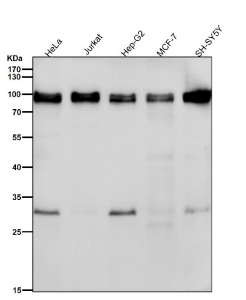
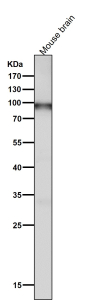
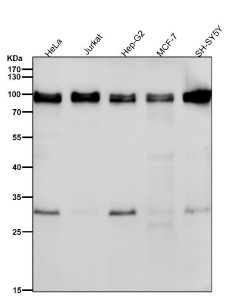
Rabbit IgG in phosphate buffered saline, pH 7.4, 150mM NaCl, 0.02% sodium azide and 50% glycerol, 0.4-0.5mg/ml BSA. UBTF antibody detects Upstream binding factor 1, encoded by the UBTF gene. Upstream binding factor 1 is a nucleolar transcription factor essential for ribosomal RNA synthesis and ribosome biogenesis. UBTF antibody provides researchers with a highly specific reagent for investigating transcriptional regulation, nucleolar organization, and diseases associated with altered ribosome production.Upstream binding factor 1 binds ribosomal DNA promoter sequences and induces conformational changes that promote recruitment of RNA polymerase I and associated factors. Research using UBTF antibody has shown that the protein cooperates with selectivity factor 1 and other nucleolar proteins to form the transcription initiation complex. By bending ribosomal DNA and stabilizing transcription machinery, Upstream binding factor 1 ensures efficient expression of ribosomal RNA, a prerequisite for ribosome assembly and cellular protein synthesis.Studies with UBTF antibody have demonstrated that the protein is subject to regulation by post-translational modifications. Phosphorylation by kinases such as ERK and mTOR influences DNA binding activity and transcriptional output. This regulation allows cells to couple ribosome biogenesis with growth signals, ensuring that protein production capacity matches proliferative demands. Such control is critical during development, stress adaptation, and oncogenic transformation.In addition to transcriptional regulation, Upstream binding factor 1 contributes to nucleolar structure. Research using UBTF antibody has revealed that UBTF localizes to transcriptionally active nucleolar regions, forming foci that align with ribosomal DNA arrays. Loss of UBTF disrupts nucleolar organization, reduces ribosomal RNA transcription, and impairs ribosome assembly. These structural roles highlight UBTF as both a functional transcription factor and a nucleolar architectural protein.Dysregulation of UBTF has been implicated in cancer and neurodegenerative disease. Studies with UBTF antibody have shown that elevated UBTF activity supports increased ribosome biogenesis in tumors, fueling uncontrolled cell proliferation. Overexpression correlates with poor prognosis in certain cancers, making UBTF a potential diagnostic marker and therapeutic target. Conversely, mutations in UBTF have been associated with pediatric neurodevelopmental syndromes and neurodegeneration, linking impaired ribosome production to neuronal dysfunction. These findings underscore the dual importance of UBTF in health and disease.Upstream binding factor 1 also interacts with chromatin remodeling factors. Research using UBTF antibody has demonstrated that UBTF recruits or cooperates with histone modifiers to establish transcriptionally competent rDNA chromatin. Through these interactions, UBTF integrates epigenetic cues with transcriptional output, providing a mechanism for long-term regulation of ribosome synthesis in response to environmental signals.UBTF antibody is widely applied in chromatin immunoprecipitation, immunofluorescence, and western blotting. Chromatin immunoprecipitation identifies UBTF binding across ribosomal DNA repeats, immunofluorescence demonstrates nucleolar localization, and western blotting confirms expression levels and post-translational modifications. These experimental applications make UBTF antibody indispensable for studying transcriptional control of ribosome biogenesis.By supplying validated UBTF antibody reagents, NSJ Bioreagents supports studies into nucleolar function, transcription regulation, and pathology. Detection of Upstream binding factor 1 provides researchers with precise insight into ribosomal RNA transcription and its role in cellular growth and disease.
| Keywords: | Anti-UBTF, Anti-Autoantigen NOR-90, Anti-Upstream-binding factor 1, Anti-Nucleolar transcription factor 1, UBTF Antibody / UBF1 / Upstream binding factor 1 |
| Supplier: | NSJ Bioreagents |
| Supplier-Nr: | FY13331 |
Properties
| Application: | WB, IHC |
| Antibody Type: | Monoclonal |
| Clone: | 32U20 |
| Conjugate: | No |
| Host: | Rabbit |
| Species reactivity: | human, mouse, rat |
| Immunogen: | A synthesized peptide derived from human UBF1 |
| Format: | Affinity Purified |
Database Information
| KEGG ID : | K09273 | Matching products |
| UniProt ID : | P17480 | Matching products |
| Gene ID : | GeneID 7343 | Matching products |
Handling & Safety
| Storage: | -20°C |
| Shipping: | -20°C (International: -20°C) |
Caution
Our products are for laboratory research use only: Not for administration to humans!
Our products are for laboratory research use only: Not for administration to humans!
Information about the product reference will follow.
more
You will get a certificate here
Viewed