
Cookie preferences
This website uses cookies, which are necessary for the technical operation of the website and are always set. Other cookies, which increase the comfort when using this website, are used for direct advertising or to facilitate interaction with other websites and social networks, are only set with your consent.
Configuration
Technically required
These cookies are necessary for the basic functions of the shop.
"Allow all cookies" cookie
"Decline all cookies" cookie
CSRF token
Cookie preferences
Currency change
Customer-specific caching
FACT-Finder tracking
Individual prices
Selected shop
Session
Comfort functions
These cookies are used to make the shopping experience even more appealing, for example for the recognition of the visitor.
Note
Show the facebook fanpage in the right blod sidebar
Statistics & Tracking
Affiliate program
Conversion and usertracking via Google Tag Manager
Track device being used

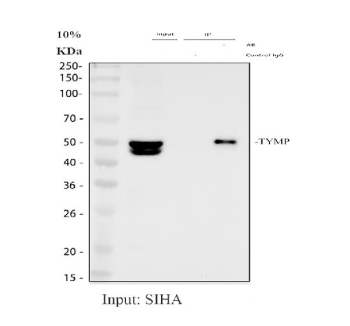
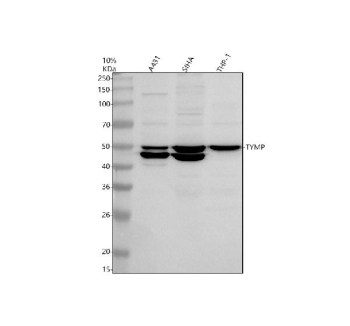
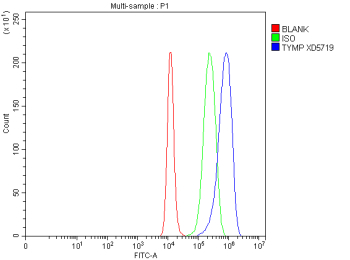
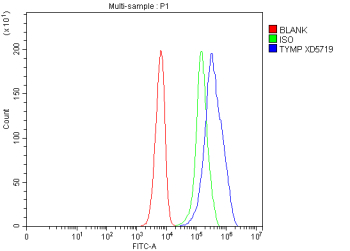


| Item number | Size | Datasheet | Manual | SDS | Delivery time | Quantity | Price |
|---|---|---|---|---|---|---|---|
| NSJ-FY13337 | 100 µg | - | - |
3 - 10 business days* |
790.00€
|
If you have any questions, please use our Contact Form.
You can also order by e-mail: info@biomol.com
Larger quantity required? Request bulk
You can also order by e-mail: info@biomol.com
Larger quantity required? Request bulk
Adding 0.2 ml of distilled water will yield a concentration of 500 ug/ml. TYMP antibody detects... more
Product information "Anti-TYMP / Thymidine phosphorylase / PD-ECGF"
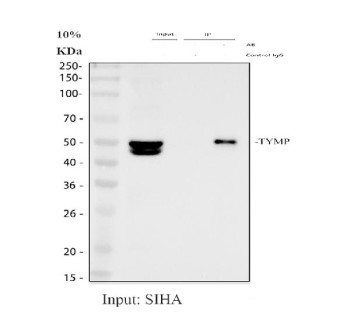
Adding 0.2 ml of distilled water will yield a concentration of 500 ug/ml. TYMP antibody detects Thymidine phosphorylase, also known as Platelet-derived endothelial cell growth factor (PD-ECGF), an enzyme encoded by the TYMP gene located on chromosome 22q13.33. TYMP is a cytoplasmic enzyme that catalyzes the reversible phosphorolysis of thymidine to thymine and 2-deoxy-D-ribose-1-phosphate, functioning in nucleotide metabolism and angiogenic signaling. It is widely expressed in endothelial cells, macrophages, and platelets, with particularly high levels observed in tumor vasculature and regenerative tissues. TYMP plays a dual role as a metabolic enzyme and a pro-angiogenic factor, linking DNA salvage pathways with vascular growth regulation.As a key enzyme in pyrimidine salvage metabolism, TYMP maintains nucleotide pool balance for DNA synthesis and repair. Beyond its catalytic role, extracellular TYMP functions as PD-ECGF, promoting endothelial cell migration, angiogenesis, and wound healing. TYMP activity increases during hypoxia and tissue regeneration, facilitating the formation of new capillaries in response to injury or ischemia. Co-localization studies show TYMP associating with endothelial integrins and extracellular matrix components in angiogenic tissues.Structurally, TYMP forms a homodimer with each subunit containing a thymidine-binding pocket and phosphate-binding residues essential for catalysis. It belongs to the thymidine phosphorylase family of pyrimidine salvage enzymes. The enzyme's catalytic activity also generates deoxyribose sugars that act as angiogenic mediators, linking metabolism to vascular signaling. TYMP interacts with molecules such as integrin alphavbeta3 and extracellular matrix proteins to enhance endothelial cell adhesion and migration.Functionally, TYMP contributes to multiple biological processes, including angiogenesis, platelet activation, and oxidative stress response. Its expression is regulated by hypoxia-inducible factor 1-alpha (HIF-1alpha), cytokines, and growth factors such as VEGF and TNF-alpha. In cancer, TYMP expression is upregulated in tumor-associated macrophages and endothelial cells, promoting neovascularization and tumor progression. However, TYMP also exhibits cytotoxic effects in thymidine phosphorylase-deficient conditions by accumulating toxic thymidine metabolites, as seen in mitochondrial neurogastrointestinal encephalopathy (MNGIE).Dysregulation of TYMP is clinically significant. Loss-of-function mutations cause MNGIE, a rare mitochondrial disorder characterized by gastrointestinal dysmotility, neuropathy, and leukoencephalopathy. Overexpression of TYMP is associated with poor prognosis in several cancers, including colorectal, breast, and gastric carcinoma, where it drives angiogenesis and tumor growth. Pathway involvement includes pyrimidine salvage metabolism, hypoxia response, and VEGF-mediated angiogenic signaling. In regenerative medicine, TYMP serves as a biomarker and target for promoting vascular repair and wound healing.Immunohistochemical staining using TYMP antibody shows cytoplasmic and extracellular localization in endothelial and stromal cells. The TYMP antibody from NSJ Bioreagents is an excellent reagent for studies on nucleotide metabolism, angiogenesis, and tumor biology.
| Keywords: | Anti-TYMP, Anti-TdRPase, Anti-Gliostatin, Anti-Thymidine phosphorylase, Anti-Platelet-derived endothelial cell growth factor, TYMP Antibody / Thymidine phosphorylase / PD-ECGF |
| Supplier: | NSJ Bioreagents |
| Supplier-Nr: | FY13337 |
Properties
| Application: | WB, IP, FC, ELISA |
| Antibody Type: | Polyclonal |
| Conjugate: | No |
| Host: | Rabbit |
| Species reactivity: | human |
| Immunogen: | E.coli-derived human PD-ECGF/TYMP recombinant protein (Position: P13-Q482) |
| Format: | Purified |
Database Information
| KEGG ID : | K00758 | Matching products |
| UniProt ID : | P19971 | Matching products |
| Gene ID : | GeneID 1890 | Matching products |
Handling & Safety
| Storage: | +4°C |
| Shipping: | +4°C (International: +4°C) |
Caution
Our products are for laboratory research use only: Not for administration to humans!
Our products are for laboratory research use only: Not for administration to humans!
Information about the product reference will follow.
more
You will get a certificate here
Viewed