
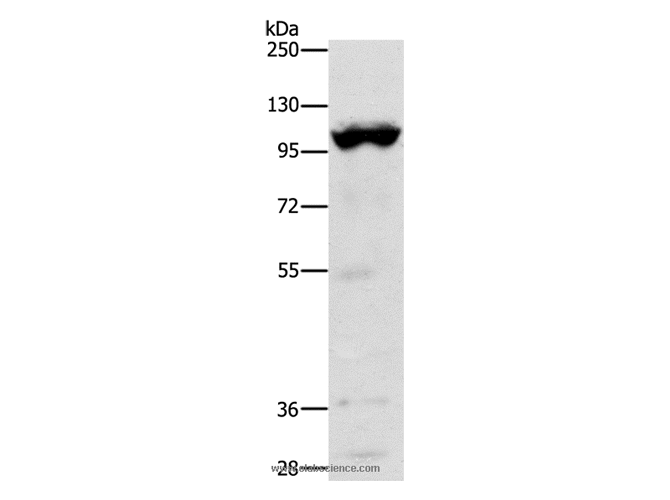
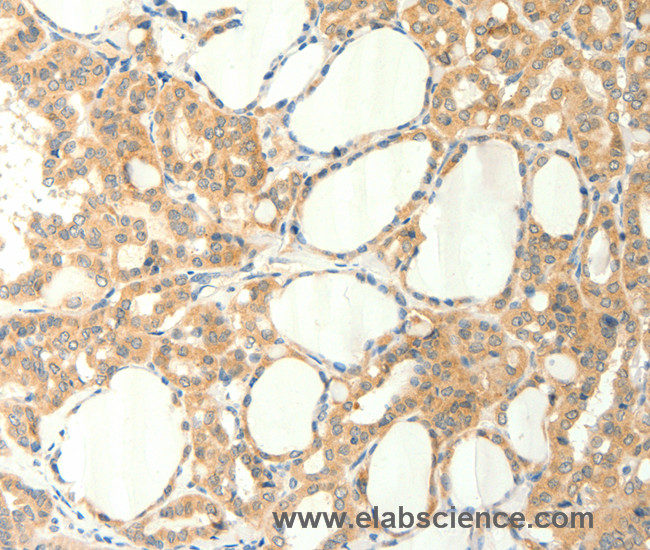
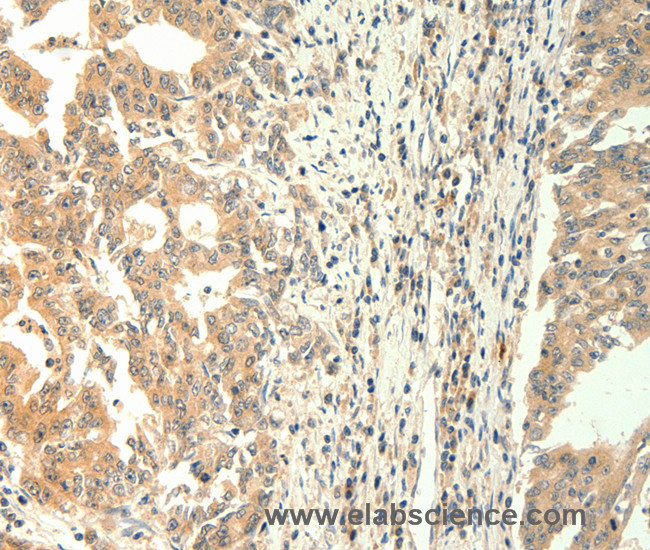
Anti-TRPM5

Item number Size Datasheet Manual SDS Delivery time Quantity Price
E-AB-12915.20 20 µl -

7 - 16 business days*

89.00€
E-AB-12915.60 60 µl -

7 - 16 business days*

174.00€
E-AB-12915.120 120 µl -

7 - 16 business days*

292.00€
E-AB-12915.200 200 µl -

7 - 16 business days*

485.00€
 
This gene encodes a member of the transient receptor potential (TRP) protein family, which is a... more
Product information "Anti-TRPM5"
This gene encodes a member of the transient receptor potential (TRP) protein family, which is a diverse group of proteins with structural features typical of ion channels. This protein plays an important role in taste transduction, and has characteristics of a calcium-activated, non-selective cation channel that carries Na+, K+, and Cs+ ions equally well, but not Ca(2+) ions. It is activated by lower concentrations of intracellular Ca(2+), and inhibited by higher concentrations. It is also a highly temperature-sensitive, heat activated channel showing a steep increase of inward currents at temperatures between 15 and 35 degrees Celsius. This gene is located within the Beckwith-Wiedemann syndrome critical region-1 on chromosome 11p15.5, and has been shown to be imprinted, with exclusive expression from the paternal allele. Protein function: Voltage-modulated Ca(2+)-activated, monovalent cation channel (VCAM) that mediates a transient membrane depolarization and plays a central role in taste transduction. Monovalent- specific, non-selective cation channel that mediates the transport of Na(+), K(+) and Cs(+) ions equally well. Activated directly by increases in intracellular Ca(2+), but is impermeable to it. Gating is voltage-dependent and displays rapid activation and deactivation kinetics upon channel stimulation even during sustained elevations in Ca(2+). Also activated by a fast intracellular Ca(2+) increase in response to inositol 1,4,5- triphosphate-producing receptor agonists. The channel is blocked by extracellular acidification. External acidification has 2 effects, a fast reversible block of the current and a slower irreversible enhancement of current inactivation. Is a highly temperature-sensitive, heat activated channel showing a steep increase of inward currents at temperatures between 15 and 35 degrees Celsius. Heat activation is due to a shift of the voltage- dependent activation curve to negative potentials. Activated by arachidonic acid in vitro. May be involved in perception of bitter, sweet and umami tastes. May also be involved in sensing semiochemicals. [The UniProt Consortium]
Keywords: Anti-LTrpC5, Anti-LTrpC-5, Anti-MLSN1- and TRP-related gene 1 protein, Anti-Long transient receptor potential channel 5, Anti-Transient receptor potential cation channel subfamily M member 5, TRPM5 Polyclonal Antibody
Supplier: Elabscience
Supplier-Nr: E-AB-12915

Properties

Application: WB, IHC, ELISA
Antibody Type: Polyclonal
Conjugate: No
Host: Rabbit
Species reactivity: human, mouse
Immunogen: Synthetic peptide of human TRPM5
Format: Purified

Handling & Safety

Storage: -20°C
Shipping: 4°C (International: -20°C)
Caution
Our products are for laboratory research use only: Not for administration to humans!
You will get a certificate here
or to request a certificate of analysis.
Read, write and discuss reviews... more
Customer review for "Anti-TRPM5"
Write a review
or to review a product.
Viewed