
Cookie preferences
This website uses cookies, which are necessary for the technical operation of the website and are always set. Other cookies, which increase the comfort when using this website, are used for direct advertising or to facilitate interaction with other websites and social networks, are only set with your consent.
Configuration
Technically required
These cookies are necessary for the basic functions of the shop.
"Allow all cookies" cookie
"Decline all cookies" cookie
CSRF token
Cookie preferences
Currency change
Customer-specific caching
FACT-Finder tracking
Individual prices
Selected shop
Session
Comfort functions
These cookies are used to make the shopping experience even more appealing, for example for the recognition of the visitor.
Note
Show the facebook fanpage in the right blod sidebar
Statistics & Tracking
Affiliate program
Conversion and usertracking via Google Tag Manager
Track device being used


| Item number | Size | Datasheet | Manual | SDS | Delivery time | Quantity | Price |
|---|---|---|---|---|---|---|---|
| NSJ-V6122-20UG | 20 µg | - | - |
3 - 10 business days* |
684.00€
|
||
| NSJ-V6122-100UG | 100 µg | - | - |
3 - 10 business days* |
1,265.00€
|
If you have any questions, please use our Contact Form.
You can also order by e-mail: info@biomol.com
Larger quantity required? Request bulk
You can also order by e-mail: info@biomol.com
Larger quantity required? Request bulk
Antibody in 1X PBS with 0.05% BSA, 0.05% sodium azide. Transducin-Like Enhancer Protein 1 (TLE1)... more
Product information "Anti-TLE1 / Transducin like enhancer of split 1, clone MSVA-856R"
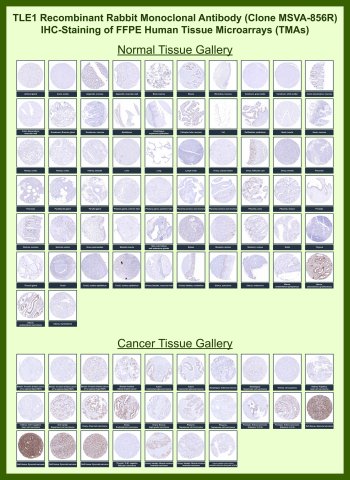
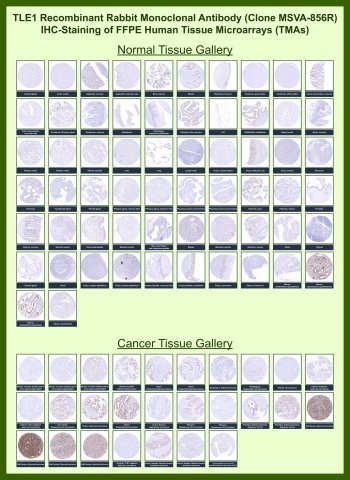
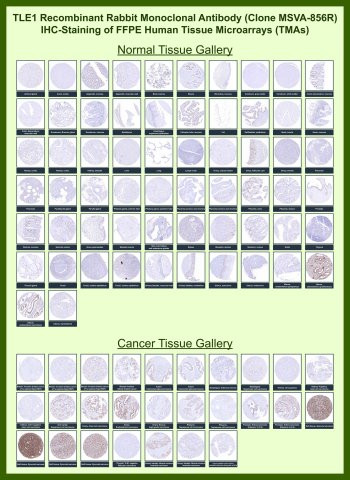
Antibody in 1X PBS with 0.05% BSA, 0.05% sodium azide. Transducin-Like Enhancer Protein 1 (TLE1) is a nuclear transcriptional corepressor encoded by the human TLE1 gene and belongs to the Groucho/TLE family of transcriptional regulators that modulate developmental and differentiation pathways. TLE1 Antibody for IHC / Transducin-Like Enhancer Protein 1 IHC Antibody (clone MSVA-856R) is optimized for immunohistochemistry detection of nuclear TLE1 expression in formalin-fixed paraffin-embedded tissue sections. In surgical pathology, TLE1 immunohistochemistry is widely used as a diagnostic marker because strong nuclear staining is commonly observed in synovial sarcoma and certain other soft tissue tumors.TLE1 antibody, also referred to as Transducin-like enhancer protein 1 antibody or Groucho-related TLE1 antibody in the literature, recognizes a transcriptional corepressor that functions by interacting with multiple DNA-binding transcription factors and chromatin regulatory complexes. Unlike classical transcription factors, TLE1 does not bind DNA directly but instead acts as a scaffold protein that recruits histone deacetylases and other chromatin remodeling proteins to suppress transcriptional activity. Through these interactions, TLE1 participates in several signaling pathways including Notch signaling, Wnt signaling, and other developmental regulatory networks that control cellular differentiation and tissue development.Within the nucleus, TLE1 contains a conserved N-terminal Q-rich oligomerization domain and a C-terminal WD repeat domain that mediates interactions with transcription factors and regulatory protein complexes. These structural elements allow TLE1 to form transcriptional repression complexes that regulate gene expression programs involved in embryogenesis, lineage specification, and cellular proliferation. As a result, TLE1 expression patterns can reflect the transcriptional state of specific cell populations and tumor types.In diagnostic immunohistochemistry, TLE1 staining is particularly valuable in the evaluation of synovial sarcoma, where strong and diffuse nuclear staining is frequently observed in tumor cells. TLE1 immunohistochemistry is therefore commonly incorporated into antibody panels used to evaluate spindle cell and soft tissue tumors. When interpreted alongside additional markers and morphologic features, TLE1 staining can assist pathologists in distinguishing synovial sarcoma from other spindle cell neoplasms and soft tissue malignancies.Tissue microarray analysis has become an important tool for evaluating the specificity and distribution of immunohistochemical markers across large numbers of tissues. Human tissue microarray (TMA) studies containing multiple normal tissues and tumor types allow systematic assessment of TLE1 immunohistochemistry staining patterns under standardized experimental conditions. These TMA datasets often demonstrate strong nuclear staining in synovial sarcoma while showing more limited expression in most normal tissues, supporting the diagnostic utility of TLE1 as a tumor-associated immunohistochemical marker.A recombinant rabbit monoclonal clone MSVA-856R antibody targets Transducin-Like Enhancer Protein 1 and enables sensitive nuclear detection of TLE1 protein in immunohistochemistry applications. This antibody is useful for studying transcriptional regulatory pathways and for evaluating TLE1 expression patterns in tumor tissue sections and tissue microarray (TMA) panels used in biomarker research and pathology investigations.This antibody is also part of a broader collection of IHC antibodies validated by tissue microarray analysis, supporting consistent staining across normal and cancer tissues.
| Keywords: | Anti-TLE1, Anti-E(Sp1) homolog, Anti-Transducin-like enhancer protein 1, Anti-Enhancer of split groucho-like protein 1, TLE1 Antibody / Transducin like enhancer of split 1 |
| Supplier: | NSJ Bioreagents |
| Supplier-Nr: | V6122 |
Properties
| Application: | IHC |
| Antibody Type: | Monoclonal |
| Clone: | MSVA-856R |
| Conjugate: | No |
| Host: | Rabbit |
| Species reactivity: | human |
| Immunogen: | Recombinant human TLE1 fragment (around amino acids 175-338) (exact sequence is proprietary) |
| Format: | Purified |
Database Information
| KEGG ID : | K04497 | Matching products |
| UniProt ID : | Q04724 | Matching products |
| Gene ID : | GeneID 7088 | Matching products |
Handling & Safety
| Storage: | -20°C |
| Shipping: | -20°C (International: -20°C) |
Caution
Our products are for laboratory research use only: Not for administration to humans!
Our products are for laboratory research use only: Not for administration to humans!
Information about the product reference will follow.
more
You will get a certificate here
Viewed