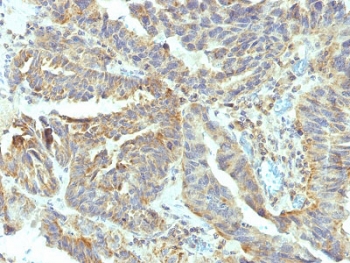
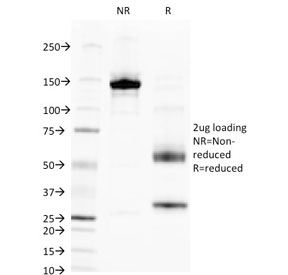
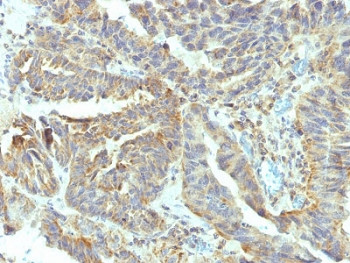
Anti-Tissue-nonspecific Alkaline Phosphatase / ALPL, clone V17.1

Item number Size Datasheet Manual SDS Delivery time Quantity Price
NSJ-V7411SAF-100UG 100 µg - -

3 - 10 business days*

810.00€
 
1 mg/ml in 1X PBS, BSA free, sodium azide free. There are at least four distinct but related... more
Product information "Anti-Tissue-nonspecific Alkaline Phosphatase / ALPL, clone V17.1"
1 mg/ml in 1X PBS, BSA free, sodium azide free. There are at least four distinct but related alkaline phosphatases: intestinal, placental, placental-like, and liver/bone/kidney (tissue non-specific). The first three are located together on chromosome 2, while the tissue non-specific form is located on chromosome 1. The product of this gene is a membrane bound glycosylated enzyme that is not expressed in any particular tissue and is, therefore, referred to as the tissue-nonspecific form of the enzyme. The exact physiological function of the alkaline phosphatases is not known. A proposed function of this form of the enzyme is matrix mineralization, however, mice that lack a functional form of this enzyme show normal skeletal development. This enzyme has been linked directly to hypo-phosphatasia, a disorder that is characterized by hypercalcemia and includes skeletal defects. The character of this disorder can vary, however, depending on the specific mutation since this determines age of onset and severity of symptoms. Alternatively spliced transcript variants, which encode the same protein, have been identified for this gene. Protein function: Alkaline phosphatase that metabolizes various phosphate compounds and plays a key role in skeletal mineralization and adaptive thermogenesis (PubMed:12162492, PubMed:23688511, PubMed:25982064). Has broad substrate specificity and can hydrolyze a considerable variety of compounds: however, only a few substrates, such as diphosphate (inorganic pyrophosphate, PPi), pyridoxal 5'-phosphate (PLP) and N- phosphocreatine are natural substrates (PubMed:12162492, PubMed:2220817). Plays an essential role in skeletal and dental mineralization via its ability to hydrolyze extracellular diphosphate, a potent mineralization inhibitor, to phosphate: it thereby promotes hydroxyapatite crystal formation and increases inorganic phosphate concentration (PubMed:23688511, PubMed:25982064). Acts in a non- redundant manner with PHOSPHO1 in skeletal mineralization: while PHOSPHO1 mediates the initiation of hydroxyapatite crystallization in the matrix vesicles (MVs), ALPL/TNAP catalyzes the spread of hydroxyapatite crystallization in the extracellular matrix. Also promotes dephosphorylation of osteopontin (SSP1), an inhibitor of hydroxyapatite crystallization in its phosphorylated state, it is however unclear whether ALPL/TNAP mediates SSP1 dephosphorylation via a direct or indirect manner. Catalyzes dephosphorylation of PLP to pyridoxal (PL), the transportable form of vitamin B6, in order to provide a sufficient amount of PLP in the brain, an essential cofactor for enzymes catalyzing the synthesis of diverse neurotransmitters (PubMed:20049532, PubMed:2220817). Additionally, also able to mediate ATP degradation in a stepwise manner to adenosine, thereby regulating the availability of ligands for purinergic receptors. Also capable of dephosphorylating microbial products, such as lipopolysaccharides (LPS) as well as other phosphorylated small-molecules, such as poly-inosine:cytosine (poly I:C) (PubMed:28448526). Acts as a key regulator of adaptive thermogenesis as part of the futile creatine cycle: localizes to the mitochondria of thermogenic fat cells and acts by mediating hydrolysis of N-phosphocreatine to initiate a futile cycle of creatine dephosphorylation and phosphorylation. During the futile creatine cycle, creatine and N-phosphocreatine are in a futile cycle, which dissipates the high energy charge of N-phosphocreatine as heat without performing any mechanical or chemical work. [The UniProt Consortium]
Keywords: Anti-TNSALP, Anti-AP-TNAP, Anti-TNS-ALP, Anti-Phosphoamidase, Anti-Phosphocreatine phosphatase, Anti-Alkaline phosphatase liver/bone/kidney isozyme, Anti-Alkaline phosphatase, tissue-nonspecific isozyme, Tissue-nonspecific Alkaline Phosphatase Antibody /
Supplier: NSJ Bioreagents
Supplier-Nr: V7411SAF

Properties

Application: FC, IF, IHC
Antibody Type: Monoclonal
Clone: V17.1
Conjugate: No
Host: Mouse
Species reactivity: human
Immunogen: Alkaline Phosphatase
Format: Purified

Handling & Safety

Storage: +4°C
Shipping: +4°C (International: +4°C)
Caution
Our products are for laboratory research use only: Not for administration to humans!
You will get a certificate here
or to request a certificate of analysis.
Read, write and discuss reviews... more
Customer review for "Anti-Tissue-nonspecific Alkaline Phosphatase / ALPL, clone V17.1"
Write a review
or to review a product.
Viewed