
Cookie preferences
This website uses cookies, which are necessary for the technical operation of the website and are always set. Other cookies, which increase the comfort when using this website, are used for direct advertising or to facilitate interaction with other websites and social networks, are only set with your consent.
Configuration
Technically required
These cookies are necessary for the basic functions of the shop.
"Allow all cookies" cookie
"Decline all cookies" cookie
CSRF token
Cookie preferences
Currency change
Customer-specific caching
FACT-Finder tracking
Individual prices
Selected shop
Session
Comfort functions
These cookies are used to make the shopping experience even more appealing, for example for the recognition of the visitor.
Note
Show the facebook fanpage in the right blod sidebar
Statistics & Tracking
Affiliate program
Conversion and usertracking via Google Tag Manager
Track device being used

| Item number | Size | Datasheet | Manual | SDS | Delivery time | Quantity | Price |
|---|---|---|---|---|---|---|---|
| NSJ-R31909 | 100 µg | - | - |
7 - 12 business days* |
790.00€
|
If you have any questions, please use our Contact Form.
You can also order by e-mail: info@biomol.com
Larger quantity required? Request bulk
You can also order by e-mail: info@biomol.com
Larger quantity required? Request bulk
0.5mg/ml if reconstituted with 0.2ml sterile DI water. THBS1 is also known as Thrombospondin 1,... more
Product information "Anti-Thrombospondin / THBS1"
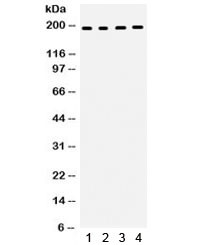
0.5mg/ml if reconstituted with 0.2ml sterile DI water. THBS1 is also known as Thrombospondin 1, TSP1. The protein encoded by this gene is a subunit of a disulfide-linked homotrimeric protein. It is an adhesive glycoprotein that mediates cell-to-cell and cell-to-matrix interactions. Also this protein can bind to fibrinogen, fibronectin, laminin, type V collagen and integrins alpha-V/beta-1. This protein has been shown to play roles in platelet aggregation, angiogenesis, and tumorigenesis. In addition, the thrombospondin-1 protein is a member of the thrombospondinfamily. It is a multi-domain matrix glycoprotein that has been shown to be a natural inhibitor of neovascularization and tumorigenesis in healthy tissue. Both positive and negative modulation of endothelial cell adhesion, motility, and growth have been attributed to TSP1. This should not be surprising considering that TSP1 interacts with at least 12 cell adhesion receptors, including CD36, ?v integrins, ?1 integrins, syndecan, and integrin-associated protein (IAP or CD47). It also interacts with numerous proteases involved in angiogenesis, including plasminogen, urokinase, matrix metalloproteinase, thrombin, cathepsin, and elastase. Protein function: Adhesive glycoprotein that mediates cell-to-cell and cell-to- matrix interactions (PubMed:15014436, PubMed:18285447, PubMed:2430973, PubMed:6489349). Multifunctional, involved in inflammation, angiogenesis, wound healing, reactive oxygen species (ROS) signaling, nitrous oxide (NO) signaling, apoptosis, senescence, aging, cellular self-renewal, stemness, and cardiovascular and metabolic homeostasis (PubMed:10613822, PubMed:11134179, PubMed:1371676, PubMed:14568985, PubMed:24511121, PubMed:29042481, PubMed:32679764). Negatively modulates dendritic cell activation and cytokine release, as part of an autocrine feedback loop, contributing to the resolution of inflammation and immune homeostasis (PubMed:14568985). Ligand for receptor CD47 (PubMed:19004835, PubMed:8550562). Modulates nitrous oxide (NO) signaling via CD47, hence playing a role as a pressor agent, supporting blood pressure. Plays a role in endothelial cell senescence, acting via CD47, by increasing the abundance and activation of NADPH oxidase NOX1, and so generating excess ROS (PubMed:29042481). Inhibits stem cell self-renewal, acting via CD47 signaling, probably by regulation of the stem cell transcription factors POU5F1/OCT4, SOX2, MYC/c-Myc and KLF4. Negatively modulates wound healing, acting via CD47. Ligand for receptor CD36 (PubMed:10613822, PubMed:11134179, PubMed:1371676). Involved in inducing apoptosis in podocytes in response to elevated free fatty acids, acting via CD36. Plays a role in suppressing angiogenesis, acting, depending on context, via CD36 or CD47 (PubMed:10613822, PubMed:11134179, PubMed:1371676, PubMed:32679764). Promotes cellular senescence in a TP53-CDKN1A-RB1 signaling-dependent manner (PubMed:29042481). Ligand for immunoglobulin-like cell surface receptor SIRPA (PubMed:24511121). Involved in ROS signaling in non- phagocytic cells, stimulating NADPH oxidase-derived ROS production, acting via interaction with SIRPA (PubMed:24511121). Plays a role in metabolic dysfunction in diet-induced obesity, perhaps acting by exacerbating adipose inflammatory activity, its effects may be mediated, at least in part, through enhanced adipocyte proliferation. Plays a role in ER stress response, via its interaction with the activating transcription factor 6 alpha (ATF6) which produces adaptive ER stress response factors. May be involved in age-related conditions, including metabolic dysregulation, during normal aging (PubMed:29042481, PubMed:32679764). [The UniProt Consortium]
| Keywords: | Anti-TSP, Anti-Glycoprotein G, Anti-Thrombospondin-1, Thrombospondin Antibody / THBS1 |
| Supplier: | NSJ Bioreagents |
| Supplier-Nr: | R31909 |
Properties
| Application: | WB |
| Antibody Type: | Polyclonal |
| Conjugate: | No |
| Host: | Rabbit |
| Species reactivity: | human, mouse, rat |
| Immunogen: | Amino acids AFRIEDANLIPPVPDDKFQDLVDAVRAEK of human THBS1 |
| Format: | Purified |
Database Information
| KEGG ID : | K16857 | Matching products |
| UniProt ID : | P07996 | Matching products |
| Gene ID : | GeneID 7057 | Matching products |
Handling & Safety
| Storage: | +4°C |
| Shipping: | +4°C (International: -20°C) |
Caution
Our products are for laboratory research use only: Not for administration to humans!
Our products are for laboratory research use only: Not for administration to humans!
Information about the product reference will follow.
more
You will get a certificate here


Viewed