
Cookie preferences
This website uses cookies, which are necessary for the technical operation of the website and are always set. Other cookies, which increase the comfort when using this website, are used for direct advertising or to facilitate interaction with other websites and social networks, are only set with your consent.
Configuration
Technically required
These cookies are necessary for the basic functions of the shop.
"Allow all cookies" cookie
"Decline all cookies" cookie
CSRF token
Cookie preferences
Currency change
Customer-specific caching
FACT-Finder tracking
Individual prices
Selected shop
Session
Comfort functions
These cookies are used to make the shopping experience even more appealing, for example for the recognition of the visitor.
Note
Show the facebook fanpage in the right blod sidebar
Statistics & Tracking
Affiliate program
Conversion and usertracking via Google Tag Manager
Track device being used

| Item number | Size | Datasheet | Manual | SDS | Delivery time | Quantity | Price |
|---|---|---|---|---|---|---|---|
| NSJ-FY13348 | 100 µg | - | - |
3 - 10 business days* |
790.00€
|
If you have any questions, please use our Contact Form.
You can also order by e-mail: info@biomol.com
Larger quantity required? Request bulk
You can also order by e-mail: info@biomol.com
Larger quantity required? Request bulk
Adding 0.2 ml of distilled water will yield a concentration of 500 ug/ml. TGM7 antibody detects... more
Product information "Anti-TGM7 / Transglutaminase 7"
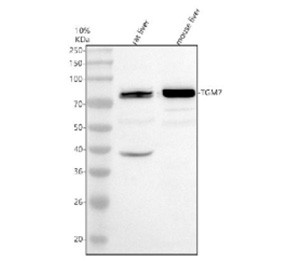
Adding 0.2 ml of distilled water will yield a concentration of 500 ug/ml. TGM7 antibody detects Transglutaminase 7, a cytoplasmic and membrane-associated enzyme encoded by the TGM7 gene on chromosome 15q15.2. TGM7 belongs to the transglutaminase enzyme family and catalyzes calcium-dependent protein crosslinking by forming ?-(gamma-glutamyl)lysine bonds between proteins. This post-translational modification stabilizes protein assemblies and contributes to epithelial differentiation, wound healing, and barrier function. TGM7 is expressed in skin, gastrointestinal epithelium, and reproductive tissues, with developmental expression during keratinocyte maturation and spermatogenesis.Functionally, TGM7 participates in the formation of insoluble protein structures within epithelial cells, supporting tissue integrity under mechanical and environmental stress. It crosslinks structural proteins such as keratins, involucrin, and loricrin, enhancing the strength of epithelial layers. Co-localization studies show TGM7 associating with the plasma membrane and cytoskeletal components during terminal differentiation of keratinocytes. The enzyme also contributes to barrier maintenance in the gastrointestinal tract and reproductive system.Structurally, TGM7 shares conserved catalytic residues with other transglutaminases, including the catalytic triad of cysteine, histidine, and aspartate. It contains a core transamidase domain flanked by beta-sandwich and beta-barrel domains that facilitate substrate recognition and enzymatic activity. TGM7 is part of the transglutaminase enzyme family, which includes TGM1-6 and Factor XIIIa, all of which catalyze similar crosslinking reactions. Calcium binding activates TGM7, promoting conformational changes that expose the catalytic site for substrate processing.TGM7 plays roles beyond structural reinforcement, including regulation of cell adhesion, apoptosis, and immune responses. It has been shown to modulate integrin signaling and extracellular matrix interactions. Dysregulation of TGM7 expression is linked to skin disorders, inflammatory bowel disease, and cancer. Overexpression has been observed in colorectal and pancreatic tumors, where TGM7 may promote cell migration and invasion through cytoskeletal remodeling. Pathway involvement includes keratinocyte differentiation, cell adhesion, and calcium signaling.Tissue-specific studies indicate that TGM7 expression is high in differentiated epithelial cells and germ cells, reflecting its contribution to terminal differentiation and reproductive tissue function. During embryonic development, it supports epithelial morphogenesis and barrier establishment. Its enzymatic crosslinking activity provides stability to tissues exposed to environmental stressors such as mechanical abrasion and chemical insult.Immunohistochemical staining using TGM7 antibody shows cytoplasmic and membrane localization in epithelial tissues and testis. The TGM7 antibody from NSJ Bioreagents is an excellent reagent for investigating transglutaminase-mediated crosslinking, epithelial differentiation, and barrier function in normal and pathological conditions.
| Keywords: | Anti-TGM7, Anti-Transglutaminase Z, Anti-Transglutaminase-7, Anti-Protein-glutamine gamma-glutamyltransferase Z, TGM7 Antibody / Transglutaminase 7 |
| Supplier: | NSJ Bioreagents |
| Supplier-Nr: | FY13348 |
Properties
| Application: | WB, ELISA |
| Antibody Type: | Polyclonal |
| Conjugate: | No |
| Host: | Rabbit |
| Species reactivity: | mouse, rat |
| Immunogen: | E.coli-derived human TGM7 recombinant protein (Position: E147-D701) |
| Format: | Purified |
Database Information
| KEGG ID : | K05623 | Matching products |
| UniProt ID : | Q96PF1 | Matching products |
| Gene ID : | GeneID 116179 | Matching products |
Handling & Safety
| Storage: | +4°C |
| Shipping: | +4°C (International: +4°C) |
Caution
Our products are for laboratory research use only: Not for administration to humans!
Our products are for laboratory research use only: Not for administration to humans!
Information about the product reference will follow.
more
You will get a certificate here
Viewed