
Cookie preferences
This website uses cookies, which are necessary for the technical operation of the website and are always set. Other cookies, which increase the comfort when using this website, are used for direct advertising or to facilitate interaction with other websites and social networks, are only set with your consent.
Configuration
Technically required
These cookies are necessary for the basic functions of the shop.
"Allow all cookies" cookie
"Decline all cookies" cookie
CSRF token
Cookie preferences
Currency change
Customer-specific caching
FACT-Finder tracking
Individual prices
Selected shop
Session
Comfort functions
These cookies are used to make the shopping experience even more appealing, for example for the recognition of the visitor.
Note
Show the facebook fanpage in the right blod sidebar
Statistics & Tracking
Affiliate program
Conversion and usertracking via Google Tag Manager
Track device being used


| Item number | Size | Datasheet | Manual | SDS | Delivery time | Quantity | Price |
|---|---|---|---|---|---|---|---|
| NSJ-FY12206 | 100 µg | - | - |
3 - 10 business days* |
790.00€
|
If you have any questions, please use our Contact Form.
You can also order by e-mail: info@biomol.com
Larger quantity required? Request bulk
You can also order by e-mail: info@biomol.com
Larger quantity required? Request bulk
Adding 0.2 ml of distilled water will yield a concentration of 500 ug/ml. TGM5 antibody detects... more
Product information "Anti-TGM5 / Transglutaminase 5"
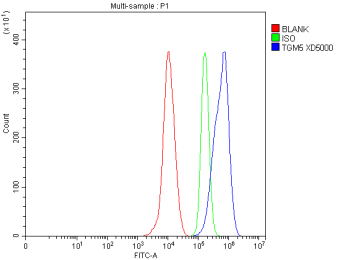
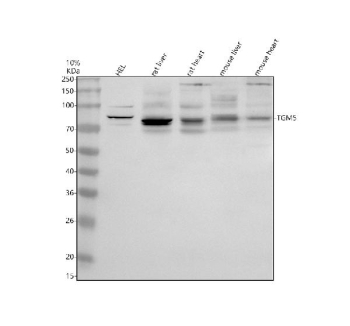
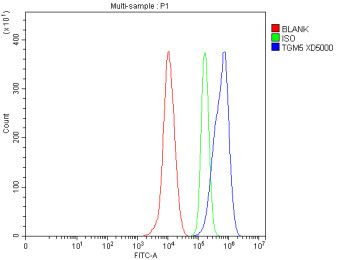
Adding 0.2 ml of distilled water will yield a concentration of 500 ug/ml. TGM5 antibody detects Transglutaminase-5, encoded by the TGM5 gene on chromosome 15q15.2. TGM5 antibody is used in research on epidermal biology, keratinocyte differentiation, and skin barrier formation. TGM5 belongs to the transglutaminase family of Ca2+-dependent enzymes that catalyze crosslinking of proteins via isopeptide bonds. TGM5 is expressed primarily in epidermis and other stratified epithelia, where it contributes to cornified envelope formation, strengthening skin barrier integrity. Mutations in TGM5 cause acral peeling skin syndrome, highlighting its essential role.Structurally, TGM5 is a ~78 kDa enzyme with an N-terminal beta-sandwich domain, a catalytic core containing the conserved transglutaminase triad, and two C-terminal beta-barrel domains. The catalytic cysteine forms thioester intermediates during transamidation reactions. Structural similarities to other transglutaminases confirm conserved mechanisms but tissue-specific regulation.Functionally, TGM5 catalyzes crosslinking of structural proteins including involucrin, loricrin, and small proline-rich proteins. This activity stabilizes the cornified envelope of keratinocytes, ensuring epidermal resilience and barrier function. Knockdown or mutation disrupts barrier integrity, leading to peeling and sensitivity. Researchers employ TGM5 antibody to study keratinocyte biology, epidermal differentiation, and barrier formation.Clinically, TGM5 mutations cause acral peeling skin syndrome, characterized by painless shedding of the outer epidermis. Pathogenic variants impair catalytic activity, disrupting keratinocyte crosslinking. TGM5 is also studied in cancer, where altered expression influences differentiation and tumor progression. It may serve as a biomarker of keratinocyte differentiation status in skin diseases. NSJ Bioreagents supplies TGM5 antibody as a reagent for dermatology and barrier research.Experimentally, TGM5 antibody is applied in western blotting to detect the ~78 kDa protein, in immunohistochemistry to study epidermal localization, and in immunofluorescence to visualize keratinocyte differentiation. Enzyme activity assays combined with TGM5 antibody confirm correlations between expression and functional crosslinking activity.
| Keywords: | Anti-TGM5, Anti-Transglutaminase-5, Anti-Transglutaminase X, Anti-Protein-glutamine gamma-glutamyltransferase 5, TGM5 Antibody / Transglutaminase 5 |
| Supplier: | NSJ Bioreagents |
| Supplier-Nr: | FY12206 |
Properties
| Application: | WB, FC, ELISA |
| Antibody Type: | Polyclonal |
| Conjugate: | No |
| Host: | Rabbit |
| Species reactivity: | human, mouse, rat |
| Immunogen: | E.coli-derived human TGM5 recombinant protein (Position: E146-K608) |
| Format: | Purified |
Database Information
| KEGG ID : | K05622 | Matching products |
| UniProt ID : | O43548 | Matching products |
| Gene ID : | GeneID 9333 | Matching products |
Handling & Safety
| Storage: | +4°C |
| Shipping: | +4°C (International: +4°C) |
Caution
Our products are for laboratory research use only: Not for administration to humans!
Our products are for laboratory research use only: Not for administration to humans!
Information about the product reference will follow.
more
You will get a certificate here
Viewed