
Cookie preferences
This website uses cookies, which are necessary for the technical operation of the website and are always set. Other cookies, which increase the comfort when using this website, are used for direct advertising or to facilitate interaction with other websites and social networks, are only set with your consent.
Configuration
Technically required
These cookies are necessary for the basic functions of the shop.
"Allow all cookies" cookie
"Decline all cookies" cookie
CSRF token
Cookie preferences
Currency change
Customer-specific caching
FACT-Finder tracking
Individual prices
Selected shop
Session
Comfort functions
These cookies are used to make the shopping experience even more appealing, for example for the recognition of the visitor.
Note
Show the facebook fanpage in the right blod sidebar
Statistics & Tracking
Affiliate program
Conversion and usertracking via Google Tag Manager
Track device being used




| Item number | Size | Datasheet | Manual | SDS | Delivery time | Quantity | Price |
|---|---|---|---|---|---|---|---|
| NSJ-FY12406 | 100 µg | - | - |
7 - 12 business days* |
790.00€
|
If you have any questions, please use our Contact Form.
You can also order by e-mail: info@biomol.com
Larger quantity required? Request bulk
You can also order by e-mail: info@biomol.com
Larger quantity required? Request bulk
Adding 0.2 ml of distilled water will yield a concentration of 500 ug/ml. The TGFBI antibody... more
Product information "Anti-TGFBI / Transforming growth factor-beta-induced protein ig-h3"
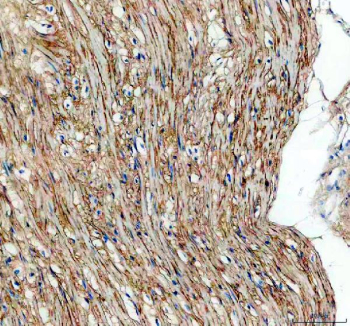
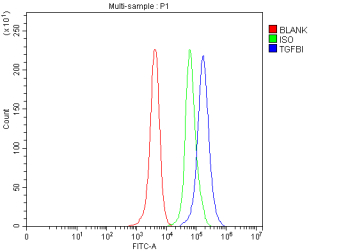
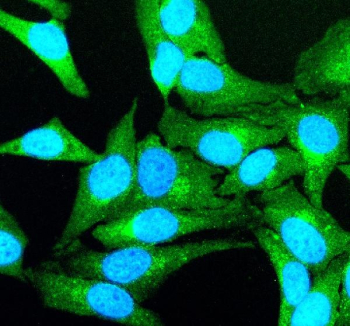
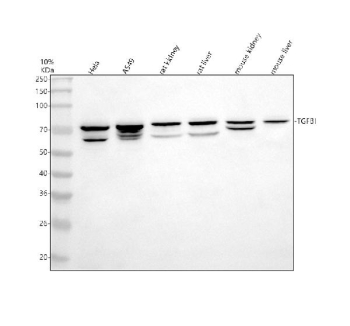
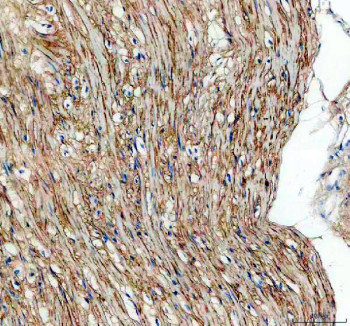
Adding 0.2 ml of distilled water will yield a concentration of 500 ug/ml. The TGFBI antibody targets Transforming growth factor-beta-induced protein ig-h3, a secreted extracellular matrix protein encoded by the TGFBI gene. Induced by TGF-beta signaling, this protein plays critical roles in cell adhesion, migration, and matrix organization. Transforming growth factor-beta-induced protein ig-h3 contains multiple fasciclin domains that mediate interactions with integrins and collagen, promoting tissue integrity and repair. The TGFBI antibody provides a valuable tool for studying extracellular signaling, wound healing, and fibrotic disease mechanisms.Transforming growth factor-beta-induced protein ig-h3 is secreted into the extracellular space, where it binds integrins such as alphavbeta3 and alpha3beta1 to regulate adhesion and cell-matrix communication. It is widely expressed in corneal, epithelial, and connective tissues. The TGFBI antibody allows visualization of its distribution and quantification under TGF-beta stimulation, providing insight into how this protein orchestrates matrix remodeling. Its RGD motif facilitates integrin binding, influencing cell attachment, migration, and differentiation.Mutations in the TGFBI gene cause a spectrum of hereditary corneal dystrophies, including granular, lattice, and Avellino types, characterized by amyloid or hyaline deposits in the cornea. The TGFBI antibody supports studies into these pathologies, enabling detection of protein accumulation and abnormal deposition patterns. By tracking misfolded Transforming growth factor-beta-induced protein ig-h3, researchers can better understand disease progression and potential therapeutic interventions aimed at preventing protein aggregation.Beyond ocular disease, TGFBI is implicated in cancer, fibrosis, and tissue regeneration. It may function as either a tumor suppressor or promoter depending on context, influencing epithelial-to-mesenchymal transition (EMT) and extracellular matrix stiffness. The TGFBI antibody supports exploration of these dual roles by enabling quantification of expression levels in tumor microenvironments and fibrotic tissues. TGFBI overexpression is associated with enhanced metastasis in certain cancers, making it a potential biomarker for disease progression.The TGFBI antibody performs well in western blotting, immunohistochemistry, and immunofluorescence, showing distinct extracellular and pericellular staining consistent with matrix localization. NSJ Bioreagents provides this antibody as a validated reagent with reproducible specificity across model systems. By supporting detailed study of Transforming growth factor-beta-induced protein ig-h3, the TGFBI antibody advances understanding of matrix biology, TGF-beta signaling, and the molecular mechanisms driving fibrosis and corneal dystrophy.
| Keywords: | Anti-TGFBI, Anti-Kerato-epithelin, Anti-RGD-containing collagen-associated protein, Anti-Transforming growth factor-beta-induced protein ig-h3, TGFBI Antibody / Transforming growth factor-beta-induced protein ig-h3 |
| Supplier: | NSJ Bioreagents |
| Supplier-Nr: | FY12406 |
Properties
| Application: | WB, IHC, ICC/IF, FC, ELISA |
| Antibody Type: | Polyclonal |
| Conjugate: | No |
| Host: | Rabbit |
| Species reactivity: | human, mouse, rat |
| Immunogen: | E.coli-derived human BIGH3/TGFBI recombinant protein (Position: K27-H683) |
| Format: | Purified |
Database Information
| KEGG ID : | K19519 | Matching products |
| UniProt ID : | Q15582 | Matching products |
| Gene ID : | GeneID 7045 | Matching products |
Handling & Safety
| Storage: | +4°C |
| Shipping: | +4°C (International: +4°C) |
Caution
Our products are for laboratory research use only: Not for administration to humans!
Our products are for laboratory research use only: Not for administration to humans!
Information about the product reference will follow.
more
You will get a certificate here
Viewed