
Cookie preferences
This website uses cookies, which are necessary for the technical operation of the website and are always set. Other cookies, which increase the comfort when using this website, are used for direct advertising or to facilitate interaction with other websites and social networks, are only set with your consent.
Configuration
Technically required
These cookies are necessary for the basic functions of the shop.
"Allow all cookies" cookie
"Decline all cookies" cookie
CSRF token
Cookie preferences
Currency change
Customer-specific caching
FACT-Finder tracking
Individual prices
Selected shop
Session
Comfort functions
These cookies are used to make the shopping experience even more appealing, for example for the recognition of the visitor.
Note
Show the facebook fanpage in the right blod sidebar
Statistics & Tracking
Affiliate program
Conversion and usertracking via Google Tag Manager
Track device being used


| Item number | Size | Datasheet | Manual | SDS | Delivery time | Quantity | Price |
|---|---|---|---|---|---|---|---|
| NSJ-V6115-20UG | 20 µg | - | - |
7 - 12 business days* |
684.00€
|
||
| NSJ-V6115-100UG | 100 µg | - | - |
7 - 12 business days* |
1,265.00€
|
If you have any questions, please use our Contact Form.
You can also order by e-mail: info@biomol.com
Larger quantity required? Request bulk
You can also order by e-mail: info@biomol.com
Larger quantity required? Request bulk
Antibody in 1X PBS with 0.05% BSA, 0.05% sodium azide. Steroidogenic Acute Regulatory Protein... more
Product information "Anti-StAR / Steroidogenic acute regulatory protein, clone MSVA-740R"
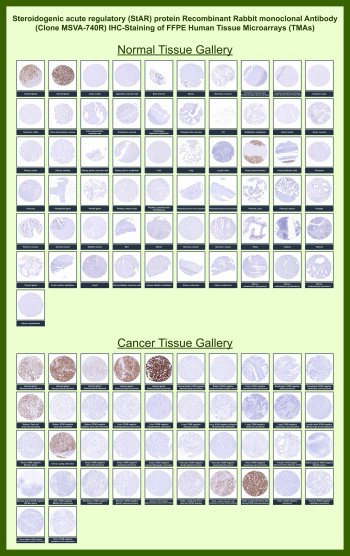
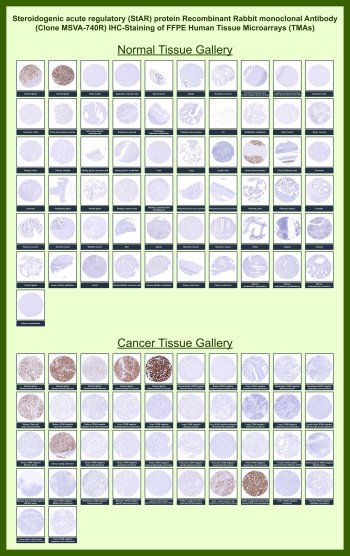
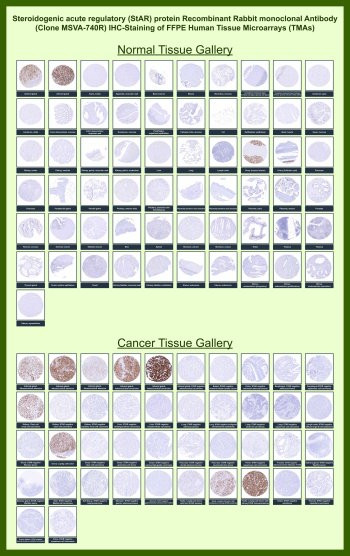
Antibody in 1X PBS with 0.05% BSA, 0.05% sodium azide. Steroidogenic Acute Regulatory Protein (StAR), encoded by the STARD1 gene, is a mitochondrial cholesterol transport protein that plays a central role in steroid hormone biosynthesis within endocrine tissues. The StAR Antibody for IHC / Steroidogenic Acute Regulatory Protein IHC Antibody (clone MSVA-740R) is a recombinant rabbit monoclonal antibody optimized for immunohistochemistry detection of steroidogenic cells in formalin-fixed paraffin-embedded tissue sections. StAR mediates the transfer of cholesterol from the outer to the inner mitochondrial membrane, a process considered the rate-limiting step of steroid hormone production. Because this function occurs specifically in steroid-producing cells, immunohistochemistry using a StAR antibody is widely applied to identify steroidogenic cell populations in tissue sections and to evaluate steroidogenic differentiation in endocrine tissues.StAR expression is strongly enriched in organs responsible for steroid hormone synthesis, including the adrenal cortex, testicular Leydig cells, and ovarian theca and luteal cells. Immunohistochemistry staining with a StAR antibody typically produces distinct cytoplasmic staining corresponding to mitochondria-rich steroidogenic cells. In adrenal gland sections, immunohistochemistry labeling highlights cells of the adrenal cortex involved in glucocorticoid and mineralocorticoid production, while medullary cells are largely negative. In gonadal tissues, StAR antibody staining identifies Leydig cells of the testis and steroidogenic ovarian cells, producing a clear histologic pattern that allows steroidogenic cell populations to be visualized in tissue architecture using immunohistochemistry.Immunohistochemistry detection of StAR is also highly relevant for studies examining endocrine tumors and steroidogenic lineage differentiation. Adrenocortical adenomas, adrenocortical carcinomas, and certain gonadal tumors may retain steroidogenic characteristics, and immunohistochemistry staining for Steroidogenic Acute Regulatory Protein can assist in identifying these cell populations in tissue sections. As a result, StAR antibody reagents are frequently incorporated into immunohistochemistry research panels evaluating adrenal tumors, steroidogenic differentiation, and endocrine tissue biology.Large-scale immunohistochemistry analysis using human tissue microarray (TMA) panels containing multiple normal and cancer tissues provides a powerful approach to evaluate StAR expression across many tissue types simultaneously. Human tissue microarrays contain numerous tissue cores arranged on a single slide, allowing systematic comparison of staining patterns across normal organs and tumor specimens. Using a StAR antibody for IHC in human tissue microarray studies enables researchers to compare steroidogenic marker expression across large cohorts, evaluate staining patterns between endocrine tissues and non-steroidogenic organs, and analyze steroidogenic differentiation in tumor samples through standardized immunohistochemistry analysis.Another important application of StAR immunohistochemistry is the identification of steroid-producing cell populations within complex endocrine organs. In adrenal gland sections, immunohistochemistry staining for StAR highlights steroidogenic cortical cells while sparing the adrenal medulla, providing a clear visual distinction between steroidogenic and catecholamine-producing compartments. Similar patterns are observed in gonadal tissues where immunohistochemistry identifies Leydig cells in the testis and steroidogenic cells of the ovary. Because of this highly specific tissue distribution, StAR antibody staining patterns observed by immunohistochemistry provide valuable insight into steroidogenic cell identity and endocrine tissue organization.A recombinant rabbit monoclonal antibody such as clone MSVA-740R enables reliable immunohistochemistry detection of Steroidogenic Acute Regulatory Protein in FFPE tissues and human tissue microarray panels. Consistent staining of steroidogenic cells across normal and tumor tissue cores supports research applications focused on endocrine organ biology, steroid hormone biosynthesis, and characterization of steroidogenic differentiation in human tissue specimens.This antibody is also part of a broader collection of IHC antibodies validated by tissue microarray analysis, supporting consistent staining across normal and cancer tissues.
| Keywords: | Anti-STAR, Anti-START domain-containing protein 1, Anti-Steroidogenic acute regulatory protein, mitochondrial, StAR Antibody / Steroidogenic acute regulatory protein |
| Supplier: | NSJ Bioreagents |
| Supplier-Nr: | V6115 |
Properties
| Application: | IHC |
| Antibody Type: | Monoclonal |
| Clone: | MSVA-740R |
| Conjugate: | No |
| Host: | Rabbit |
| Species reactivity: | human |
| Immunogen: | Recombinant fragment (around amino acids 39-108) of human STAR protein (exact sequence is proprietary) |
| Format: | Purified |
Database Information
| KEGG ID : | K16931 | Matching products |
| UniProt ID : | P49675 | Matching products |
| Gene ID : | GeneID 6770 | Matching products |
Handling & Safety
| Storage: | -20°C |
| Shipping: | -20°C (International: -20°C) |
Caution
Our products are for laboratory research use only: Not for administration to humans!
Our products are for laboratory research use only: Not for administration to humans!
Information about the product reference will follow.
more
You will get a certificate here
Viewed