
Cookie preferences
This website uses cookies, which are necessary for the technical operation of the website and are always set. Other cookies, which increase the comfort when using this website, are used for direct advertising or to facilitate interaction with other websites and social networks, are only set with your consent.
Configuration
Technically required
These cookies are necessary for the basic functions of the shop.
"Allow all cookies" cookie
"Decline all cookies" cookie
CSRF token
Cookie preferences
Currency change
Customer-specific caching
FACT-Finder tracking
Individual prices
Selected shop
Session
Comfort functions
These cookies are used to make the shopping experience even more appealing, for example for the recognition of the visitor.
Note
Show the facebook fanpage in the right blod sidebar
Statistics & Tracking
Affiliate program
Conversion and usertracking via Google Tag Manager
Track device being used



| Item number | Size | Datasheet | Manual | SDS | Delivery time | Quantity | Price |
|---|---|---|---|---|---|---|---|
| NSJ-FY12890 | 100 µg | - | - |
3 - 10 business days* |
790.00€
|
If you have any questions, please use our Contact Form.
You can also order by e-mail: info@biomol.com
Larger quantity required? Request bulk
You can also order by e-mail: info@biomol.com
Larger quantity required? Request bulk
Adding 0.2 ml of distilled water will yield a concentration of 500 ug/ml. STAMBP antibody detects... more
Product information "Anti-STAMBP / STAM-binding protein"
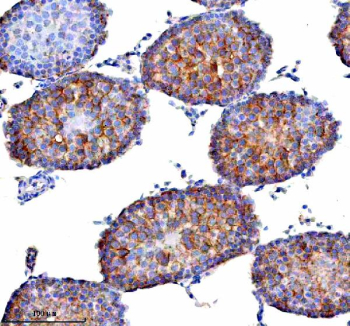
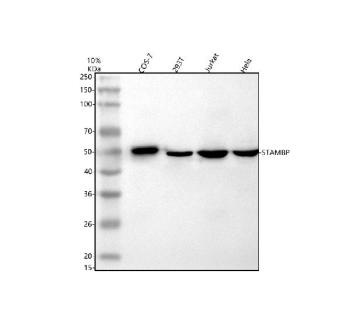
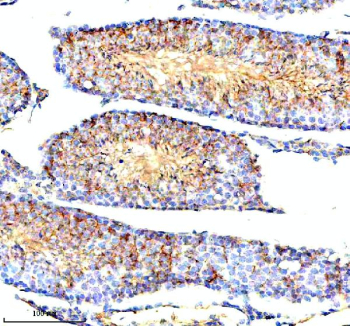
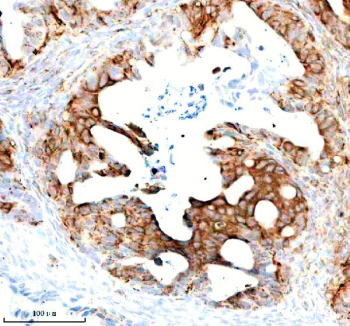
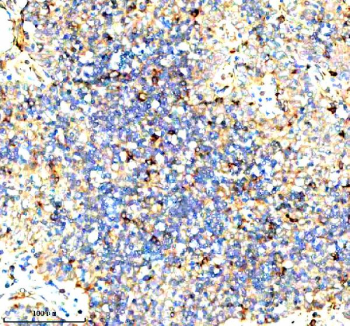
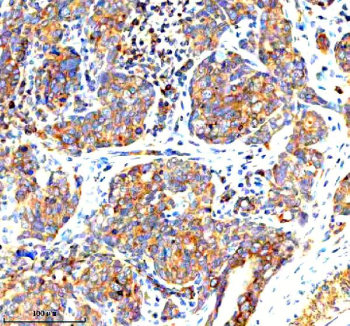
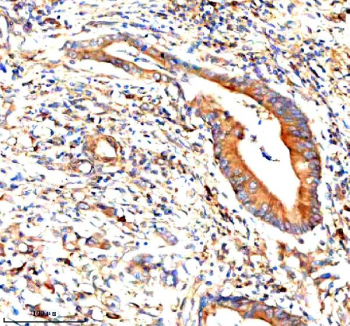
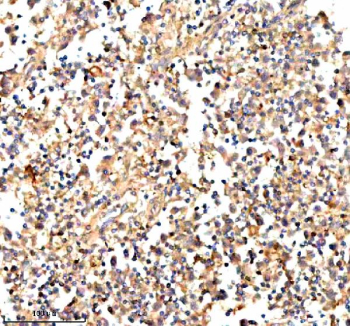
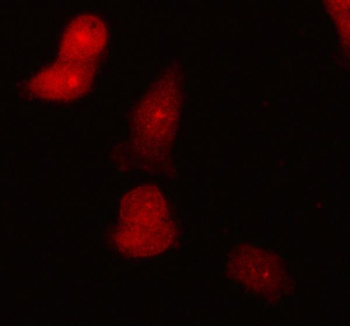
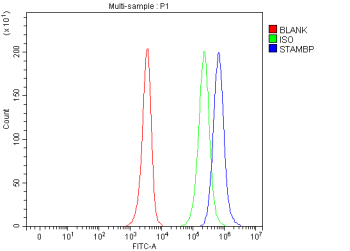
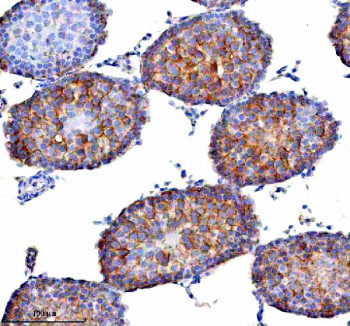
Adding 0.2 ml of distilled water will yield a concentration of 500 ug/ml. STAMBP antibody detects STAM-binding protein, a deubiquitinating enzyme that regulates endosomal sorting, cytokine receptor trafficking, and signal termination. Encoded by the STAMBP gene on chromosome 2p13.1, this enzyme is a member of the JAMM (JAB1/MPN/Mov34 metalloenzyme) family of zinc-dependent deubiquitinases that cleave ubiquitin chains from endosomal cargo proteins. STAMBP plays a critical role in maintaining receptor turnover and preventing abnormal accumulation of ubiquitinated proteins within endosomes.Structurally, STAMBP is a 424-amino-acid cytoplasmic protein of approximately 49 kilodaltons containing a JAMM motif responsible for zinc ion coordination and catalytic activity, as well as SH3-binding regions that enable interaction with signal transducing adaptor molecules (STAM1 and STAM2). It localizes to early endosomes and participates in the endosomal sorting complex required for transport (ESCRT) machinery, modulating trafficking of growth factor receptors such as EGFR and cytokine receptors after ligand binding.The STAMBP antibody is widely used in cell signaling, membrane trafficking, and neurodevelopmental research to study ubiquitin processing, receptor regulation, and lysosomal degradation pathways. Western blot analysis detects a 49 kilodalton band corresponding to STAMBP, while immunofluorescence reveals punctate endosomal staining. This antibody enables precise detection of endosomal deubiquitinating enzyme activity and ESCRT complex assembly.Functionally, STAMBP removes Lys63-linked ubiquitin chains from endosomal cargo proteins, facilitating recycling or degradation decisions within the endolysosomal pathway. Its activity prevents overactivation of growth factor signaling and supports normal receptor turnover. Mutations in STAMBP cause microcephaly-capillary malformation syndrome (MIC-CAP), a rare congenital disorder characterized by neurodevelopmental delay, seizures, and vascular malformations resulting from defective ubiquitin recycling. Altered STAMBP expression also contributes to tumor progression and immune dysregulation through prolonged receptor signaling. The STAMBP antibody provides a powerful tool for characterizing ubiquitin-dependent trafficking, growth factor regulation, and endosomal sorting mechanisms. NSJ Bioreagents validates this antibody for its applications, ensuring robust and reproducible detection in trafficking and signaling studies.
| Keywords: | Anti-STAMBP, Anti-STAM-binding protein, Anti-Endosome-associated ubiquitin isopeptidase, Anti-Associated molecule with the SH3 domain of STAM, STAMBP Antibody / STAM-binding protein |
| Supplier: | NSJ Bioreagents |
| Supplier-Nr: | FY12890 |
Properties
| Application: | WB, IHC, ICC/IF, FC, ELISA |
| Antibody Type: | Polyclonal |
| Conjugate: | No |
| Host: | Rabbit |
| Species reactivity: | human, monkey, mouse, rat |
| Immunogen: | E.coli-derived human STAMBP recombinant protein (Position: K187-R424) |
| Format: | Purified |
Database Information
| KEGG ID : | K11866 | Matching products |
| UniProt ID : | O95630 | Matching products |
| Gene ID : | GeneID 10617 | Matching products |
Handling & Safety
| Storage: | +4°C |
| Shipping: | +4°C (International: +4°C) |
Caution
Our products are for laboratory research use only: Not for administration to humans!
Our products are for laboratory research use only: Not for administration to humans!
Information about the product reference will follow.
more
You will get a certificate here
Viewed