
Cookie preferences
This website uses cookies, which are necessary for the technical operation of the website and are always set. Other cookies, which increase the comfort when using this website, are used for direct advertising or to facilitate interaction with other websites and social networks, are only set with your consent.
Configuration
Technically required
These cookies are necessary for the basic functions of the shop.
"Allow all cookies" cookie
"Decline all cookies" cookie
CSRF token
Cookie preferences
Currency change
Customer-specific caching
FACT-Finder tracking
Individual prices
Selected shop
Session
Comfort functions
These cookies are used to make the shopping experience even more appealing, for example for the recognition of the visitor.
Note
Show the facebook fanpage in the right blod sidebar
Statistics & Tracking
Affiliate program
Conversion and usertracking via Google Tag Manager
Track device being used

| Item number | Size | Datasheet | Manual | SDS | Delivery time | Quantity | Price |
|---|---|---|---|---|---|---|---|
| NSJ-FY13185 | 100 µl | - | - |
7 - 12 business days* |
790.00€
|
If you have any questions, please use our Contact Form.
You can also order by e-mail: info@biomol.com
Larger quantity required? Request bulk
You can also order by e-mail: info@biomol.com
Larger quantity required? Request bulk
Rabbit IgG in phosphate buffered saline, pH 7.4, 150mM NaCl, 0.02% sodium azide and 50% glycerol,... more
Product information "Anti-SRR / Serine racemase, clone 30S73"
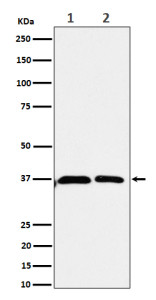
Rabbit IgG in phosphate buffered saline, pH 7.4, 150mM NaCl, 0.02% sodium azide and 50% glycerol, 0.4-0.5mg/ml BSA. SRR antibody detects Serine racemase, encoded by the SRR gene. Serine racemase is a pyridoxal phosphate dependent enzyme that catalyzes the conversion of L-serine to D-serine. D-serine functions as a co-agonist at NMDA receptors in the brain, where it modulates synaptic plasticity, learning, and memory. SRR antibody provides researchers with a specific reagent to study neurotransmission, amino acid metabolism, and neuropsychiatric disease.Serine racemase is expressed primarily in astrocytes and neurons, where it controls production of D-serine in the central nervous system. Research using SRR antibody has shown that D-serine binds to the glycine site of NMDA receptors, regulating receptor activation. This makes SRR activity essential for synaptic plasticity, long-term potentiation, and cognitive function. Loss of D-serine production due to impaired SRR activity results in deficits in NMDA receptor signaling.Dysregulation of Serine racemase is linked to neurological and psychiatric disorders. Studies with SRR antibody have revealed that reduced activity contributes to schizophrenia by decreasing D-serine availability and NMDA receptor function. Conversely, excessive D-serine production may promote excitotoxicity and neurodegeneration in conditions such as amyotrophic lateral sclerosis and Alzheimer's disease. These findings position SRR as both a biomarker and a potential therapeutic target.Beyond the brain, Serine racemase contributes to metabolism and signaling in peripheral tissues. Research using SRR antibody has suggested roles in kidney function and immune regulation. Because D-serine influences both neural and systemic physiology, SRR is an enzyme with broad biological significance.SRR antibody is widely used in western blotting, immunohistochemistry, and immunofluorescence. Western blotting detects full-length and truncated forms, immunohistochemistry highlights expression in brain regions, and immunofluorescence demonstrates astrocytic and neuronal localization. These applications make SRR antibody versatile in neuroscience and physiology research.By supplying validated SRR antibody reagents, NSJ Bioreagents supports research into neurotransmission, psychiatric disease, and neurodegeneration. Detection of Serine racemase provides insight into how amino acid metabolism intersects with brain signaling and disease.
| Keywords: | Anti-SRR, Anti-Serine racemase, Anti-L-serine dehydratase, Anti-D-serine dehydratase, Anti-L-serine ammonia-lyase, Anti-D-serine ammonia-lyase, SRR Antibody / Serine racemase |
| Supplier: | NSJ Bioreagents |
| Supplier-Nr: | FY13185 |
Properties
| Application: | WB |
| Antibody Type: | Monoclonal |
| Clone: | 30S73 |
| Conjugate: | No |
| Host: | Rabbit |
| Species reactivity: | human |
| Immunogen: | A synthesized peptide derived from human Serine racemase |
| Format: | Affinity Purified |
Database Information
| KEGG ID : | K12235 | Matching products |
| UniProt ID : | Q9GZT4 | Matching products |
| Gene ID : | GeneID 63826 | Matching products |
Handling & Safety
| Storage: | -20°C |
| Shipping: | -20°C (International: -20°C) |
Caution
Our products are for laboratory research use only: Not for administration to humans!
Our products are for laboratory research use only: Not for administration to humans!
Information about the product reference will follow.
more
You will get a certificate here
Viewed