
Cookie preferences
This website uses cookies, which are necessary for the technical operation of the website and are always set. Other cookies, which increase the comfort when using this website, are used for direct advertising or to facilitate interaction with other websites and social networks, are only set with your consent.
Configuration
Technically required
These cookies are necessary for the basic functions of the shop.
"Allow all cookies" cookie
"Decline all cookies" cookie
CSRF token
Cookie preferences
Currency change
Customer-specific caching
FACT-Finder tracking
Individual prices
Selected shop
Session
Comfort functions
These cookies are used to make the shopping experience even more appealing, for example for the recognition of the visitor.
Note
Show the facebook fanpage in the right blod sidebar
Statistics & Tracking
Affiliate program
Conversion and usertracking via Google Tag Manager
Track device being used


| Item number | Size | Datasheet | Manual | SDS | Delivery time | Quantity | Price |
|---|---|---|---|---|---|---|---|
| NSJ-FY12923 | 100 µg | - | - |
3 - 10 business days* |
790.00€
|
If you have any questions, please use our Contact Form.
You can also order by e-mail: info@biomol.com
Larger quantity required? Request bulk
You can also order by e-mail: info@biomol.com
Larger quantity required? Request bulk
Adding 0.2 ml of distilled water will yield a concentration of 500 ug/ml. SNTA1 antibody detects... more
Product information "Anti-SNTA1 / Alpha-1-Syntrophin"
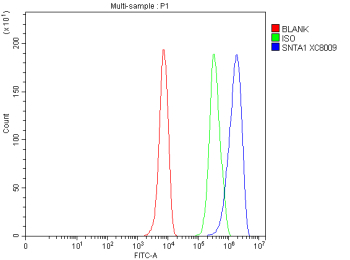
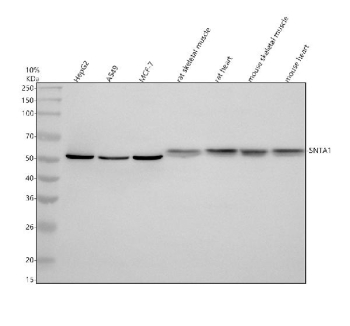
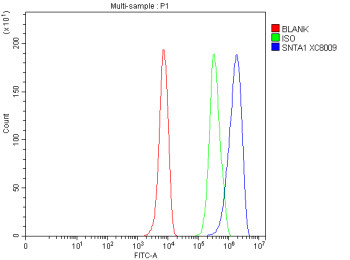
Adding 0.2 ml of distilled water will yield a concentration of 500 ug/ml. SNTA1 antibody detects Alpha-1-syntrophin, a cytoskeletal adaptor protein that organizes signaling complexes at the plasma membrane, particularly in muscle and neuronal tissues. Encoded by the SNTA1 gene on chromosome 20q11.2, this protein belongs to the syntrophin family of PDZ domain-containing scaffold proteins that associate with dystrophin and dystrobrevin to form part of the dystrophin-associated protein complex (DAPC). Alpha-1-syntrophin facilitates communication between membrane channels, receptors, and intracellular signaling proteins, contributing to cellular structural integrity and signaling regulation.Structurally, Alpha-1-syntrophin is a 505-amino-acid cytoplasmic protein of approximately 55 kilodaltons containing multiple modular domains, including a pleckstrin homology (PH) domain, a PDZ domain, and a C-terminal syntrophin unique (SU) region. These domains mediate interactions with membrane proteins such as neuronal nitric oxide synthase (nNOS), ion channels, and cytoskeletal elements. The protein localizes to the sarcolemma in muscle cells and to synaptic and submembranous regions in neurons.The SNTA1 antibody is widely used in muscle biology, neuroscience, and cardiovascular research to study membrane organization, signal transduction, and cytoskeletal dynamics. Western blot analysis detects a 55 kilodalton band corresponding to Alpha-1-syntrophin, while immunofluorescence reveals membrane-associated and cytoplasmic staining patterns consistent with its adaptor function. This antibody provides a reliable tool for examining the molecular architecture of membrane-associated signaling complexes.Functionally, SNTA1 regulates nitric oxide signaling, calcium homeostasis, and ion channel activity by linking nNOS and other signaling proteins to the DAPC. Mutations in SNTA1 have been associated with long QT syndrome and cardiac arrhythmias, suggesting a role in maintaining proper electrical signaling in cardiomyocytes. Alpha-1-syntrophin also influences cellular migration and polarization by anchoring signaling complexes at specific membrane domains. The SNTA1 antibody supports research into cytoskeletal organization, membrane signaling, and neuromuscular disease. NSJ Bioreagents validates this antibody for its applications, ensuring reliable and reproducible detection in cell signaling and structural biology studies.
| Keywords: | Anti-SNTA1, Anti-Syntrophin-1, Anti-Alpha-1-syntrophin, Anti-Pro-TGF-alpha cytoplasmic domain-interacting protein 1, Anti-59 kDa dystrophin-associated protein A1 acidic component 1, SNTA1 Antibody / Alpha-1-Syntrophin |
| Supplier: | NSJ Bioreagents |
| Supplier-Nr: | FY12923 |
Properties
| Application: | WB, FC, ELISA |
| Antibody Type: | Polyclonal |
| Conjugate: | No |
| Host: | Rabbit |
| Species reactivity: | human, mouse, rat |
| Immunogen: | E.coli-derived human SNTA1 recombinant protein (Position: Q76-H480) |
| Format: | Purified |
Database Information
| KEGG ID : | K24063 | Matching products |
| UniProt ID : | Q13424 | Matching products |
| Gene ID : | GeneID 6640 | Matching products |
Handling & Safety
| Storage: | +4°C |
| Shipping: | +4°C (International: +4°C) |
Caution
Our products are for laboratory research use only: Not for administration to humans!
Our products are for laboratory research use only: Not for administration to humans!
Information about the product reference will follow.
more
You will get a certificate here
Viewed