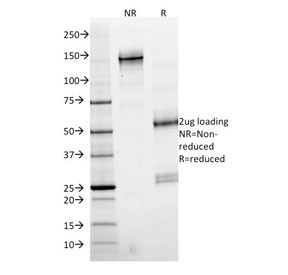
Anti-SMAD4, clone SMAD4/2524

Anti-SMAD4, clone SMAD4/2524

Item number Size Datasheet Manual SDS Delivery time Quantity Price
NSJ-V7939-20UG 20 µg - -

3 - 10 business days*

375.00€
NSJ-V7939-100UG 100 µg - -

3 - 10 business days*

810.00€
 
0.2 mg/ml with 0.1 mg/ml BSA (US sourced), 0.05% sodium azide. Signaling from the... more
Product information "Anti-SMAD4, clone SMAD4/2524"
0.2 mg/ml with 0.1 mg/ml BSA (US sourced), 0.05% sodium azide. Signaling from the ligand-activated membrane receptor serine/threonine kinases to nuclear targets is mediated by a set of evolutionarily conserved proteins known as DPC4. Upon ligand binding, the receptors of the TGF- family phosphorylate SMAD proteins (SMAD1 and SMAD2). These proteins then move into the nucleus, where they activate transcription. To carry out this function, the receptor activated SMAD1 and 2 require association with the product of deleted in pancreatic carcinoma, locus 4 (DPC4), also known as SMAD4. SMAD4/DPC4 is also implicated as a tumor suppressor, since it is inactivated in more than half of pancreatic carcinomas and to a lesser extent in a variety of other cancers. SMAD4 is absent in approximately 80% of pancreatic adenocarcinoma, but rarely in endometrial, colorectal, ovarian, lung, breast adenocarcinomas, and malignant melanom. SMAD4 is an important marker for confirming a diagnosis of pancreatic adenocarcinoma. Patients with pancreatic adenocarcinomas with SMAD4 protein expression had significantly longer survival than SMAD4 negative patients. Protein function: In muscle physiology, plays a central role in the balance between atrophy and hypertrophy. When recruited by MSTN, promotes atrophy response via phosphorylated SMAD2/4. MSTN decrease causes SMAD4 release and subsequent recruitment by the BMP pathway to promote hypertrophy via phosphorylated SMAD1/5/8. Acts synergistically with SMAD1 and YY1 in bone morphogenetic protein (BMP)-mediated cardiac- specific gene expression. Binds to SMAD binding elements (SBEs) (5'- GTCT/AGAC-3') within BMP response element (BMPRE) of cardiac activating regions. Common SMAD (co-SMAD) is the coactivator and mediator of signal transduction by TGF-beta (transforming growth factor). Component of the heterotrimeric SMAD2/SMAD3-SMAD4 complex that forms in the nucleus and is required for the TGF-mediated signaling (PubMed:25514493). Promotes binding of the SMAD2/SMAD4/FAST-1 complex to DNA and provides an activation function required for SMAD1 or SMAD2 to stimulate transcription. Component of the multimeric SMAD3/SMAD4/JUN/FOS complex which forms at the AP1 promoter site, required for synergistic transcriptional activity in response to TGF- beta. May act as a tumor suppressor. Positively regulates PDPK1 kinase activity by stimulating its dissociation from the 14-3-3 protein YWHAQ which acts as a negative regulator. [The UniProt Consortium]
Keywords: Anti-DPC4, Anti-Smad4, Anti-SMAD4, Anti-hSMAD4, Anti-SMAD 4, Anti-MAD homolog 4, Anti-SMAD family member 4, Anti-Mothers against DPP homolog 4, Anti-Deletion target in pancreatic carcinoma 4, Anti-Mothers against decapentaplegic homolog 4, SMAD4 Antibody
Supplier: NSJ Bioreagents
Supplier-Nr: V7939

Properties

Application: ELISA
Antibody Type: Monoclonal
Clone: SMAD4/2524
Conjugate: No
Host: Mouse
Species reactivity: human
Immunogen: Recombinant full length human protein
Format: Purified

Handling & Safety

Storage: +4°C
Shipping: +4°C (International: +4°C)
Caution
Our products are for laboratory research use only: Not for administration to humans!
You will get a certificate here
or to request a certificate of analysis.
Read, write and discuss reviews... more
Customer review for "Anti-SMAD4, clone SMAD4/2524"
Write a review
or to review a product.
Viewed