
Cookie preferences
This website uses cookies, which are necessary for the technical operation of the website and are always set. Other cookies, which increase the comfort when using this website, are used for direct advertising or to facilitate interaction with other websites and social networks, are only set with your consent.
Configuration
Technically required
These cookies are necessary for the basic functions of the shop.
"Allow all cookies" cookie
"Decline all cookies" cookie
CSRF token
Cookie preferences
Currency change
Customer-specific caching
FACT-Finder tracking
Individual prices
Selected shop
Session
Comfort functions
These cookies are used to make the shopping experience even more appealing, for example for the recognition of the visitor.
Note
Show the facebook fanpage in the right blod sidebar
Statistics & Tracking
Affiliate program
Conversion and usertracking via Google Tag Manager
Track device being used


| Item number | Size | Datasheet | Manual | SDS | Delivery time | Quantity | Price |
|---|---|---|---|---|---|---|---|
| NSJ-FY12938 | 100 µg | - | - |
3 - 10 business days* |
790.00€
|
If you have any questions, please use our Contact Form.
You can also order by e-mail: info@biomol.com
Larger quantity required? Request bulk
You can also order by e-mail: info@biomol.com
Larger quantity required? Request bulk
Adding 0.2 ml of distilled water will yield a concentration of 500 ug/ml. SLC7A14 antibody... more
Product information "Anti-SLC7A14 / Solute carrier family 7 member 14"
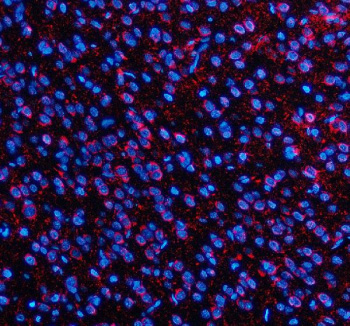
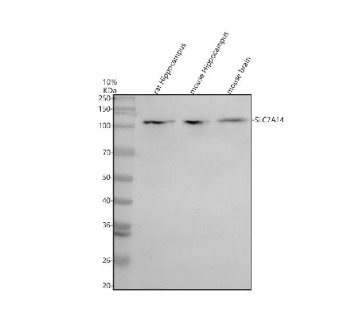
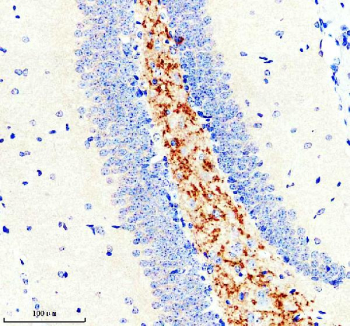
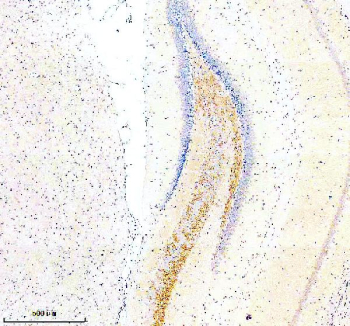
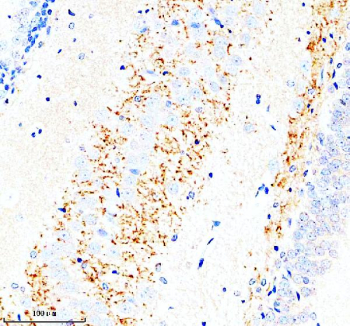
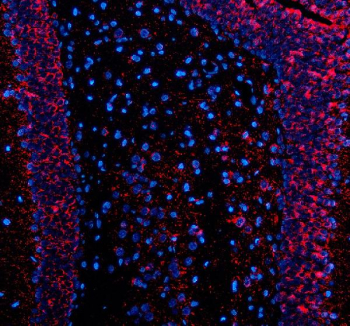
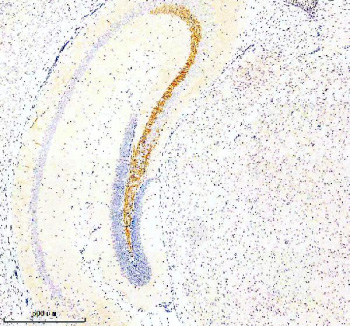
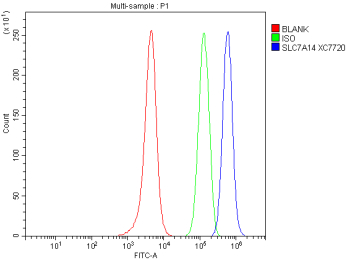
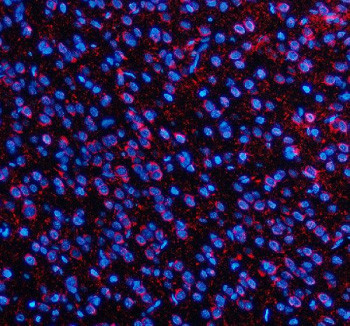
Adding 0.2 ml of distilled water will yield a concentration of 500 ug/ml. SLC7A14 antibody detects Solute carrier family 7 member 14, a lysosomal cationic amino acid transporter critical for maintaining lysosomal homeostasis and neuronal survival. The UniProt recommended name is Solute carrier family 7 member 14 (SLC7A14), with alternate names cationic amino acid transporter-related protein 1 (CATR1), SLC7A14 protein, and lysosomal arginine transporter. SLC7A14 belongs to the solute carrier (SLC) superfamily of amino acid transporters, specifically the cationic amino acid transporter-like (CAT-like) subgroup.Functionally, SLC7A14 antibody recognizes a multi-pass transmembrane protein localized to the lysosomal membrane, where it facilitates the uptake of arginine and other cationic amino acids from the cytoplasm into the lysosome. This transport is essential for maintaining amino acid balance, lysosomal integrity, and mTOR signaling. SLC7A14 is highly expressed in sensory neurons of the retina and cochlea, and loss of function leads to progressive vision and hearing loss. Mutations in SLC7A14 cause autosomal recessive retinitis pigmentosa and auditory neuropathy, making it a gene of growing clinical significance in neurodegeneration research.At the molecular level, SLC7A14 contains 14 predicted transmembrane helices and shares structural features with other CAT family members but displays lysosome-specific trafficking signals. The transporter's localization depends on interactions with adaptor protein complexes such as AP-3 and lysosomal membrane proteins including LAMP1. SLC7A14 antibody is employed to study neuronal lysosome biology, amino acid metabolism, and neurodegenerative disease models. Studies demonstrate that reduced SLC7A14 impairs lysosomal function, increases oxidative stress, and triggers neuronal apoptosis. Expression analysis shows enrichment in inner hair cells, photoreceptors, and hippocampal neurons, linking it to sensory function and neural plasticity.The SLC7A14 gene is located on chromosome 3q26.2 and encodes a 561-amino acid protein. Beyond sensory tissues, SLC7A14 transcripts have been detected in endocrine cells and fibroblasts, suggesting roles in nutrient sensing and metabolic regulation. Overexpression experiments indicate SLC7A14 contributes to amino acid-regulated mTORC1 activation, coupling lysosomal nutrient availability with cellular growth signals. The SLC7A14 antibody is valuable for immunofluorescence and confocal microscopy to confirm lysosomal localization and evaluate expression changes in disease models. NSJ Bioreagents provides well-characterized antibodies validated for human, mouse, and rat samples, supporting research into lysosomal transport and neurodegenerative mechanisms.
| Keywords: | Anti-SLC7A14, Anti-Solute carrier family 7 member 14, Anti-Gamma-aminobutyric acid transporter SLC7A14, SLC7A14 Antibody / Solute carrier family 7 member 14 |
| Supplier: | NSJ Bioreagents |
| Supplier-Nr: | FY12938 |
Properties
| Application: | WB, IHC, IF, FC, ELISA |
| Antibody Type: | Polyclonal |
| Conjugate: | No |
| Host: | Rabbit |
| Species reactivity: | human, mouse, rat |
| Immunogen: | E.coli-derived human SLC7A14 recombinant protein (Position: D9-E771) |
| Format: | Purified |
Database Information
| KEGG ID : | K13871 | Matching products |
| UniProt ID : | Q8TBB6 | Matching products |
| Gene ID : | GeneID 57709 | Matching products |
Handling & Safety
| Storage: | +4°C |
| Shipping: | +4°C (International: +4°C) |
Caution
Our products are for laboratory research use only: Not for administration to humans!
Our products are for laboratory research use only: Not for administration to humans!
Information about the product reference will follow.
more
You will get a certificate here
Viewed