
Cookie preferences
This website uses cookies, which are necessary for the technical operation of the website and are always set. Other cookies, which increase the comfort when using this website, are used for direct advertising or to facilitate interaction with other websites and social networks, are only set with your consent.
Configuration
Technically required
These cookies are necessary for the basic functions of the shop.
"Allow all cookies" cookie
"Decline all cookies" cookie
CSRF token
Cookie preferences
Currency change
Customer-specific caching
FACT-Finder tracking
Individual prices
Selected shop
Session
Comfort functions
These cookies are used to make the shopping experience even more appealing, for example for the recognition of the visitor.
Note
Show the facebook fanpage in the right blod sidebar
Statistics & Tracking
Affiliate program
Conversion and usertracking via Google Tag Manager
Track device being used

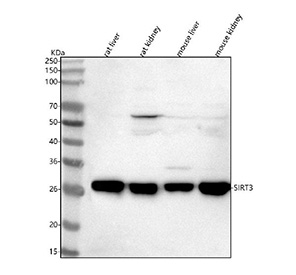
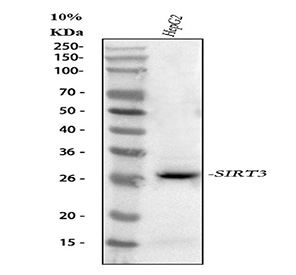
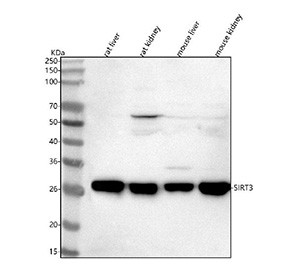

| Item number | Size | Datasheet | Manual | SDS | Delivery time | Quantity | Price |
|---|---|---|---|---|---|---|---|
| NSJ-FY13395 | 100 µg | - | - |
3 - 10 business days* |
790.00€
|
If you have any questions, please use our Contact Form.
You can also order by e-mail: info@biomol.com
Larger quantity required? Request bulk
You can also order by e-mail: info@biomol.com
Larger quantity required? Request bulk
Adding 0.2 ml of distilled water will yield a concentration of 500 ug/ml. Sirtuin 3 antibody... more
Product information "Anti-SIRT3"
Adding 0.2 ml of distilled water will yield a concentration of 500 ug/ml. Sirtuin 3 antibody detects SIRT3, a mitochondrial NAD-dependent deacetylase that serves as a central regulator of cellular energy balance and mitochondrial protein function. The UniProt recommended name is NAD-dependent protein deacetylase sirtuin-3 (SIRT3). As a core member of the mitochondrial sirtuin family, SIRT3 coordinates metabolic efficiency, oxidative stress management, and mitochondrial adaptation to physiological demands such as fasting, exercise, and nutrient limitation.Sirtuin 3 antibody identifies a protein synthesized as a precursor that is targeted to mitochondria, where it becomes activated through proteolytic processing. The mature SIRT3 enzyme resides predominantly in the mitochondrial matrix, where it modulates acetylation status of enzymes involved in oxidative phosphorylation, amino acid metabolism, ketogenesis, and antioxidant defense. By deacetylating factors such as SOD2, IDH2, and components of the electron transport chain, SIRT3 helps maintain ATP production capacity while controlling reactive oxygen species (ROS) accumulation.The SIRT3 gene on chromosome 11p15.5 is widely expressed in metabolically active tissues including heart, liver, kidney, brown adipose tissue, and skeletal muscle. In these tissues, SIRT3 acts as a metabolic rheostat, enhancing mitochondrial performance during increased energy demand. In liver, SIRT3 supports fatty acid oxidation and helps maintain normal lipid homeostasis. In muscle, it improves mitochondrial endurance and contributes to exercise-induced metabolic remodeling. In thermogenic tissues, SIRT3 assists in maintaining heat production and energy expenditure.Beyond its bioenergetic role, SIRT3 is deeply integrated into mechanisms of cellular resilience. Rising intracellular NAD levels activate SIRT3 under conditions of stress, fasting, or caloric restriction, triggering a broad pro-survival program that enhances mitochondrial stability, preserves mitochondrial DNA integrity, and limits oxidative injury. Through regulation of mitochondrial permeability and apoptotic factors, SIRT3 also helps determine cellular fate during metabolic or oxidative challenge. These combined functions position SIRT3 as a crucial guardian of mitochondrial health.Dysregulation of SIRT3 has been associated with a wide spectrum of diseases. Reduced SIRT3 expression contributes to metabolic syndrome, insulin resistance, hepatic steatosis, and age-related mitochondrial decline. In neurodegenerative disease, insufficient SIRT3 activity may heighten neuronal vulnerability to oxidative stress. In cardiovascular injury, SIRT3 protects cardiac mitochondria from dysfunction caused by ischemia and oxidative overload. In several cancers, SIRT3 can function either as a tumor suppressor or metabolic facilitator depending on cellular environment, reflecting its diverse regulatory influence on mitochondrial pathways.Research using Sirtuin 3 antibody supports studies in mitochondrial metabolism, redox regulation, stress adaptation, aging biology, and metabolic disease. SIRT3 antibody is validated for use in relevant research applications to detect mitochondrial deacetylase expression and examine mechanisms of metabolic control. NSJ Bioreagents provides Sirtuin 3 antibody reagents optimized for mitochondrial research, metabolic physiology, and oxidative stress biology.Researchers studying mitochondrial metabolism, oxidative stress adaptation, and cellular energy regulation pathways may also be interested in our SIRT3 Antibody / Mitochondrial Metabolism Regulator page featuring validated immunofluorescence, flow cytometry, and protein microarray specificity data for mitochondrial biology research.
| Keywords: | Anti-SIRT3, Anti-SIR2-like protein 3, Anti-Regulatory protein SIR2 homolog 3, Anti-NAD-dependent protein delactylase sirtuin-3, Anti-NAD-dependent protein deacetylase sirtuin-3, mitochondrial, SIRT3 Antibody |
| Supplier: | NSJ Bioreagents |
| Supplier-Nr: | FY13395 |
Properties
| Application: | WB, ELISA |
| Antibody Type: | Polyclonal |
| Conjugate: | No |
| Host: | Rabbit |
| Species reactivity: | human, mouse, rat |
| Immunogen: | E.coli-derived human SIRT3 recombinant protein (Position: R43-K399). Human Sirtuin 3 shares 83.5% amino acid (aa) sequence identity with mouse Sirtuin 3 |
| Format: | Purified |
Database Information
| KEGG ID : | K11413 | Matching products |
| UniProt ID : | Q9NTG7 | Matching products |
| Gene ID : | GeneID 23410 | Matching products |
Handling & Safety
| Storage: | +4°C |
| Shipping: | +4°C (International: +4°C) |
Caution
Our products are for laboratory research use only: Not for administration to humans!
Our products are for laboratory research use only: Not for administration to humans!
Information about the product reference will follow.
more
You will get a certificate here
Viewed