
Cookie preferences
This website uses cookies, which are necessary for the technical operation of the website and are always set. Other cookies, which increase the comfort when using this website, are used for direct advertising or to facilitate interaction with other websites and social networks, are only set with your consent.
Configuration
Technically required
These cookies are necessary for the basic functions of the shop.
"Allow all cookies" cookie
"Decline all cookies" cookie
CSRF token
Cookie preferences
Currency change
Customer-specific caching
FACT-Finder tracking
Individual prices
Selected shop
Session
Comfort functions
These cookies are used to make the shopping experience even more appealing, for example for the recognition of the visitor.
Note
Show the facebook fanpage in the right blod sidebar
Statistics & Tracking
Affiliate program
Conversion and usertracking via Google Tag Manager
Track device being used



| Item number | Size | Datasheet | Manual | SDS | Delivery time | Quantity | Price |
|---|---|---|---|---|---|---|---|
| NSJ-FY12962 | 100 µg | - | - |
3 - 10 business days* |
790.00€
|
If you have any questions, please use our Contact Form.
You can also order by e-mail: info@biomol.com
Larger quantity required? Request bulk
You can also order by e-mail: info@biomol.com
Larger quantity required? Request bulk
Adding 0.2 ml of distilled water will yield a concentration of 500 ug/ml. SHARPIN antibody... more
Product information "Anti-SHARPIN / SHANK-associated RH domain-interacting protein"
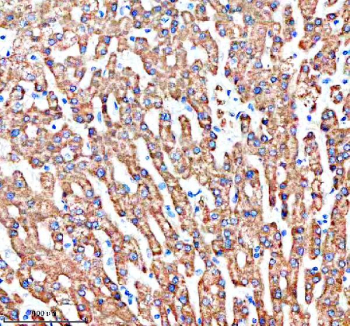
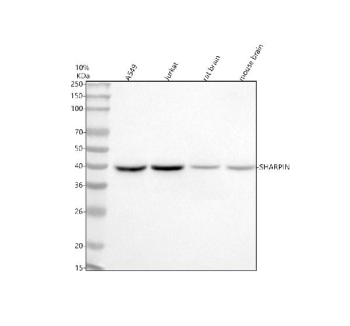
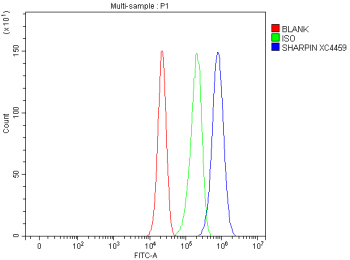
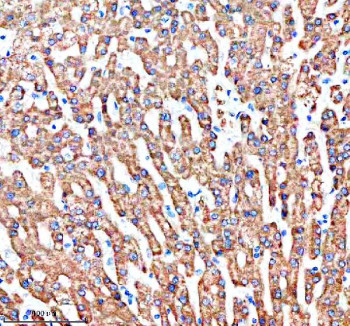
Adding 0.2 ml of distilled water will yield a concentration of 500 ug/ml. SHARPIN antibody detects SHANK-associated RH domain-interacting protein, a multifunctional adaptor protein involved in inflammation, apoptosis, and cytoskeletal signaling. The UniProt recommended name is SHANK-associated RH domain-interacting protein (SHARPIN). This cytoplasmic protein is a key component of the linear ubiquitin chain assembly complex (LUBAC), which modulates NF-kappaB activation and immune response signaling.Functionally, SHARPIN antibody recognizes a 387-amino-acid protein that acts as a scaffolding subunit linking the ubiquitin ligase HOIP (RNF31) and HOIL-1L (RBCK1) to form the active LUBAC complex. This complex catalyzes linear (M1-linked) polyubiquitination of signaling proteins, stabilizing TNF receptor-associated complexes and promoting NF-kappaB activation. Through this pathway, SHARPIN regulates innate and adaptive immune responses, cell survival, and inflammatory gene transcription. It also negatively regulates apoptotic signaling by inhibiting caspase activation downstream of TNF receptors.The SHARPIN gene is located on chromosome 8q24.3 and encodes a widely expressed cytoplasmic protein enriched in immune cells, skin, and neural tissues. Beyond immune regulation, SHARPIN interacts with integrins and actin-associated proteins to control cell adhesion and motility. It binds to the SHANK family of postsynaptic scaffolds, linking cytoskeletal dynamics to synaptic stability and plasticity. SHARPIN thus functions as both an immune modulator and structural adaptor in distinct cellular contexts.Deficiency or mutation of SHARPIN disrupts LUBAC assembly, leading to impaired NF-kappaB signaling and increased apoptosis. Mouse models lacking SHARPIN exhibit severe chronic inflammation and skin lesions, known as the chronic proliferative dermatitis (cpdm) phenotype. In humans, SHARPIN dysregulation has been implicated in inflammatory diseases, cancer, and neurodegeneration. Elevated SHARPIN expression correlates with tumor progression in prostate and breast cancers, where it enhances PI3K/AKT signaling and resistance to apoptosis.SHARPIN antibody is widely used for research into inflammatory signaling, ubiquitination, and immune regulation. Applications include immunoblotting, immunohistochemistry, and co-immunoprecipitation to analyze LUBAC complex formation and function. Its detection provides insight into TNF receptor signaling, cell death control, and integrin-mediated adhesion. In neurobiology, SHARPIN interacts with SHANK scaffolds and PSD-95 at excitatory synapses, influencing postsynaptic organization and neuronal communication.Structurally, SHARPIN contains an N-terminal PH domain-like motif, a central ubiquitin-like (UBL) domain, and a C-terminal Npl4 zinc finger (NZF) domain responsible for binding linear ubiquitin chains. Post-translational regulation includes phosphorylation and ubiquitination, controlling its participation in signaling networks. NSJ Bioreagents provides SHARPIN antibody reagents validated for use in inflammation, ubiquitin signaling, and neurobiology research.
| Keywords: | Anti-Sharpin, Anti-SHARPIN, Anti-Shank-interacting protein-like 1, Anti-Shank-associated RH domain-interacting protein, SHARPIN Antibody / SHANK-associated RH domain-interacting protein |
| Supplier: | NSJ Bioreagents |
| Supplier-Nr: | FY12962 |
Properties
| Application: | WB, IHC, FC, ELISA |
| Antibody Type: | Polyclonal |
| Conjugate: | No |
| Host: | Rabbit |
| Species reactivity: | human, mouse, rat |
| Immunogen: | E.coli-derived human SHARPIN recombinant protein (Position: H25-R325) |
| Format: | Purified |
Database Information
| KEGG ID : | K20894 | Matching products |
| UniProt ID : | Q9H0F6 | Matching products |
| Gene ID : | GeneID 81858 | Matching products |
Handling & Safety
| Storage: | +4°C |
| Shipping: | +4°C (International: +4°C) |
Caution
Our products are for laboratory research use only: Not for administration to humans!
Our products are for laboratory research use only: Not for administration to humans!
Information about the product reference will follow.
more
You will get a certificate here
Viewed