
Cookie preferences
This website uses cookies, which are necessary for the technical operation of the website and are always set. Other cookies, which increase the comfort when using this website, are used for direct advertising or to facilitate interaction with other websites and social networks, are only set with your consent.
Configuration
Technically required
These cookies are necessary for the basic functions of the shop.
"Allow all cookies" cookie
"Decline all cookies" cookie
CSRF token
Cookie preferences
Currency change
Customer-specific caching
FACT-Finder tracking
Individual prices
Selected shop
Session
Comfort functions
These cookies are used to make the shopping experience even more appealing, for example for the recognition of the visitor.
Note
Show the facebook fanpage in the right blod sidebar
Statistics & Tracking
Affiliate program
Conversion and usertracking via Google Tag Manager
Track device being used



| Item number | Size | Datasheet | Manual | SDS | Delivery time | Quantity | Price |
|---|---|---|---|---|---|---|---|
| NSJ-FY13006 | 100 µg | - | - |
7 - 12 business days* |
790.00€
|
If you have any questions, please use our Contact Form.
You can also order by e-mail: info@biomol.com
Larger quantity required? Request bulk
You can also order by e-mail: info@biomol.com
Larger quantity required? Request bulk
Adding 0.2 ml of distilled water will yield a concentration of 500 ug/ml. SFMBT2 antibody detects... more
Product information "Anti-SFMBT2 / Scm-like with four MBT domains protein 2"
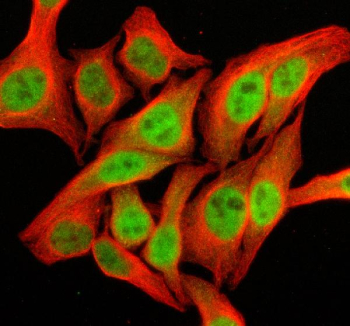
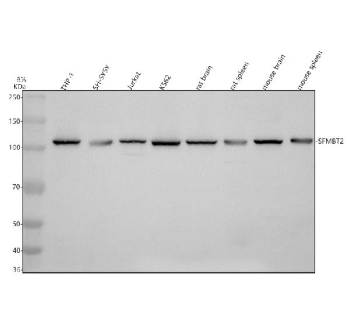
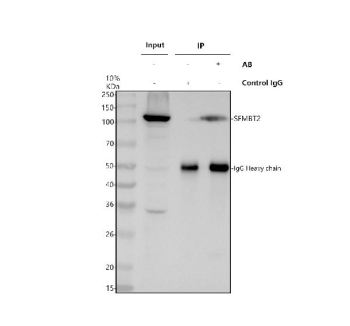
Adding 0.2 ml of distilled water will yield a concentration of 500 ug/ml. SFMBT2 antibody detects Scm-like with four MBT domains protein 2, a chromatin-associated transcriptional repressor involved in epigenetic gene silencing. The UniProt recommended name is Scm-like with four MBT domains protein 2 (SFMBT2). This protein belongs to the polycomb group (PcG)-related MBT family, which regulates gene expression through chromatin compaction and histone modification recognition.Functionally, SFMBT2 antibody identifies a 1220-amino-acid nuclear protein that binds to methylated histones, particularly histone H3 dimethylated on lysine 9 (H3K9me2) and lysine 27 (H3K27me2). SFMBT2 functions as a transcriptional corepressor by stabilizing repressive chromatin domains, thereby restricting transcriptional activation of developmental and cell cycle genes. It is a structural homolog of Drosophila Scm (Sex comb on midleg), which participates in Polycomb repressive complex formation.The SFMBT2 gene is located on chromosome 8q13.3 and encodes a protein widely expressed in embryonic and adult tissues, with enrichment in stem cells and reproductive organs. SFMBT2 plays a key role in early embryogenesis and trophoblast differentiation by maintaining chromatin architecture and silencing specific developmental genes. In trophoblast stem cells, SFMBT2 contributes to maintenance of stemness and regulation of imprinted gene expression.Epigenetically, SFMBT2 interacts with histone deacetylases (HDACs) and other repressive complexes to enforce gene silencing. It binds methylated histones through its MBT (malignant brain tumor) domains, which function as methyl-lysine recognition modules. Loss or depletion of SFMBT2 leads to de-repression of silenced loci, chromatin decondensation, and transcriptional misregulation. In cancer, altered SFMBT2 expression has been observed in hepatocellular carcinoma and prostate cancer, implicating it in tumor growth and chromatin remodeling.SFMBT2 antibody is widely used in epigenetics, chromatin biology, and transcriptional regulation studies. It is suitable for immunoblotting, chromatin immunoprecipitation (ChIP), and immunofluorescence to investigate SFMBT2 localization and histone interactions. This antibody aids in exploring PcG-mediated gene repression and chromatin dynamics in development and disease. It also helps characterize the role of SFMBT2 in maintaining heterochromatin and transcriptional stability.Structurally, SFMBT2 contains four MBT domains arranged in tandem that form a histone-binding scaffold, along with N-terminal coiled-coil motifs that mediate protein-protein interactions. Post-translational regulation includes phosphorylation and ubiquitination, which may influence chromatin association. NSJ Bioreagents provides SFMBT2 antibody reagents validated for use in chromatin modification, epigenetic regulation, and developmental biology research.
| Keywords: | Anti-SFMBT2, Anti-Scm-like with four MBT domains protein 2, SFMBT2 Antibody / Scm-like with four MBT domains protein 2 |
| Supplier: | NSJ Bioreagents |
| Supplier-Nr: | FY13006 |
Properties
| Application: | WB, ICC/IF, IP, ELISA |
| Antibody Type: | Polyclonal |
| Conjugate: | No |
| Host: | Rabbit |
| Species reactivity: | human, mouse, rat |
| Immunogen: | E.coli-derived human SFMBT2 recombinant protein (Position: Q136-D851) |
| Format: | Purified |
Database Information
| KEGG ID : | K26269 | Matching products |
| UniProt ID : | Q5VUG0 | Matching products |
| Gene ID : | GeneID 57713 | Matching products |
Handling & Safety
| Storage: | +4°C |
| Shipping: | +4°C (International: +4°C) |
Caution
Our products are for laboratory research use only: Not for administration to humans!
Our products are for laboratory research use only: Not for administration to humans!
Information about the product reference will follow.
more
You will get a certificate here
Viewed