
Cookie preferences
This website uses cookies, which are necessary for the technical operation of the website and are always set. Other cookies, which increase the comfort when using this website, are used for direct advertising or to facilitate interaction with other websites and social networks, are only set with your consent.
Configuration
Technically required
These cookies are necessary for the basic functions of the shop.
"Allow all cookies" cookie
"Decline all cookies" cookie
CSRF token
Cookie preferences
Currency change
Customer-specific caching
FACT-Finder tracking
Individual prices
Selected shop
Session
Comfort functions
These cookies are used to make the shopping experience even more appealing, for example for the recognition of the visitor.
Note
Show the facebook fanpage in the right blod sidebar
Statistics & Tracking
Affiliate program
Conversion and usertracking via Google Tag Manager
Track device being used

NEW
| Item number | Size | Datasheet | Manual | SDS | Delivery time | Quantity | Price |
|---|---|---|---|---|---|---|---|
| NSJ-FY13422 | 100 µl | - | - |
3 - 10 business days* |
790.00€
|
If you have any questions, please use our Contact Form.
You can also order by e-mail: info@biomol.com
Larger quantity required? Request bulk
You can also order by e-mail: info@biomol.com
Larger quantity required? Request bulk
Rabbit IgG in phosphate buffered saline, pH 7.4, 150mM NaCl, 0.02% sodium azide and 50% glycerol,... more
Product information "Anti-SENP2 / Small ubiquitin-related modifier 1, clone 24S77"
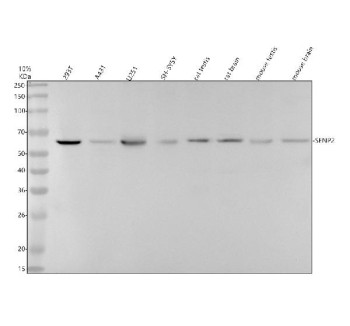
Rabbit IgG in phosphate buffered saline, pH 7.4, 150mM NaCl, 0.02% sodium azide and 50% glycerol, 0.4-0.5mg/ml BSA. SENP2 antibody recognizes SUMO-specific protease 2 (SENP2), a cysteine protease that plays a central role in regulating protein sumoylation dynamics within the cell. SENP2 belongs to the sentrin-specific protease family and is responsible for both the maturation of SUMO precursors and the removal of SUMO modifications from target proteins. Through these activities, SENP2 controls the balance between sumoylated and de-sumoylated protein states, influencing numerous cellular processes including transcription, cell cycle progression, and stress responses.SENP2 is primarily localized to the nucleus, where it associates with nuclear pore complexes and chromatin-associated protein assemblies. Its positioning allows SENP2 to regulate sumoylation of transcription factors, chromatin modifiers, and nuclear structural proteins. By reversing SUMO conjugation, SENP2 modulates protein stability, subcellular localization, and protein-protein interactions. A SENP2 antibody supports research into how dynamic SUMO cycling fine-tunes nuclear signaling and gene regulation.Functionally, SENP2 acts as a regulatory checkpoint within the SUMO pathway. It processes immature SUMO proteins to expose the C-terminal diglycine motif required for conjugation, while also cleaving SUMO from modified substrates. This dual activity enables SENP2 to influence both the availability of SUMO and the duration of SUMO-dependent signaling events. SENP2-mediated desumoylation is particularly important during cellular stress, mitosis, and differentiation, where rapid changes in protein modification status are required for adaptive responses.SENP2 expression has been observed across multiple tissues, reflecting its involvement in fundamental cellular functions. Alterations in SENP2 expression or activity have been linked to dysregulated transcriptional control and aberrant cell cycle regulation. In disease-related research, SENP2 has been studied in the context of cancer and cardiovascular biology, where changes in SUMO signaling can affect cell proliferation, survival, and stress tolerance. Monitoring SENP2 expression provides insight into how SUMO-dependent pathways contribute to normal physiology and disease-associated signaling changes.At the molecular level, the SENP2 gene encodes a protein of approximately 65 kDa that contains a conserved catalytic domain required for SUMO protease activity. Proper SENP2 function depends on its precise subcellular localization and interaction with SUMO-modified substrates. Disruption of SENP2-mediated desumoylation can lead to accumulation of SUMO-conjugated proteins and altered regulatory outcomes. A SENP2 antibody enables detection and analysis of SENP2 expression in research applications focused on post-translational modification, nuclear signaling, and SUMO pathway regulation, with NSJ Bioreagents providing reagents intended for research use.
| Keywords: | Anti-SENP2, Anti-Axam2, Anti-Sentrin-specific protease 2, Anti-SMT3-specific isopeptidase 2, Anti-Sentrin/SUMO-specific protease SENP2, SENP2 Antibody / Small ubiquitin-related modifier 1 |
| Supplier: | NSJ Bioreagents |
| Supplier-Nr: | FY13422 |
Properties
| Application: | WB |
| Antibody Type: | Monoclonal |
| Clone: | 24S77 |
| Conjugate: | No |
| Host: | Rabbit |
| Species reactivity: | human, mouse, rat |
| Immunogen: | Synthesized peptide derived from human Small ubiquitin-related modifier 1 protein |
| Format: | Affinity Purified |
Database Information
| KEGG ID : | K03345 | Matching products |
| UniProt ID : | Q9HC62 | Matching products |
| Gene ID : | GeneID 59343 | Matching products |
Handling & Safety
| Storage: | -20°C |
| Shipping: | -20°C (International: -20°C) |
Caution
Our products are for laboratory research use only: Not for administration to humans!
Our products are for laboratory research use only: Not for administration to humans!
Information about the product reference will follow.
more
You will get a certificate here
Viewed