
Cookie preferences
This website uses cookies, which are necessary for the technical operation of the website and are always set. Other cookies, which increase the comfort when using this website, are used for direct advertising or to facilitate interaction with other websites and social networks, are only set with your consent.
Configuration
Technically required
These cookies are necessary for the basic functions of the shop.
"Allow all cookies" cookie
"Decline all cookies" cookie
CSRF token
Cookie preferences
Currency change
Customer-specific caching
FACT-Finder tracking
Individual prices
Selected shop
Session
Comfort functions
These cookies are used to make the shopping experience even more appealing, for example for the recognition of the visitor.
Note
Show the facebook fanpage in the right blod sidebar
Statistics & Tracking
Affiliate program
Conversion and usertracking via Google Tag Manager
Track device being used



| Item number | Size | Datasheet | Manual | SDS | Delivery time | Quantity | Price |
|---|---|---|---|---|---|---|---|
| NSJ-FY13351 | 100 µg | - | - |
3 - 10 business days* |
790.00€
|
If you have any questions, please use our Contact Form.
You can also order by e-mail: info@biomol.com
Larger quantity required? Request bulk
You can also order by e-mail: info@biomol.com
Larger quantity required? Request bulk
Adding 0.2 ml of distilled water will yield a concentration of 500 ug/ml. Renin receptor antibody... more
Product information "Anti-Renin receptor / ATP6AP2"
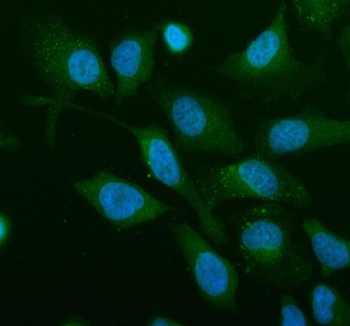
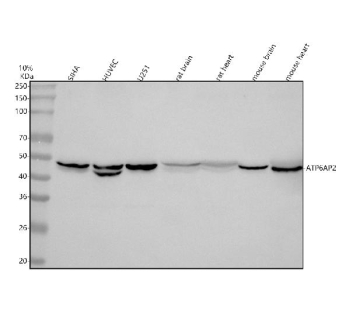
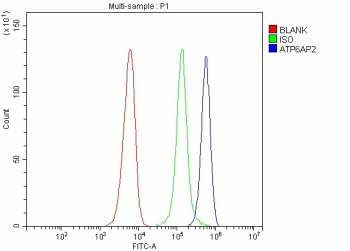
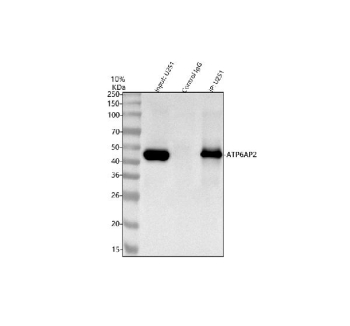
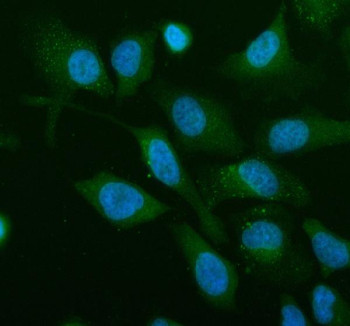
Adding 0.2 ml of distilled water will yield a concentration of 500 ug/ml. Renin receptor antibody detects the (Pro)renin receptor, also known as ATP6AP2, a multifunctional membrane protein encoded by the ATP6AP2 gene on chromosome Xp11.4. ATP6AP2 serves dual roles as a receptor for renin and prorenin and as an accessory subunit of the vacuolar H+-ATPase (V-ATPase) complex. It is a type I transmembrane protein expressed in kidney, heart, brain, and vascular tissues, where it regulates blood pressure, renal physiology, and cellular acidification. ATP6AP2 plays crucial roles in the renin-angiotensin system (RAS) and lysosomal proton pump function.Functionally, ATP6AP2 binds both renin and its precursor prorenin, enhancing angiotensin I generation and activating intracellular signaling pathways independent of angiotensin II. This binding promotes cell proliferation, fibrosis, and inflammation through ERK1/2 and MAPK activation. In the kidney, ATP6AP2 is localized to juxtaglomerular and distal tubular cells, where it regulates renin signaling and fluid balance. As a V-ATPase accessory subunit, it stabilizes proton pump assembly, contributing to lysosomal acidification and endosomal trafficking.Structurally, ATP6AP2 contains an extracellular renin-binding domain, a single transmembrane segment, and a short cytoplasmic tail that mediates interactions with the V-ATPase complex. It is classified within the V-ATPase assembly factor family, sharing homology with ATP6AP1. Co-localization studies show ATP6AP2 at the plasma membrane, endosomes, and lysosomes, reflecting its multifunctional localization and dual biological roles. Known interaction partners include renin, prorenin, and the V-ATPase V0 domain subunits.ATP6AP2 is widely expressed in cardiovascular and neural tissues, with developmental expression detected in embryonic heart and brain, suggesting roles in organogenesis. In the central nervous system, ATP6AP2 modulates neuronal development, synaptic transmission, and autophagy regulation. Dysregulation of ATP6AP2 expression or mutation causes X-linked intellectual disability and Parkinsonism with spasticity (ATP6AP2-related disorder). In vascular smooth muscle and cardiac fibroblasts, ATP6AP2 signaling contributes to hypertension, cardiac hypertrophy, and fibrosis through MAPK and TGF-beta activation.Clinically, elevated ATP6AP2 expression is associated with cardiovascular diseases, diabetic nephropathy, and tumor progression. It influences Wnt and Notch signaling pathways that regulate proliferation and differentiation. Pathway associations include renin-angiotensin signaling, proton transport via V-ATPase, and lysosomal degradation. Tissue-specific studies show high ATP6AP2 activity in renal epithelia and cardiomyocytes, coordinating hormonal and metabolic regulation.Immunohistochemical staining using Renin receptor antibody reveals membrane and cytoplasmic localization in kidney and cardiac tissues. The Renin receptor antibody from NSJ Bioreagents is an excellent reagent for research into RAS signaling, proton pump function, and cardiovascular disease mechanisms.
| Keywords: | Anti-N14F, Anti-ATP6AP2, Anti-Renin receptor, Anti-Renin/prorenin receptor, Anti-Embryonic liver differentiation factor 10, Anti-ER-localized type I transmembrane adapter, Anti-ATPase H(+)-transporting lysosomal accessory protein 2, Anti-ATPase H(+)-trans |
| Supplier: | NSJ Bioreagents |
| Supplier-Nr: | FY13351 |
Properties
| Application: | WB, ICC/IF, IP, FC |
| Antibody Type: | Polyclonal |
| Conjugate: | No |
| Host: | Rabbit |
| Species reactivity: | human, mouse, rat |
| Immunogen: | A synthetic peptide corresponding to a sequence at the C-terminus of human Renin receptor/ATP6AP2 |
| Format: | Purified |
Database Information
| KEGG ID : | K19514 | Matching products |
| UniProt ID : | O75787 | Matching products |
| Gene ID : | GeneID 10159 | Matching products |
Handling & Safety
| Storage: | +4°C |
| Shipping: | +4°C (International: +4°C) |
Caution
Our products are for laboratory research use only: Not for administration to humans!
Our products are for laboratory research use only: Not for administration to humans!
Information about the product reference will follow.
more
You will get a certificate here
Viewed