
Anti-Recombinant UBE3A, clone A758

| Item number | Size | Datasheet | Manual | SDS | Delivery time | Quantity | Price |
|---|---|---|---|---|---|---|---|
| E-AN302038L.50 | 50 µl | - |
7 - 16 business days* |
304.00€
|
|||
| E-AN302038L.100 | 100 µl | - |
7 - 16 business days* |
464.00€
|
If you have any questions, please use our Contact Form.
You can also order by e-mail: info@biomol.com
Larger quantity required? Request bulk
You can also order by e-mail: info@biomol.com
Larger quantity required? Request bulk
UBE3A, also commonly referred to as E6AP (E6 Associated Protein), is an E3 ubiquitin protein... more
Product information "Anti-Recombinant UBE3A, clone A758"
UBE3A, also commonly referred to as E6AP (E6 Associated Protein), is an E3 ubiquitin protein ligase and founding member of the HECT (Homologous to the E6 Carboxyl Terminus) family of E3 ligases. UBE3A has been shown to be hijacked by the oncogenic E6 protein of high-risk human papillomaviruses (HPV16 and HPV18) that causes the ubiquitination activity of UBE3A to be inappropriately directed toward several specific cellular proteins, the most notable of which, with respect to carcinogenesis, is p53. Although the DNA-repair enzyme, HHR23A (human homolog A of Rad23), was the first described E6-independent substrate of UBE3A, very few E6-independent targets of UBE3A have been identified. This continues to be an active area of research, particularly because mutations or disruption in expression of UBE3A in the brain are the cause of Angelman syndrome (AS), a severe form of mental retardation. Although UBE3A is expressed in most human tissues from both parental alleles, it is expressed from the maternal allele in subregions of the brain, with the paternal allele being epigenetically silenced. AS is caused by disruptions in expression of the materal UBE3A allele, generally by large chromosomal deletion, but also by point mutations within the UBE3A coding sequence. This strongly suggests that lack of ubiquitination of one or more UBE3A substrates in neuronal tissue is responsible for the AS phenotype. Indeed, a recent study identified several new neuronal substrates of UBE3A including Arc and Ephexin-5. The immediate early gene Arc (activity-regulated cytoskeleton-associated protein) is rapidly upregulated after robust neuronal stimulation and promotes internalization of AMPA-type glutamate receptors (AMPARs), resulting in reduction in synaptic strength. UBE3A ubiquitinates Arc and promotes its degradation by the 26S proteasome, thus preventing AMPAR internalization. Disruption in neuronal UBE3A function leads to an increase in Arc expression and a decrease in AMPARs at excitatory synapses, which may contribute to the neurological symptoms of AS.
| Keywords: | Anti-UBE3A, Anti-Ubiquitin-protein ligase E3A, Anti-E6AP ubiquitin-protein ligase, Anti-Renal carcinoma antigen NY-REN-54, Anti-HECT-type ubiquitin transferase E3A, Anti-Human papillomavirus E6-associated protein, Anti-Oncogenic protein-associated protein |
| Supplier: | Elabscience |
| Supplier-Nr: | E-AN302038L |
Properties
| Application: | WB |
| Antibody Type: | Monoclonal |
| Clone: | A758 |
| Conjugate: | No |
| Host: | Rabbit |
| Species reactivity: | human |
| Immunogen: | Peptide. This information is proprietary to PTMab. |
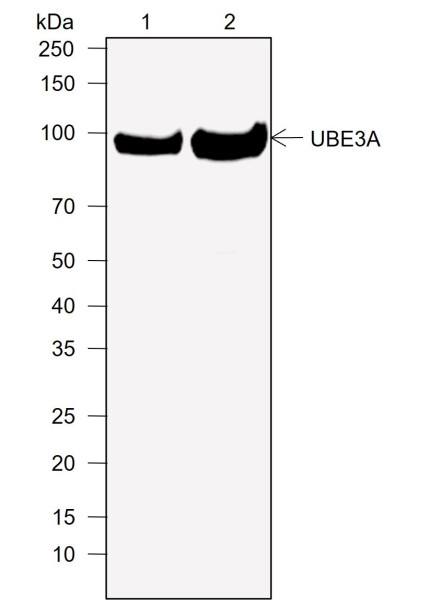
| MW: | 95 kD |
Database Information
| KEGG ID : | K10587 | Matching products |
| UniProt ID : | Q05086 | Matching products |
| Gene ID : | GeneID 7337 | Matching products |
Handling & Safety
| Storage: | -20°C |
| Shipping: | -20°C (International: -20°C) |
| Signal Word: | Warning |
| GHS Hazard Pictograms: |

|
| H Phrases: | H317 |
| P Phrases: | P261, P272, P280, P302+352, P333+313 |
Caution
Our products are for laboratory research use only: Not for administration to humans!
Our products are for laboratory research use only: Not for administration to humans!
Information about the product reference will follow.
more
You will get a certificate here
Viewed