
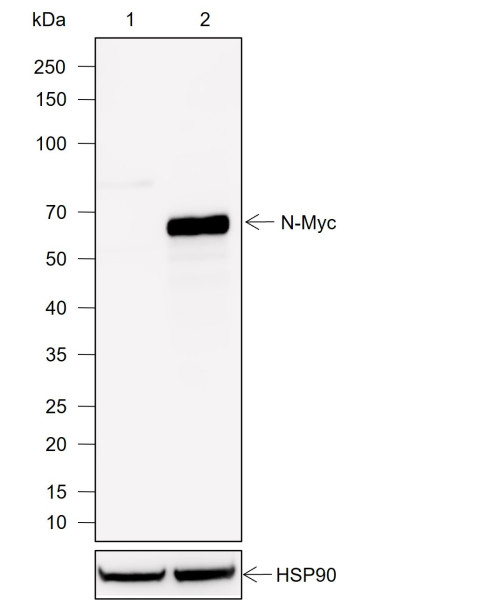
Anti-Recombinant N-Myc, clone A754

| Item number | Size | Datasheet | Manual | SDS | Delivery time | Quantity | Price |
|---|---|---|---|---|---|---|---|
| E-AN302034L.50 | 50 µl | - |
7 - 16 business days* |
304.00€
|
|||
| E-AN302034L.100 | 100 µl | - |
7 - 16 business days* |
464.00€
|
If you have any questions, please use our Contact Form.
You can also order by e-mail: info@biomol.com
Larger quantity required? Request bulk
You can also order by e-mail: info@biomol.com
Larger quantity required? Request bulk
Members of the Myc/Max/Mad network function as transcriptional regulators with roles in various... more
Product information "Anti-Recombinant N-Myc, clone A754"
Members of the Myc/Max/Mad network function as transcriptional regulators with roles in various aspects of cell behavior, including proliferation, differentiation, and apoptosis. These proteins share a common basic-helix-loop-helix leucine zipper (bHLH-ZIP) motif required for dimerization and DNA-binding. Max was originally discovered based on its ability to associate with c-Myc and found to be required for the ability of Myc to bind DNA and activate transcription. Subsequently, Max has been viewed as a central component of the transcriptional network, forming homodimers as well as heterodimers with other members of the Myc and Mad families. The association between Max and either Myc or Mad can have opposing effects on transcriptional regulation and cell behavior. The Mad family consists of four related proteins, Mad1, Mad2 (Mxi1), Mad3, and Mad4, and the more distantly related members of the bHLH-ZIP family, Mnt and Mga. Like Myc, the Mad proteins are tightly regulated with short half-lives. In general, Mad family members interfere with Myc-mediated processes, such as proliferation, transformation, and prevention of apoptosis by inhibiting transcription.In humans the Myc family consists of 5 genes: c-Myc, N Myc, L-Myc, R-Myc, and B-Myc. While c-Myc is expressed in many proliferating cells, N-Myc expression is very restricted, with highest levels in during embryonic development and then in the adult during B-cell development. These expression patterns and results from targeted deletion of N-Myc suggest that N-Myc plays an important role in tissue development and differentiation. In addition, amplification or overexpression of N-Myc has been found in human neuroblastomas and is associated with rapid progression and poor prognosis.
| Keywords: | Anti-MYCN, Anti-N-myc proto-oncogene protein, Anti-Class E basic helix-loop-helix protein 37, Recombinant N-Myc Monoclonal Antibody |
| Supplier: | Elabscience |
| Supplier-Nr: | E-AN302034L |
Properties
| Application: | WB |
| Antibody Type: | Monoclonal |
| Clone: | A754 |
| Conjugate: | No |
| Host: | Rabbit |
| Species reactivity: | human |
| Immunogen: | Peptide. This information is proprietary to PTMab. |
| MW: | 62 kD |
Database Information
| KEGG ID : | K09109 | Matching products |
| UniProt ID : | P04198 | Matching products |
| Gene ID : | GeneID 4613 | Matching products |
Handling & Safety
| Storage: | -20°C |
| Shipping: | -20°C (International: -20°C) |
| Signal Word: | Warning |
| GHS Hazard Pictograms: |

|
| H Phrases: | H317 |
| P Phrases: | P261, P272, P280, P302+352, P333+313 |
Caution
Our products are for laboratory research use only: Not for administration to humans!
Our products are for laboratory research use only: Not for administration to humans!
Information about the product reference will follow.
more
You will get a certificate here
Viewed