
Cookie preferences
This website uses cookies, which are necessary for the technical operation of the website and are always set. Other cookies, which increase the comfort when using this website, are used for direct advertising or to facilitate interaction with other websites and social networks, are only set with your consent.
Configuration
Technically required
These cookies are necessary for the basic functions of the shop.
"Allow all cookies" cookie
"Decline all cookies" cookie
CSRF token
Cookie preferences
Currency change
Customer-specific caching
FACT-Finder tracking
Individual prices
Selected shop
Session
Comfort functions
These cookies are used to make the shopping experience even more appealing, for example for the recognition of the visitor.
Note
Show the facebook fanpage in the right blod sidebar
Statistics & Tracking
Affiliate program
Conversion and usertracking via Google Tag Manager
Track device being used


| Item number | Size | Datasheet | Manual | SDS | Delivery time | Quantity | Price |
|---|---|---|---|---|---|---|---|
| Cay42780-100 | 100 µl | - |
6 - 10 business days* |
554.00€
|
If you have any questions, please use our Contact Form.
You can also order by e-mail: info@biomol.com
Larger quantity required? Request bulk
You can also order by e-mail: info@biomol.com
Larger quantity required? Request bulk
Poliovirus receptor (PVR), also known as CD155, is a member of the nectin-like family of adhesion... more
Product information "Anti-PVR/CD155 Rabbit (Clone RM514)"
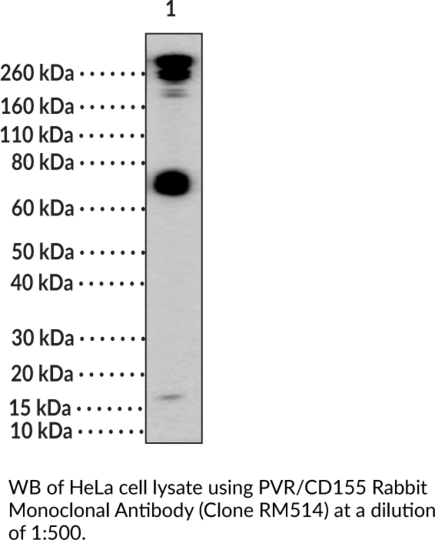
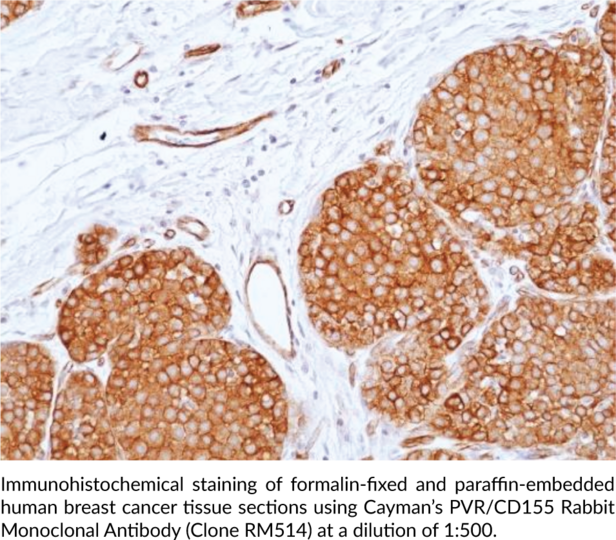
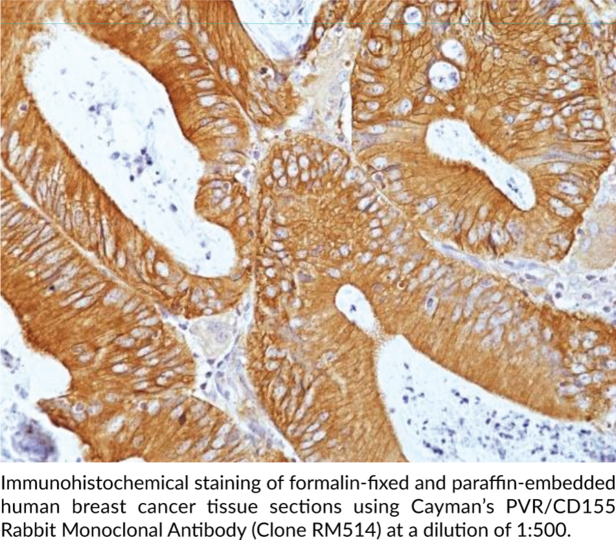
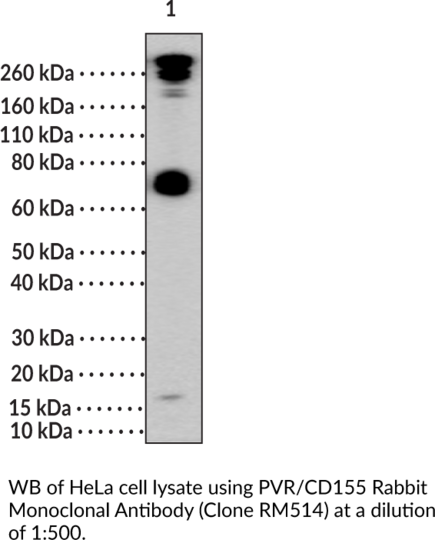
Poliovirus receptor (PVR), also known as CD155, is a member of the nectin-like family of adhesion molecules encoded by the Pvr gene in mice that regulates cell migration and proliferation and immune cell activation. It contains an N-terminal extracellular domain with three immunoglobulin-like (Ig-like) loops, C1-like and C2 domains that mediate dimerization, a transmembrane segment that acts as a ligand for receptors expressed by immune cells, and a C-terminal cytoplasmic tail that interacts with intracellular scaffold proteins. PVR is highly expressed by enterocytes and gastrointestinal lymphatic tissues. It localizes to the cell surface where it forms cis-homodimers that associate by trans-interactions with nectin-3 cis-homodimers expressed on adjacent cells, resulting in cell-cell adhesion. PVR internalization by endocytosis disrupts PDGFR and integrin alphaVbeta3 signaling, inducing contact inhibition of cell movement and proliferation. PVR binds the co-stimulatory receptor CD226/DNAM-1, which is widely expressed by most immune cells, including T cells, B cells, natural killer (NK) cells, and monocytes, and the inhibitory receptors TIGIT and CD96, which are expressed by NK cells and T cells, inducing activation or inhibition of immune cells in a receptor-specific manner. It is also the receptor for poliovirus attachment and entry into cells. In cancer cells, PVR expression is upregulated by FGF stimulation or expression of the oncogene Ras and downregulated by the unfolded protein response. Pvr knockdown reduces tumor growth and the number of lung metastases in B16/F10 or LWT1 mouse xenograft models. Cayman's PVR/CD155 Rabbit Monoclonal Antibody (Clone RM514) can be used for immunohistochemistry (IHC) and Western blot (WB) applications.. Cross reactivity: (+) PVR: . (+) Human: .. Protein function: Mediates NK cell adhesion and triggers NK cell effector functions. Binds two different NK cell receptors: CD96 and CD226. These interactions accumulates at the cell-cell contact site, leading to the formation of a mature immunological synapse between NK cell and target cell. This may trigger adhesion and secretion of lytic granules and IFN-gamma and activate cytotoxicity of activated NK cells. May also promote NK cell-target cell modular exchange, and PVR transfer to the NK cell. This transfer is more important in some tumor cells expressing a lot of PVR, and may trigger fratricide NK cell activation, providing tumors with a mechanism of immunoevasion. Plays a role in mediating tumor cell invasion and migration. [The UniProt Consortium]
| Keywords: | HVED, Necl-5, Nectin-like Protein 5, TAGE4 |
| Supplier: | Cayman Chemical |
| Supplier-Nr: | 42780 |
Properties
| Application: | IHC, WB |
| Antibody Type: | Monoclonal |
| Clone: | RM 514 |
| Conjugate: | No |
| Host: | Rabbit |
| Species reactivity: | human |
| Immunogen: | Peptide corresponding to residues near the C-terminus of human PVR |
| Format: | Purified |
Database Information
| KEGG ID : | K06539 | Matching products |
| UniProt ID : | P15151 | Matching products |
| Gene ID : | GeneID 5817 | Matching products |
Handling & Safety
| Storage: | -20°C |
| Shipping: | -20°C (International: -20°C) |
Caution
Our products are for laboratory research use only: Not for administration to humans!
Our products are for laboratory research use only: Not for administration to humans!
Information about the product reference will follow.
more
You will get a certificate here
Viewed