
Cookie preferences
This website uses cookies, which are necessary for the technical operation of the website and are always set. Other cookies, which increase the comfort when using this website, are used for direct advertising or to facilitate interaction with other websites and social networks, are only set with your consent.
Configuration
Technically required
These cookies are necessary for the basic functions of the shop.
"Allow all cookies" cookie
"Decline all cookies" cookie
CSRF token
Cookie preferences
Currency change
Customer-specific caching
FACT-Finder tracking
Individual prices
Selected shop
Session
Comfort functions
These cookies are used to make the shopping experience even more appealing, for example for the recognition of the visitor.
Note
Show the facebook fanpage in the right blod sidebar
Statistics & Tracking
Affiliate program
Conversion and usertracking via Google Tag Manager
Track device being used


| Item number | Size | Datasheet | Manual | SDS | Delivery time | Quantity | Price |
|---|---|---|---|---|---|---|---|
| NSJ-FY12973 | 100 µg | - | - |
7 - 12 business days* |
790.00€
|
If you have any questions, please use our Contact Form.
You can also order by e-mail: info@biomol.com
Larger quantity required? Request bulk
You can also order by e-mail: info@biomol.com
Larger quantity required? Request bulk
Adding 0.2 ml of distilled water will yield a concentration of 500 ug/ml. PPIH antibody detects... more
Product information "Anti-PPIH / Peptidyl-prolyl cis-trans isomerase H"
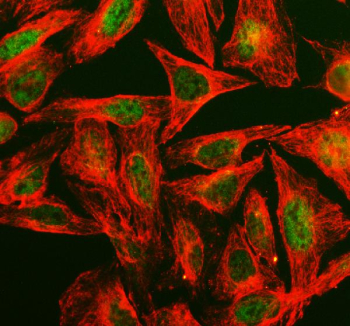
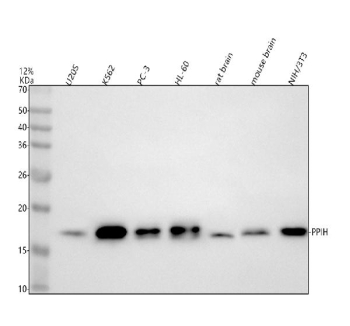
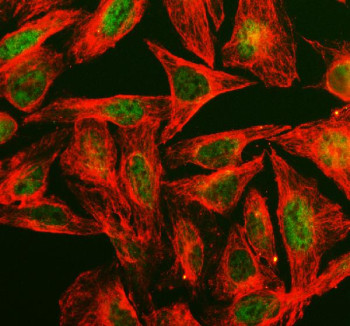
Adding 0.2 ml of distilled water will yield a concentration of 500 ug/ml. PPIH antibody detects Peptidyl-prolyl cis-trans isomerase H, a cyclophilin family enzyme that assists in protein folding and pre-mRNA splicing. The UniProt recommended name is Peptidyl-prolyl cis-trans isomerase H (PPIH), also known as Cyclophilin H. PPIH catalyzes the cis-trans isomerization of peptide bonds preceding proline residues, a rate-limiting step in protein folding and conformational regulation.Functionally, PPIH antibody identifies a 177-amino-acid protein localized primarily in the nucleus, where it associates with the spliceosome machinery. PPIH is a component of the U4/U6.U5 tri-snRNP complex, interacting with PRPF4, SNU13, and other splicing factors. Through its isomerase activity, PPIH facilitates conformational rearrangements necessary for spliceosome assembly and catalysis. Beyond its role in RNA splicing, PPIH also contributes to protein folding and trafficking, reflecting its general chaperone-like activity within the cyclophilin family.The PPIH gene is located on chromosome 1p34.2 and encodes a protein containing a single cyclophilin-type peptidyl-prolyl isomerase (PPIase) domain. PPIH is structurally similar to other cyclophilins such as PPIA and PPIL1 but exhibits specialized interactions within the spliceosome. Its enzymatic activity accelerates folding of substrates containing cis-proline bonds, influencing the conformation of RNA-binding proteins and enzymes involved in gene expression.Loss or inhibition of PPIH function affects pre-mRNA splicing efficiency and fidelity, leading to transcriptome-wide alterations. Dysregulation of PPIH expression has been observed in cancer and neurodegenerative diseases, suggesting roles in RNA metabolism and stress response. In cell signaling, PPIH interacts with transcription and export factors, linking splicing to mRNA maturation and nuclear export.PPIH antibody is used to study RNA processing, protein folding, and chaperone function. It is applicable for immunoblotting, immunoprecipitation, and fluorescence microscopy to examine PPIH localization and protein-protein interactions. In structural biology, PPIH serves as a model enzyme for studying cyclophilin catalytic mechanisms. Its sensitivity to cyclosporine A highlights its functional conservation across cyclophilins and its potential involvement in immunomodulatory pathways.Structurally, PPIH features a conserved beta-barrel fold typical of cyclophilins, with a hydrophobic active site pocket that accommodates the proline-containing peptide bond. It is post-translationally regulated by phosphorylation and complex assembly within spliceosomal subunits. NSJ Bioreagents provides PPIH antibody reagents validated for research in RNA biology, splicing regulation, and protein folding mechanisms.
| Keywords: | Anti-PPIH, Anti-Rotamase H, Anti-Peptidyl-prolyl cis-trans isomerase H, Anti-U-snRNP-associated cyclophilin SnuCyp-20, Anti-Small nuclear ribonucleoprotein particle-specific cyclophilin H, PPIH Antibody / Peptidyl-prolyl cis-trans isomerase H |
| Supplier: | NSJ Bioreagents |
| Supplier-Nr: | FY12973 |
Properties
| Application: | WB, ICC/IF, ELISA |
| Antibody Type: | Polyclonal |
| Conjugate: | No |
| Host: | Rabbit |
| Species reactivity: | human, mouse, rat |
| Immunogen: | E.coli-derived human PPIH recombinant protein (Position: M1-M177) |
| Format: | Purified |
Database Information
| KEGG ID : | K09567 | Matching products |
| UniProt ID : | O43447 | Matching products |
| Gene ID : | GeneID 10465 | Matching products |
Handling & Safety
| Storage: | +4°C |
| Shipping: | +4°C (International: +4°C) |
Caution
Our products are for laboratory research use only: Not for administration to humans!
Our products are for laboratory research use only: Not for administration to humans!
Information about the product reference will follow.
more
You will get a certificate here
Viewed