
Cookie preferences
This website uses cookies, which are necessary for the technical operation of the website and are always set. Other cookies, which increase the comfort when using this website, are used for direct advertising or to facilitate interaction with other websites and social networks, are only set with your consent.
Configuration
Technically required
These cookies are necessary for the basic functions of the shop.
"Allow all cookies" cookie
"Decline all cookies" cookie
CSRF token
Cookie preferences
Currency change
Customer-specific caching
FACT-Finder tracking
Individual prices
Selected shop
Session
Comfort functions
These cookies are used to make the shopping experience even more appealing, for example for the recognition of the visitor.
Note
Show the facebook fanpage in the right blod sidebar
Statistics & Tracking
Affiliate program
Conversion and usertracking via Google Tag Manager
Track device being used

| Item number | Size | Datasheet | Manual | SDS | Delivery time | Quantity | Price |
|---|---|---|---|---|---|---|---|
| NSJ-FY12855 | 100 µg | - | - |
7 - 12 business days* |
790.00€
|
If you have any questions, please use our Contact Form.
You can also order by e-mail: info@biomol.com
Larger quantity required? Request bulk
You can also order by e-mail: info@biomol.com
Larger quantity required? Request bulk
Adding 0.2 ml of distilled water will yield a concentration of 500 ug/ml. POLR1A antibody detects... more
Product information "Anti-POLR1A / DNA-directed RNA polymerase I subunit RPA1"
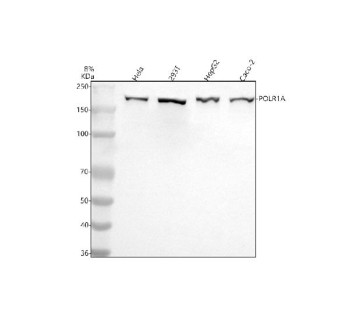
Adding 0.2 ml of distilled water will yield a concentration of 500 ug/ml. POLR1A antibody detects DNA-directed RNA polymerase I subunit RPA1, the largest catalytic subunit of RNA polymerase I, which is responsible for ribosomal RNA (rRNA) synthesis in the nucleolus. Encoded by the POLR1A gene on chromosome 2p11.2, this essential enzyme subunit forms part of the multi-protein RNA polymerase I complex that catalyzes transcription of 45S pre-rRNA, a key step in ribosome biogenesis. POLR1A serves as the catalytic core that binds DNA and nucleoside triphosphates, driving polymerization during transcription initiation and elongation.Structurally, POLR1A contains a DNA-binding cleft, catalytic residues within the active center, and multiple contact surfaces for interacting with transcription factors and other RNA polymerase I subunits. It forms the backbone of the enzyme and interacts with RPA2 and RPA3 to establish the core complex. POLR1A also associates with transcription initiation factors such as SL1 and UBF, which guide polymerase recruitment to rDNA promoters and regulate transcriptional output in response to growth signals.The POLR1A antibody is widely used in transcription, cell growth, and cancer biology research to study ribosomal biogenesis and nucleolar function. Western blot analysis detects a 190 kilodalton band corresponding to POLR1A, while immunofluorescence reveals strong nucleolar staining consistent with its role in rRNA synthesis. This antibody supports studies of transcriptional regulation, nucleolar stress responses, and metabolic control of protein synthesis.POLR1A activity is tightly linked to cellular growth and proliferation. Under conditions of nutrient abundance, mTOR signaling promotes RNA polymerase I activation and rRNA transcription, conversely, DNA damage or stress inhibits POLR1A function to conserve resources. Mutations in POLR1A cause ribosomopathies such as acrofacial dysostosis, characterized by craniofacial malformations due to impaired ribosome production. Overactivation of RNA polymerase I, on the other hand, contributes to oncogenic transformation by driving excessive ribosome biogenesis and protein synthesis. The POLR1A antibody allows precise monitoring of polymerase expression and localization under these physiological and pathological conditions.NSJ Bioreagents provides a high-quality POLR1A antibody validated for its applications. Its sensitivity and specificity enable researchers to investigate transcriptional control mechanisms, nucleolar architecture, and the coupling of rRNA synthesis to cell cycle progression and oncogenesis.
| Keywords: | Anti-A190, Anti-POLR1A, Anti-RNA polymerase I 194 kDa subunit, Anti-DNA-directed RNA polymerase I subunit A, Anti-DNA-directed RNA polymerase I subunit RPA1, Anti-DNA-directed RNA polymerase I largest subunit, POLR1A Antibody / DNA-directed RNA polymerase |
| Supplier: | NSJ Bioreagents |
| Supplier-Nr: | FY12855 |
Properties
| Application: | WB, ELISA |
| Antibody Type: | Polyclonal |
| Conjugate: | No |
| Host: | Rabbit |
| Species reactivity: | human |
| Immunogen: | E.coli-derived human POLR1A recombinant protein (Position: E607-R1720) |
| Format: | Purified |
Database Information
| KEGG ID : | K02999 | Matching products |
| UniProt ID : | O95602 | Matching products |
| Gene ID : | GeneID 25885 | Matching products |
Handling & Safety
| Storage: | +4°C |
| Shipping: | +4°C (International: +4°C) |
Caution
Our products are for laboratory research use only: Not for administration to humans!
Our products are for laboratory research use only: Not for administration to humans!
Information about the product reference will follow.
more
You will get a certificate here
Viewed